

An Initial Public Offering (IPO) represents one of the most significant financing and ownership decisions a growing company can make. It occurs when a privately owned business offers shares to public investors for the first time and becomes listed on a recognised stock exchange.
For African businesses, an IPO can provide access to substantial long-term capital for expansion, technology investment, acquisitions, infrastructure development and entry into new markets. It can also create liquidity for founders and early investors while strengthening the company’s visibility among customers, lenders and institutional investors.
Consider a privately owned agricultural processing company headquartered in Accra with operations across Ghana, Côte d’Ivoire and Senegal. After years of expansion financed through retained earnings, bank facilities and private investors, management may require considerably more capital to establish processing plants across West Africa. Rather than relying entirely on additional borrowing, the company could consider raising equity through the public market.
However, becoming publicly listed is not simply a fundraising transaction. It changes how a business is governed, scrutinised and managed.
When Should a Business Consider Going Public?
There is no single revenue, profit or valuation threshold that automatically makes a company ready for an IPO. Readiness depends on the strength of the underlying business and its ability to operate successfully under public-market requirements.
A prospective issuer should have a credible business model, reliable financial information, appropriate internal controls, competent leadership and a clear strategy for deploying the capital raised.
Governance readiness is equally important.
A business that has historically depended heavily on its founder may need to strengthen its board, delegate authority, formalise policies and establish more rigorous reporting processes before approaching public investors.
For example, a rapidly expanding fintech business in Nairobi may have impressive customer growth but still lack mature financial controls and governance systems. Delaying an IPO while these structures are strengthened could ultimately produce a more credible public offering.
The question should therefore not simply be, “Can we list?” Management should ask, “Are we genuinely ready to operate as a public company?”
How the IPO Journey Typically Begins
An IPO normally begins long before shares appear on an exchange.
Management and existing shareholders must first determine why public capital is required and whether an IPO represents the most appropriate financing strategy. The company may then appoint investment advisers or underwriters to assess its valuation, capital requirements and proposed offering structure.
A multidisciplinary transaction team is usually required. Depending on the jurisdiction and transaction, this may include investment bankers, securities lawyers, auditors, accountants, tax advisers, regulatory specialists and investor-relations professionals.
Financial statements and other corporate records are subjected to extensive review. Material risks, ownership structures, liabilities, contracts and governance arrangements must also be properly documented.
This preparation is particularly important because investors are not merely purchasing shares. They are purchasing an economic interest in the company’s future performance.
Building a Business Ready for Public Scrutiny
One of the biggest adjustments for privately controlled companies is the increased level of transparency associated with public ownership.
Financial reporting must be reliable and timely. Internal controls must be capable of supporting accurate reporting. Related-party transactions, material risks and significant corporate developments may require disclosure in accordance with applicable rules.
Board governance also becomes increasingly important.
Directors are expected to provide meaningful oversight rather than simply endorse management decisions. Audit, risk and other governance responsibilities may need to be formalised depending on applicable listing and regulatory requirements.
Imagine a family-owned manufacturing company in Kumasi preparing for a public offering. Historically, major procurement decisions may have been approved informally by the founder. Before listing, such arrangements may need to be replaced with documented approval limits, procurement controls, board oversight and clearly defined management responsibilities.
IPO preparation can therefore expose weaknesses that businesses should address even before entering the capital market.
Determining the Value of the Business
Valuation is among the most sensitive components of an IPO.
Advisers may assess expected cash flows, profitability, revenue growth, assets, liabilities, industry conditions and valuations of comparable listed companies. Market sentiment and investor demand can also influence the eventual offering price.
Suppose a healthcare technology company operating from Kigali expects rapid expansion across East Africa. Strong projected cash flows could support an attractive valuation. However, investors may apply a discount if the company faces substantial regulatory uncertainty or has yet to demonstrate sustainable profitability.
An excessively ambitious valuation can weaken investor demand and contribute to poor performance after listing. An unnecessarily low valuation, meanwhile, could result in existing shareholders giving up more economic value than necessary.
Successful pricing therefore requires a balance between the company’s expectations and what investors are prepared to pay.
Marketing the Investment Proposition
Before shares are issued, potential investors need to understand the company, its strategy and the investment opportunity.
Management and transaction advisers may engage institutional investors to explain the company’s business model, financial performance, competitive position, leadership and growth strategy. Investor feedback can provide useful insight into demand and valuation expectations.
A strong investment proposition should explain more than historical performance.
Investors want to understand how additional capital will create value.
For example, a logistics company seeking capital to establish distribution centres in Tema, Abidjan and Lagos should demonstrate how those investments could improve capacity, reduce delivery costs, increase revenue and strengthen market share.
Management credibility becomes particularly important during this stage. Investors are effectively evaluating both the business and the people responsible for executing its strategy.

Strategic Benefits of an IPO
Capital access is usually the most visible advantage of going public.
Funds raised can support new facilities, acquisitions, digital transformation, product development, geographic expansion or debt restructuring. Unlike conventional borrowing, equity capital generally does not create scheduled principal and interest repayment obligations.
A public listing can also broaden a company’s financing options. Subject to market conditions and regulatory requirements, an established listed company may later return to the capital market to raise additional funds.
Publicly traded shares can also facilitate acquisitions. Rather than financing an entire transaction with cash, a company may potentially use shares as part of the consideration.
Employee incentives represent another potential advantage. Share-based compensation arrangements can align selected employees with long-term shareholder value while helping organisations compete for specialised talent.
Finally, public listing may strengthen corporate visibility and institutional credibility, although listing status alone should never be mistaken for evidence of financial strength.
Costs and Responsibilities of Public Ownership
Companies should carefully evaluate the costs associated with an IPO before proceeding.
Transaction expenses may include advisory, legal, accounting, audit, regulatory and marketing costs. The financial commitment continues after listing because public companies face ongoing reporting, governance, compliance and investor-relations responsibilities.
Management time represents another important cost.
Senior executives who previously concentrated primarily on operations may now spend substantial time preparing market disclosures, engaging shareholders, working with directors and responding to analysts.
Greater transparency may also expose commercially sensitive information. Competitors can potentially learn more about a listed company’s margins, risks, strategic priorities and financial position through public disclosures.
There is also increased market pressure. Share prices can move because of economic conditions, investor sentiment, industry developments or short-term performance expectations.
Management must avoid allowing daily market movements to undermine sound long-term decision-making.
Alternatives to an IPO
Going public is not automatically the best solution for every growing African business.
Companies should compare an IPO with alternative sources of capital before making a decision.
Private equity can provide substantial funding while allowing a company to remain privately held. Strategic investors may contribute both capital and industry expertise. Debt financing can be appropriate where cash flows comfortably support repayment obligations.
Businesses may also consider venture capital, private placements, development finance, direct listings, crowdfunding or other financing structures where legally and commercially appropriate.
A direct listing, for example, may allow shares to become publicly tradable without following the conventional underwriting structure of a traditional IPO. However, such an approach is generally better suited to companies with substantial market recognition and existing investor interest.
The financing method should ultimately support the company’s strategy rather than being selected because public listing carries prestige.
What Investors Should Examine Before Buying
IPO enthusiasm can sometimes encourage investors to concentrate on the story surrounding a company rather than its underlying economics.
A disciplined investor should examine the offering document and understand how the company generates revenue, whether earnings are sustainable, how much debt it carries, what competitive threats exist and how management intends to use the proceeds.
Governance should also receive close attention.
Investors should consider the experience of senior management, board composition, major shareholders, related-party arrangements and material business risks.
A fast-growing digital payments company in Lagos may present an exciting investment proposition, but strong customer growth alone does not establish whether the offering price represents reasonable value.
The quality of the company and the attractiveness of the investment price are separate questions.
Understanding Post-IPO Volatility
Listing day is only the beginning of a company’s relationship with the public market.
Newly listed shares can experience substantial volatility because investors are still determining what the business is worth. Market enthusiasm may initially push prices significantly higher, while disappointing results or changing sentiment can produce sharp declines.
Existing shareholders may also be subject to restrictions preventing immediate disposal of their shares. When these lock-up arrangements eventually expire, additional shares can enter the market.
This increased supply may influence the share price, particularly where founders, employees or early investors decide to sell substantial holdings.
Investors should therefore avoid judging an IPO solely by its first few days of trading.
Building Long-Term Value After Listing
The success of an IPO should ultimately be measured by what happens after the capital has been raised.
Management must convert investor funds into sustainable economic value.
If a Ghanaian renewable-energy company raises capital to develop solar installations across West Africa, investors will eventually assess whether those projects were completed efficiently, whether revenues increased and whether the investments generated acceptable returns.
Financial discipline therefore remains essential after listing.
Public capital should not encourage unnecessary spending simply because additional funds are available. Management should maintain strong capital-allocation controls and regularly assess whether investments are producing their intended results.
Over time, operational execution, cash generation, profitability, governance and competitive strength become more important than the excitement surrounding the original listing.
Preparing African Businesses for the Public Market
African capital markets can play an important role in financing the continent’s next generation of businesses. Yet companies considering public ownership should begin preparing well before an intended listing date.
Management should strengthen financial reporting, establish reliable internal controls, review tax compliance, improve corporate governance and resolve weaknesses in financial records.
Ownership structures should also be clearly documented.
Businesses should ensure that shareholder agreements, intellectual property rights, significant contracts, licences and regulatory obligations can withstand professional due diligence.
Companies with ambitions to list should therefore treat IPO readiness as a long-term institutional development programme rather than a transaction completed shortly before approaching investors.
A Strategic Decision, Not a Corporate Trophy
An IPO can transform a business by providing access to capital, improving liquidity for shareholders and opening new strategic opportunities. But public ownership also introduces greater scrutiny, reporting obligations, governance requirements and market expectations.
For African companies, the decision should begin with a clear strategic question: what will public ownership enable the business to accomplish that cannot be achieved efficiently through other financing options?
For investors, the same discipline applies. A heavily promoted listing should never substitute for careful analysis of financial performance, governance, valuation and risk.
An IPO opens the door to the public capital market, but it does not guarantee what happens after a company walks through it. Sustainable success ultimately depends on disciplined leadership, strong governance, sound financial management and the ability to turn newly raised capital into lasting shareholder value.
Key Questions and Answers on IPO
Why Do Companies Choose to Go Public?
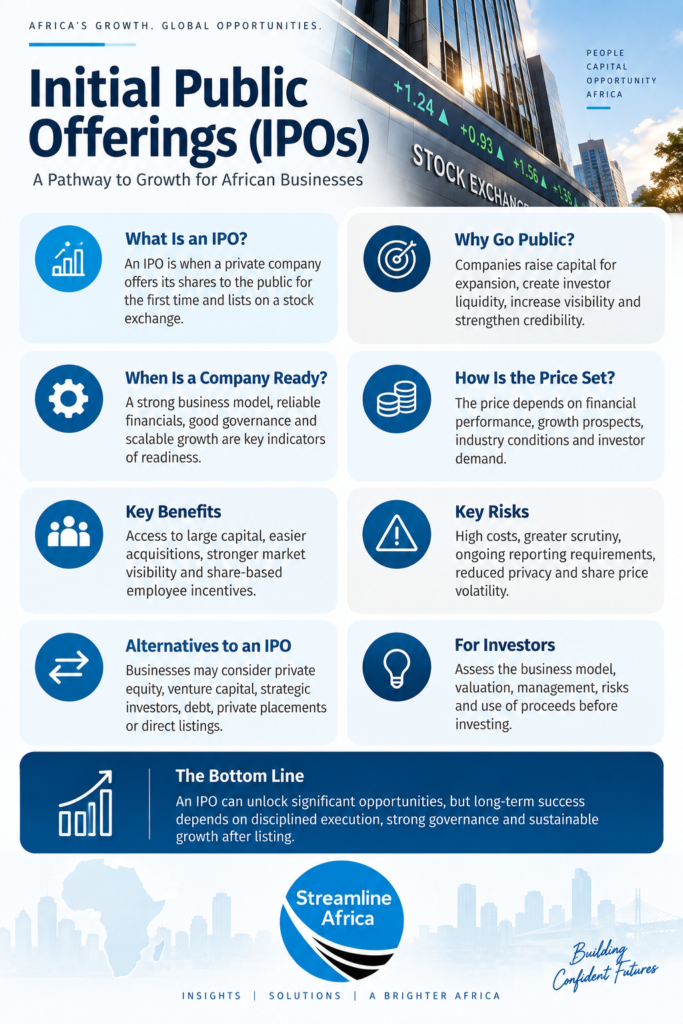
Companies usually pursue an IPO to raise significant capital for expansion, acquisitions, technology, debt reduction or entry into new markets. It can also create liquidity for founders and early investors.
When Is a Company Ready for an IPO?
A company is generally better positioned for an IPO when it has a strong business model, reliable financial reporting, sound governance, clear growth prospects and internal controls capable of meeting public-market expectations.
How Is an IPO Price Determined?
The IPO price is influenced by the company’s financial performance, expected growth, cash flows, industry conditions, comparable listed companies and the level of investor demand for the shares.
What Are the Main Benefits of Going Public?
An IPO can provide access to large pools of capital, increase corporate visibility, improve shareholder liquidity, support acquisitions and create opportunities for share-based employee incentives.
What Are the Main Risks of an IPO?
Going public can be expensive and demanding. Companies face greater regulatory scrutiny, ongoing reporting obligations, shareholder pressure, reduced privacy and exposure to fluctuations in their share price.

Are IPOs Always a Good Investment?
No. An IPO may attract significant attention, but investors should still assess the company’s financial performance, valuation, management quality, competitive position, governance and risks before investing.
What Should Investors Look for Before Buying IPO Shares?
Investors should review the company’s business model, revenue growth, profitability, debt levels, management team, major risks, intended use of funds and whether the proposed valuation appears reasonable.
What Happens After a Company Goes Public?
After listing, the company must continue meeting financial reporting, governance and regulatory requirements while demonstrating that the capital raised is being used effectively to create sustainable shareholder value.
Are There Alternatives to an IPO?
Yes. Businesses may consider private equity, venture capital, strategic investors, debt financing, private placements, development finance, crowdfunding or direct listings depending on their objectives and financial position.