

Botswana is regarded as one of Africa’s dependable investment destinations. Political stability, disciplined finances, and strong institutions have supported predictable governance. The country has combined democratic continuity with careful use of mineral wealth.
That record is now being tested by structural pressures. Botswana is landlocked, sparsely populated, and climate-exposed. Inequality, unemployment, and diamond dependence also weaken its economic model. The government aims to move from middle-income status to a high-income economy by 2036, but reaching that goal will require stronger productivity, broader private-sector participation, and faster diversification.
Diamonds and Industrial Development
Diamonds remain the foundation of Botswana’s economy. As Africa’s largest diamond producer, it uses gemstone earnings to finance public services and infrastructure. This resource base has supported stability and a sound fiscal position.
Dependence on one export nevertheless creates serious exposure. Diamonds generate about 80 percent of export revenue, leaving national income vulnerable to global luxury spending and market conditions. A sales downturn can affect revenue, reserves, confidence, and business activity.
Botswana has responded by promoting local beneficiation. Diamond sorting, valuation, cutting, and polishing, previously undertaken mainly overseas, are increasingly being conducted locally. The policy is designed to retain more value, expand employment, build technical expertise, and deepen participation in the gemstone supply chain. These activities now make a meaningful contribution to the economy and demonstrate the potential of resource-based industrialisation.
Attractive Opportunities for Investors
Botswana’s leading commercial advantage is its stable operating environment. Peaceful political transitions, clear business rules, and prudent financial management have strengthened investor confidence. The country also enjoys one of mainland sub-Saharan Africa’s strongest sovereign credit profiles, increasing its appeal to firms seeking lower political and financial risk.
Tourism provides another opportunity. Botswana hosts Africa’s largest elephant population and several renowned wildlife areas. Its high-value, low-volume tourism approach has positioned it as a premium destination for safari travel, conservation-focused hospitality, and nature-based experiences. Opportunities exist in accommodation, transport, travel technology, specialist services, and sustainable tourism infrastructure.
Manufacturing, logistics, retail, and fast-moving consumer goods also offer potential. Botswana’s close economic relationship with South Africa provides access to established supply chains, formal distribution networks, and a larger regional market. Businesses that manufacture locally, replace imports, or serve neighbouring countries may receive stronger support, particularly when they help reduce reliance on diamonds.
Major Risks and Constraints
Economic concentration remains the principal concern. Botswana’s dependence on diamonds makes it vulnerable to external shocks beyond the control of domestic policymakers. Investors should assess how weaker global demand could influence public spending, currency conditions, household consumption, and commercial confidence.
Climate change presents a significant challenge. Botswana’s arid environment already experiences recurring droughts, extreme heat, and pressure on limited water supplies. Water security will increasingly shape investment decisions in agriculture, tourism, construction, mining, and urban development. Companies entering water-intensive industries should evaluate supply reliability, conservation requirements, and the cost of resilient infrastructure.
Severe inequality and limited employment creation may also weaken long-term social stability. Despite generally respectable economic performance, prosperity remains unevenly distributed. If growth fails to create wider income opportunities, public dissatisfaction could rise. Investors should therefore incorporate local recruitment, skills development, community engagement, and inclusive procurement into their operating models.
Establishing a Business
Foreign investors are encouraged to work with the Botswana Investment and Trade Centre, which provides market information, registration guidance, incentive advice, and introductions to institutions. Company formation may take ten to sixteen weeks, depending on the chosen legal structure, sector, and licensing requirements.
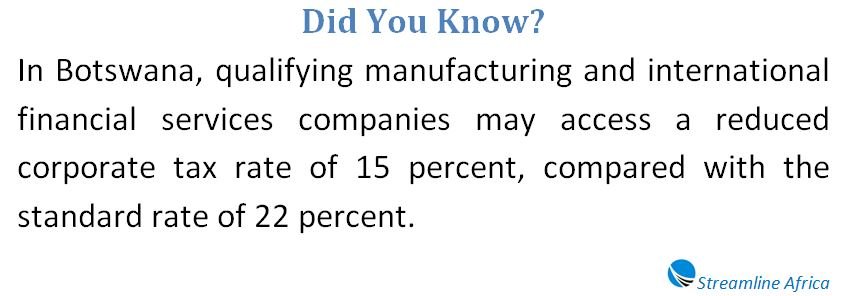
The standard corporate income tax rate is generally 22 percent. Approved manufacturing companies and qualifying international financial services businesses may benefit from a reduced 15 percent rate. These incentives reflect the government’s preference for investments that create jobs, expand exports, develop local capabilities, and introduce value-added production.
Operational difficulties should still be anticipated. Businesses may face administrative delays, localisation requirements, a small domestic market, and shortages of expertise. Effective entry strategies commonly involve partnerships with local firms, early regulatory engagement, realistic workforce planning, and regional growth models extending beyond Botswana’s population.

Business Culture and Professional Conduct
English is widely used in government, education, and commerce, making the market accessible to businesses from Anglophone countries. Professional exchanges are formal, and conservative business clothing is appropriate. Courtesy and relationship-building matter, with meetings often beginning through polite inquiries about personal well-being before commercial discussions.
Successful investors combine professionalism with patience. Decisions may require time, while trust develops through consistent communication, local presence, and respect for established procedures. Companies demonstrating commitment to employment, knowledge transfer, responsible environmental practices, and long-term partnership are likely to earn credibility.
Investment Outlook
Botswana offers political stability, institutional strength, mineral wealth, and regional connectivity. Its central challenge is transforming these advantages into a more diversified, resilient, and inclusive economy.
The opportunities will favour investors aligned with that transition. Businesses supporting manufacturing, tourism, renewable energy, water management, digital services, logistics, agriculture, and mineral beneficiation can advance national priorities while building commercial positions. With due diligence, capable local partners, and a market strategy, Botswana can provide a credible platform for sustainable investment and regional expansion in Southern Africa.
Important Takeaways
Political Stability Supports Investor Confidence
Botswana’s long record of democratic governance and peaceful political transitions makes it one of Africa’s more predictable business environments.
Diamonds Remain the Economic Backbone
Diamond exports continue to finance government spending, infrastructure, and social programmes, but this dependence leaves the economy exposed to global demand shifts.
Economic Diversification Is a National Priority
The government is actively encouraging investment in manufacturing, tourism, logistics, renewable energy, agriculture, and digital services to reduce reliance on mining.
Local Diamond Processing Creates Added Value
Expanding domestic sorting, cutting, polishing, and valuation allows Botswana to retain more revenue, create skilled employment, and strengthen its industrial base.
Tourism Offers Premium Investment Potential
Botswana’s wildlife, conservation areas, and high-value safari model create opportunities in accommodation, transport, hospitality, and sustainable tourism services.
Climate Change Is a Serious Business Risk
Drought, water scarcity, and rising temperatures may increase operating costs and affect investment decisions in mining, agriculture, tourism, and construction.
Inequality Could Affect Long-Term Stability
Although Botswana has achieved steady economic progress, high inequality and limited employment opportunities remain important social and commercial concerns.
Government Incentives Favour Productive Investment
Approved manufacturing and international financial services companies may qualify for reduced corporate tax rates, particularly when they create jobs and exports.
A Small Domestic Market Requires Regional Thinking
Investors may need to use Botswana as a platform for reaching larger Southern African markets, especially through its strong trade and supply-chain links with South Africa.
Local Partnerships Improve Market Entry
Companies are more likely to succeed when they engage regulators early, build trusted local relationships, invest in workforce development, and demonstrate long-term commitment.