

Long-term debt represents financial obligations that a company is required to repay over a period extending beyond 12 months. It is an important component of corporate finance and balance-sheet analysis because it shows the extent to which a business relies on external borrowing to support investment, expansion and long-term operating needs.
For students conducting research in accounting, finance or business management, understanding long-term debt is essential because it connects several key concepts, including capital structure, solvency, liquidity, financial risk and corporate investment decisions.
Businesses typically use long-term borrowing to finance projects whose benefits are expected to extend over several years. These may include the acquisition of machinery, construction of production facilities, infrastructure development, business expansion or major technology investments.
Long-term debt should therefore not be interpreted automatically as a negative financial indicator. Its effect depends largely on the company’s repayment capacity, cost of borrowing and ability to generate returns from the assets financed.
Long-Term Debt on the Balance Sheet
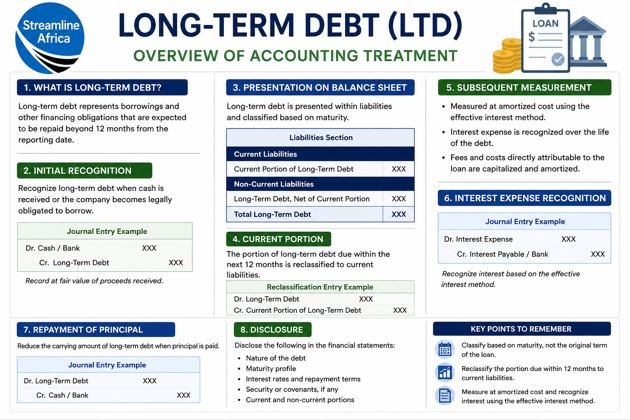
Long-term debt is reported within the liabilities section of a company’s statement of financial position, commonly referred to as the balance sheet.
Liabilities represent obligations that a business owes to external parties. For reporting purposes, they are generally divided into current and non-current liabilities based on when settlement is expected.
Current liabilities are normally due within 12 months, while non-current liabilities are obligations expected to remain outstanding beyond that period. Since long-term debt has an original repayment period exceeding one year, most of the outstanding amount is usually presented under non-current liabilities.
For example, if a company obtains a six-year bank facility to acquire industrial equipment, the portion that will not become payable within the next year would normally be classified as non-current debt.
This classification helps financial statement users distinguish between obligations requiring near-term settlement and those that place longer-term demands on company resources.
Why Businesses Use Long-Term Financing
Companies require capital to operate, invest and grow. Two of the most common sources are equity financing and debt financing.
Equity financing involves raising capital through investors in exchange for ownership in the company. Businesses may issue ordinary shares or other forms of equity to obtain funding without creating a direct repayment obligation. However, raising additional equity can reduce the ownership percentage and influence of existing shareholders.
Debt financing involves borrowing money that must eventually be repaid. Depending on the financing arrangement, borrowers may also be required to make regular interest payments and scheduled principal repayments throughout the life of the loan.
Common examples of long-term debt include corporate bonds, term loans and other multi-year borrowing arrangements.
From a corporate finance perspective, management must determine an appropriate balance between debt and equity. Excessive borrowing can increase financial risk, while avoiding debt completely may limit a company’s ability to invest in profitable opportunities.
The Current Portion of Long-Term Debt
An important concept for students to understand is the current portion of long-term debt.
A borrowing arrangement may originally have a maturity of several years, but as individual repayments become due, the amount payable within the next 12 months is normally reclassified from non-current liabilities to current liabilities.
Consider a company with GH¢20 million remaining on a five-year loan. If GH¢4 million is scheduled for repayment during the next financial year, the GH¢4 million would normally be presented as the current portion of long-term debt. The remaining GH¢16 million would continue to be reported as a non-current liability.
This accounting treatment does not change the original nature of the borrowing. The GH¢4 million remains part of a long-term financing arrangement even though its repayment date has moved within the next 12 months.
For this reason, financial analysts may combine the current and non-current portions when examining a company’s total long-term borrowing exposure.
Distinguishing Long-Term and Short-Term Debt
Research involving corporate debt requires a clear distinction between long-term borrowing and financing that was originally structured for short-term purposes.
Short-term debt is typically used to address immediate financing needs, including seasonal working-capital requirements and temporary cash shortages. Examples may include revolving credit facilities and commercial paper.
Long-term debt, by comparison, is generally associated with investments and obligations extending beyond one year. Examples include corporate bonds and multi-year term loans.
The current portion of a long-term loan should not be confused with short-term debt simply because it is now payable within 12 months. The distinction remains important when calculating financial ratios because including unrelated short-term borrowing may change the purpose and interpretation of the analysis.
Students should therefore examine both the original nature of the borrowing and its balance-sheet classification when conducting financial statement research.

Understanding the Long-Term Debt Ratio
The long-term debt ratio is a solvency measure used to assess the proportion of a company’s assets that is supported by longer-term borrowing.
The formula is:
Long-Term Debt Ratio = Total Long-Term Debt ÷ Total Assets
Total long-term debt generally includes both the non-current portion of long-term borrowings and the current portion arising from those same long-term obligations.
The result provides an indication of the company’s reliance on longer-term creditors to finance its asset base.
For example, a long-term debt ratio of 0.40 indicates that the company has long-term debt equivalent to 40% of its total assets.
In general terms, a lower ratio may suggest reduced dependence on long-term borrowing. A higher ratio may indicate greater financial leverage and potentially greater exposure to interest and repayment obligations.
However, the ratio should not be interpreted in isolation.
Illustrative Long-Term Debt Ratio Example
Assume that a fictional Ghanaian company, Meridian Industries Ltd., reports GH¢45 million in current assets and GH¢105 million in non-current assets.
Total assets would therefore equal:
GH¢45 million + GH¢105 million = GH¢150 million
Suppose the company also reports GH¢15 million as the current portion of long-term debt and GH¢60 million as non-current long-term borrowings.
Total long-term debt would be:
GH¢15 million + GH¢60 million = GH¢75 million
The long-term debt ratio would therefore be:
GH¢75 million ÷ GH¢150 million = 0.50
Expressed as a percentage, the ratio is 50%.
This means that Meridian Industries has long-term debt equivalent to 50% of the value of its total assets. It can also be interpreted as GH¢0.50 of long-term debt for every GH¢1.00 of assets recorded by the company.
The result provides useful information about leverage, but further analysis would still be required before reaching conclusions about financial strength.
How Students Should Interpret Long-Term Debt
A common research mistake is to assume that high debt is always undesirable or that low debt always indicates strong financial performance.
The appropriate amount of borrowing depends on several factors, including the company’s industry, business model, profitability, cash-flow stability and cost of financing.
Capital-intensive businesses may operate with comparatively high levels of long-term debt because they require substantial investment in factories, vehicles, equipment or infrastructure. Companies operating with fewer physical assets may require much less borrowing.
Researchers should therefore compare long-term debt ratios across several years and, where possible, against companies operating within the same industry.
A rising ratio may indicate increasing reliance on borrowed financing, while a declining ratio may suggest debt repayment or stronger asset growth. Neither trend should be interpreted without examining the reasons behind the change.
Relationship Between Debt, Solvency and Financial Risk
Long-term debt analysis is closely linked to solvency, which refers to a company’s ability to meet its long-term financial obligations.
Debt creates fixed financial commitments. Even when business performance declines, companies are generally still required to meet contractual interest and principal payments.
For this reason, excessive borrowing can increase financial risk. Companies with high debt balances may become particularly vulnerable during periods of rising interest rates, declining sales or economic uncertainty.
However, carefully managed borrowing can support growth and improve returns. If a company borrows at a reasonable financing cost and invests the funds in projects generating higher returns, debt can contribute positively to shareholder value.
The financial effect of borrowing therefore depends on both the amount of debt and how effectively the borrowed capital is used.
Using Long-Term Debt in Financial Research
For academic research, the long-term debt ratio should preferably be considered alongside other financial indicators rather than used as a standalone measure.
Debt-to-equity ratios can show how borrowing compares with shareholder financing, while interest coverage ratios provide information about a company’s ability to pay interest from operating earnings. Cash-flow analysis can also help determine whether reported profits are translating into sufficient cash to meet repayment obligations.
Students should additionally review the maturity structure of debt. A company may appear financially stable based on its total debt balance yet face significant refinancing pressure if substantial amounts become payable within a short period.
Comparative and trend analysis therefore provide a more reliable understanding of financial risk than a single ratio calculated for one reporting period.
Conclusion
Long-term debt is a central element of corporate financial analysis because it reflects how businesses finance long-term investment while creating future repayment obligations.
For students, the key analytical issue is not simply whether a company has borrowed money, but whether the level and structure of that borrowing are sustainable in relation to its assets, earnings and cash-generating capacity.
The long-term debt ratio provides a useful starting point by measuring long-term borrowing relative to total assets. However, meaningful research should combine this measure with industry comparisons, historical trends, profitability indicators, cash-flow information and other solvency measures.
A well-structured assessment of long-term debt can therefore provide valuable insight into a company’s capital structure, financing strategy and overall financial risk.
Frequently Asked Questions about Long-Term Debt
Where Is Long-Term Debt Reported?
Long-term debt is mainly reported under non-current liabilities on the balance sheet. Any amount due within the next 12 months is normally presented under current liabilities.
Why Do Companies Use Long-Term Debt?
Companies use long-term borrowing to obtain funding without immediately giving up ownership. The funds may support expansion, equipment purchases, infrastructure development or other strategic investments.
What Is the Current Portion of Long-Term Debt?
It is the part of an existing long-term borrowing arrangement that must be repaid within the next 12 months. Although classified as a current liability, it remains part of the original long-term debt.
How Is Long-Term Debt Different From Short-Term Debt?
The main difference is the repayment period and financing purpose. Long-term debt extends beyond one year, while short-term borrowing is generally used for temporary or immediate financing requirements.
What Are Common Examples of Long-Term Debt?
Common examples include corporate bonds, multi-year bank loans and term loan facilities. These arrangements usually require interest payments and eventual repayment of the principal.
What Is the Long-Term Debt Ratio?
The long-term debt ratio is a solvency measure that shows the relationship between a company’s long-term borrowings and its total assets.
How Is the Long-Term Debt Ratio Calculated?
The formula is:
Long-Term Debt Ratio = Total Long-Term Debt ÷ Total Assets
For example, GH¢60 million of long-term debt against GH¢120 million of assets produces a ratio of 0.50, or 50%.
What Does a 50% Long-Term Debt Ratio Mean?
It means the company has GH¢0.50 of long-term debt for every GH¢1.00 of assets. This indicates significant reliance on long-term borrowing, although it does not automatically mean the company is financially weak.
Is a High Long-Term Debt Ratio Always Bad?
No. A higher ratio may be reasonable for capital-intensive businesses with predictable cash flows. The key question is whether the company can comfortably service its interest and principal obligations.
Why Should Students Compare Debt Ratios Across Companies?
Comparison provides context. Debt levels that appear high in one industry may be normal in another, making peer comparisons and historical trends important for meaningful financial research.
What Other Measures Should Be Used With Long-Term Debt?
Students should consider debt-to-equity, interest coverage, profitability and cash-flow measures. Combining these indicators provides a more complete assessment of solvency and financial risk.