

As a team of accounting professionals advising businesses across West Africa, we often encounter a common challenge: many entrepreneurs focus heavily on profit without fully understanding how efficiently their resources are being used to generate that profit. One of the most revealing metrics we rely on in our advisory work is the asset turnover ratio.
From retail shops in Kumasi to logistics firms in Tema, this ratio consistently provides clarity on how well a business converts its assets into revenue. While it may appear simple on the surface, its implications are far-reaching when properly interpreted within the right context.
Defining the Asset Turnover Ratio in Practice
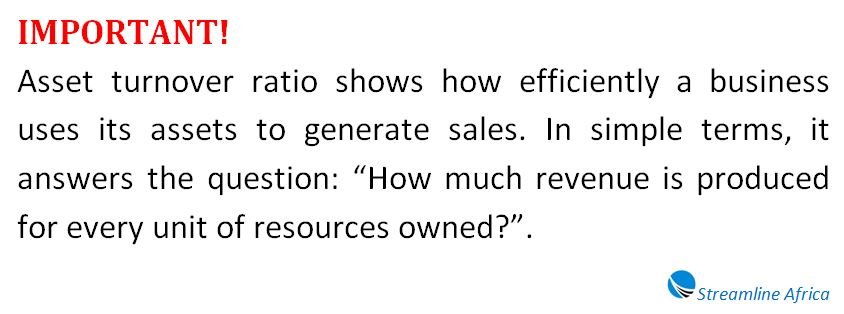
In our professional assessments, we define the asset turnover ratio as a measure of how effectively a company uses its total asset base to produce sales. It connects two fundamental financial statements—the income statement and the balance sheet—by comparing revenue with the assets deployed to generate that revenue.
When we evaluate a company with a high asset turnover ratio, we typically see a business that maximizes output from limited resources. Conversely, a low ratio often signals underutilized assets, operational inefficiencies, or a mismatch between investment and sales performance.
However, we always caution clients against drawing conclusions in isolation. This metric must be interpreted within the framework of the company’s industry and operating model.
How We Calculate the Ratio for Clients
In our engagements, we calculate the asset turnover ratio using a standardized approach that ensures consistency and accuracy. We take total annual revenue and divide it by the average total assets over the same period.
Asset Turnover=2Beginning Assets+Ending AssetsTotal Sales
We emphasize the use of average assets because it smooths out fluctuations that may occur due to seasonal investments, expansions, or asset disposals. For instance, when advising a distribution company in Accra, we noticed that a mid-year warehouse acquisition significantly increased asset values. Using an average prevented a misleading drop in the ratio.
The outcome of this calculation tells us how many units of revenue are generated for each unit of assets, offering a direct insight into operational efficiency.
Industry Context: A Critical Consideration
One of the most important principles we communicate to our clients is that asset turnover ratios vary widely across industries. Comparing companies from different sectors often leads to incorrect conclusions.
In our experience, retail and trading businesses tend to exhibit high asset turnover ratios. These businesses operate with relatively smaller asset bases and depend on high sales volume. For example, a chain of grocery stores we advised in Tamale recorded strong turnover due to rapid inventory movement.
On the other hand, sectors such as construction, telecommunications, and real estate typically show lower ratios. These industries require substantial investments in long-term assets that take time to generate revenue. A property development firm we worked with in Takoradi had significant capital tied up in ongoing projects, which naturally reduced its asset turnover ratio.
For this reason, we always benchmark companies against peers within the same industry to ensure meaningful analysis.

Practical Insights from Client Engagements
Over the years, our advisory work has revealed how this ratio reflects underlying business realities. In one case, we worked with two fashion retailers operating in different regions. One maintained a lean inventory strategy and focused on fast-selling items, while the other invested heavily in premium stock that moved slowly.
The first retailer demonstrated a significantly higher asset turnover ratio, indicating efficient use of assets. The second retailer, despite generating respectable revenue per sale, showed a lower ratio due to slower inventory movement.
Rather than labeling one business as superior, we helped both clients understand how their strategies influenced their efficiency metrics. This allowed them to make informed decisions aligned with their business goals.
The Role of Asset Turnover in Broader Financial Analysis
Within our professional framework, the asset turnover ratio is rarely used in isolation. It forms a key component of a more comprehensive analytical model known as DuPont analysis, which breaks down return on equity into distinct drivers.
ROE=(RevenueNet Income)×(Average AssetsRevenue)×(Average EquityAverage Assets)
In this framework, asset turnover represents the efficiency component. Even when profit margins are modest, a company can achieve strong returns if it generates high sales relative to its asset base.
We often use this model when advising investors or business owners seeking a deeper understanding of performance drivers. It allows us to pinpoint whether challenges stem from pricing, efficiency, or capital structure.
Distinguishing Between Total and Fixed Asset Efficiency
In certain engagements, we refine our analysis by focusing specifically on fixed assets. This leads us to the fixed asset turnover ratio, which isolates long-term assets such as machinery, buildings, and equipment.
For manufacturing clients in industrial hubs like Tema, this metric is particularly valuable. It helps us evaluate whether expensive equipment is being utilized effectively. In one instance, we identified underused machinery in a production facility, which was dragging down overall efficiency. By adjusting production schedules and improving capacity utilization, the company was able to improve its performance.
While the total asset turnover ratio provides a broad view, the fixed asset turnover ratio offers deeper operational insights in asset-intensive industries.
Recognizing the Limitations of the Metric
As accounting professionals, we are careful to highlight the limitations of the asset turnover ratio. While it provides valuable insights into efficiency, it does not capture the full picture of financial health.
For example, a company may report a high asset turnover ratio but still struggle with profitability due to high operating costs or low pricing strategies. Similarly, businesses undergoing expansion may temporarily experience lower ratios as new assets are acquired before generating revenue.
We also consider the impact of accounting policies, such as depreciation methods, which can influence asset values and distort comparisons. For this reason, we always combine this ratio with other financial indicators to form a balanced assessment.
Evaluating What Constitutes Strong Performance
In our advisory practice, we avoid assigning universal benchmarks to asset turnover ratios. Instead, we focus on relative performance within the same industry and track changes over time.
A “good” ratio is one that compares favorably with industry peers and shows consistent improvement. For example, when working with a logistics company, we observed gradual increases in asset turnover over several years. This trend indicated improved operational efficiency and better utilization of resources.
Trend analysis often provides more meaningful insights than a single data point, allowing us to identify patterns and guide strategic decisions.
Strategies We Recommend to Improve Asset Efficiency
When clients seek to improve their asset turnover ratio, we typically recommend a combination of operational and strategic adjustments. One of the most effective approaches is optimizing inventory management. By focusing on fast-moving products and reducing excess stock, businesses can increase sales without significantly increasing assets.
We also encourage better utilization of existing resources. Extending operating hours, improving customer engagement, and enhancing service delivery can drive higher revenue from the same asset base.
In some cases, we introduce just-in-time inventory systems, which reduce the need for large stock holdings. This approach has proven particularly effective for distribution and manufacturing clients.
Additionally, we advise leveraging technology to monitor asset usage and identify inefficiencies. Data-driven decision-making often leads to significant improvements in performance.
A Holistic View of Business Efficiency
From our professional standpoint, the asset turnover ratio is a vital indicator of how well a business transforms its resources into revenue. However, it is most powerful when used as part of a broader analytical framework.
By combining this metric with profitability, liquidity, and leverage ratios, we gain a comprehensive understanding of a company’s financial position. This holistic approach enables us to provide actionable insights that drive sustainable growth.
Concluding Reflections from Our Team
In our experience, businesses that consistently monitor and improve their asset turnover ratio are better positioned to compete and grow. The metric encourages disciplined resource management and highlights opportunities for operational improvement.
Ultimately, the goal is not simply to achieve a high ratio, but to ensure that assets are aligned with the company’s strategy and used effectively to generate value. When interpreted correctly and applied thoughtfully, the asset turnover ratio becomes a powerful tool for guiding financial decisions and enhancing long-term performance.
Frequently Asked Questions about Asset Turnover
Why is the asset turnover ratio important for businesses?
It helps business owners and investors understand operational efficiency. A strong ratio suggests that resources are being used effectively, while a weak ratio may highlight inefficiencies or idle assets.
How is the asset turnover ratio calculated?
It is calculated by dividing total annual sales by the average value of total assets over the same period. This gives a balanced view of how assets contribute to revenue generation.

Why do asset turnover ratios differ across industries?
Different industries operate with different asset structures. Retail businesses often have high turnover due to fast sales, while sectors like real estate or manufacturing have lower ratios because assets take longer to generate income.
Can a high asset turnover ratio guarantee profitability?
Not necessarily. A company can generate strong sales from its assets but still struggle with profits if costs are too high or pricing is too low.
What does a low asset turnover ratio indicate?
It may suggest that assets are underutilized, inventory is moving slowly, or the company has invested heavily in resources that are not yet generating sufficient revenue.
How does asset turnover relate to overall financial performance?
It plays a key role in broader analysis methods like return on equity. Efficient asset use can significantly improve overall financial results when combined with healthy profit margins.
What is the difference between total asset turnover and fixed asset turnover?
Total asset turnover considers all assets, while fixed asset turnover focuses only on long-term assets like equipment and buildings. The latter is especially useful in asset-heavy industries.
How can a business improve its asset turnover ratio?
Businesses can improve efficiency by managing inventory better, increasing sales without adding new assets, optimizing operations, and adopting smarter resource allocation strategies.