
Understanding Senegal’s Minimum Wage Framework
Senegal’s wage system provides a statutory income floor for workers in the formal economy while giving employers a baseline for payroll planning. Different minimum wage benchmarks apply according to the nature of the work, making correct sector classification essential before setting pay, calculating overtime, or preparing contracts.
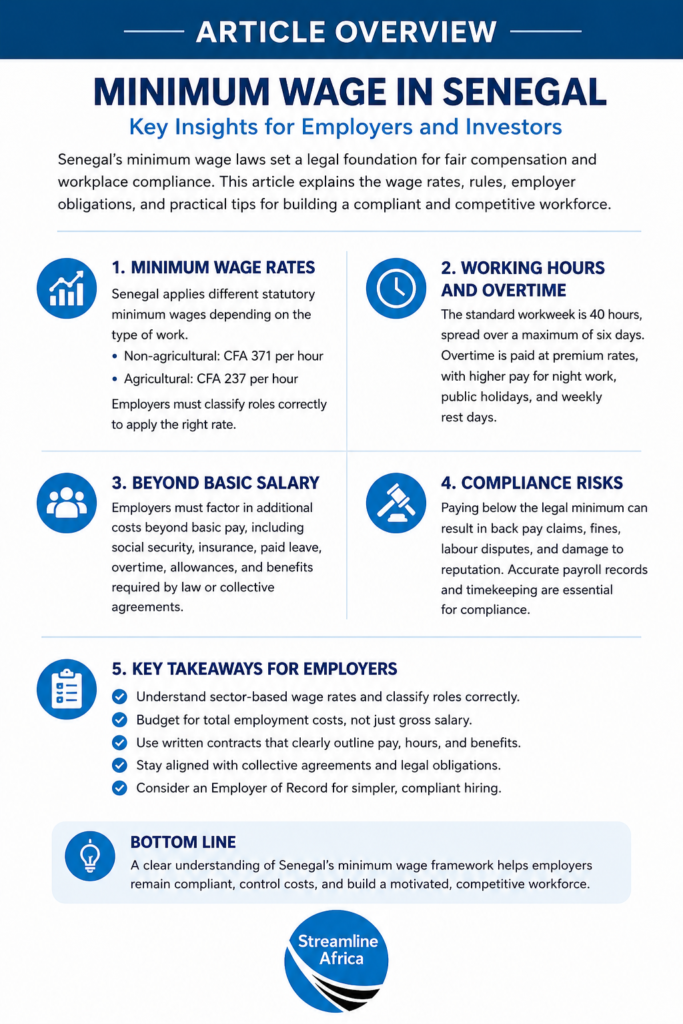
For non-agricultural activities, the commonly referenced statutory minimum is CFA 371 per hour, while agricultural workers are subject to CFA 237 per hour. These rates form the legal foundation for pay calculations, although salaries in finance, technology, logistics, professional services, and energy are often higher. In Dakar, Thiès, and other commercial centres, employers may need to exceed the statutory floor to attract experienced talent.
Senegal uses the West African CFA franc, payroll is generally monthly, French is commonly used for formal employment documentation, and the standard workweek is 40 hours. These factors should be considered together when designing compensation.
Read Also: Senegal: Evaluating the Business Landscape, Investment Risks, and Growth Potential
Why Sector Classification Matters
The difference between agricultural and non-agricultural rates makes business classification a compliance issue. Retail, manufacturing, telecommunications, consulting, hospitality, and most commercial services generally fall within the non-agricultural framework, while farming activities may fall under the agricultural rate.
Employers should not simply copy another company’s wage figure. The correct minimum depends on the work, business activity, and potentially the applicable collective agreement. A commercially reasonable payroll can still create exposure if the underlying rate is wrong.
Employers should document role classifications and check whether a sector agreement creates higher minimums, allowances, premiums, or benefits. Where a collective agreement offers more favourable terms, the more advantageous requirement should guide budgeting.
Minimum Wage Versus Market Pay
A legal minimum and a competitive salary are different. The statutory wage is the lowest lawful benchmark, while skilled-worker pay must also reflect experience, talent scarcity, location, and market expectations.
In major urban centres, professionals often command salaries above the legal floor. Using minimum wage alone may produce compliant but unattractive offers, so employers should combine legal requirements with market data for comparable roles.
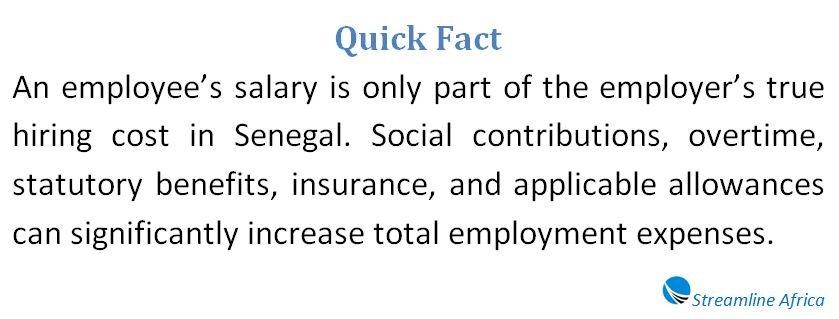
This matters especially for international companies. Total employment cost includes social contributions, paid leave, overtime, insurance obligations, and allowances required by collective agreements or company policy.
Working Hours and Overtime Costs
The normal working schedule in Senegal is generally 40 hours per week, spread across no more than six days. Once employees work beyond the normal weekly threshold, overtime rules become relevant.
Overtime premiums vary according to the number of extra hours worked and whether the work occurs at night, on a weekly rest day, or during a public holiday. Payroll teams must therefore track when overtime occurs, not merely how many hours are worked.
Night work generally falls between 10 p.m. and 5 a.m. and attracts higher compensation, while rest-day and public-holiday work may also trigger premiums. Employers should verify the exact bands applying to their industry before payroll is finalized.
Accurate timekeeping is essential. Attendance records, overtime approvals, shift schedules, and payroll calculations should align so the employer can demonstrate compliance during inspections or disputes.

Additional Employment Costs Beyond Basic Salary
Minimum wage is only one component of employment cost. Businesses must also plan for pensions, family-related social security, occupational accident coverage, healthcare-related contributions, and income tax withholding.
Employer payroll costs can materially increase spending above gross salary, making total-cost modelling essential before approving headcount.
Certain industries may also require transport, housing, meal, family, or other allowances under collective bargaining arrangements. Seniority-related payments may apply under relevant employment frameworks, and many employers voluntarily offer year-end or 13th-month-style bonuses even where such payments are not universally required by law.
A competitive compensation package should be evaluated as total employment cost rather than a salary figure.
Employment Contracts and Payroll Documentation
Written employment terms support wage compliance in Senegal. Contracts should clearly identify the employer and employee, the commencement date, job responsibilities, compensation, benefits, and other essential conditions of employment.
For payroll purposes, employers should go further by ensuring that working hours, overtime treatment, allowances, and payment frequency are clearly documented. Where a collective agreement applies, the contract should not provide terms below the standards created by that agreement.
French-language documentation is generally the most practical approach for local employment administration. Employers should also retain payslips, attendance records, overtime approvals, tax filings, social contribution records, and evidence of salary payments.
Good records support payroll accuracy. They create an audit trail showing how the company calculated wages and complied with its obligations. This becomes particularly valuable when responding to inspections, employee claims, or internal payroll reviews.
Consequences of Underpaying Employees
Paying below the applicable legal minimum can expose an employer to financial, administrative, and reputational consequences. Labour authorities may examine payroll records, working-time information, contracts, and contribution payments to determine whether employees have been correctly compensated.
Where underpayment is identified, employers may be required to correct the shortfall and settle back pay. Fines or other sanctions may also apply depending on the nature and scale of the violation. A widespread payroll error affecting many employees can therefore become significantly more expensive than the original wage difference.
The risk is not limited to government action. Employees may challenge unpaid wages or incorrectly calculated overtime through labour dispute mechanisms. For international employers, recurring wage violations may also damage recruitment, retention, vendor relationships, and confidence in the company’s local governance.
Prevention is substantially less costly than remediation. Regular payroll audits should compare actual payments with statutory minimums, collective agreement rules, overtime records, and contribution obligations.
Practical Hiring Strategies for Employers
Companies entering Senegal should begin compensation planning with the applicable statutory wage, then build upward. The first step is to classify the role correctly and confirm whether the agricultural or non-agricultural rate applies. The second is to review any industry-specific collective agreement. The third is to benchmark market salaries for the position.
Employers should then calculate the full cost of employment, including statutory contributions, likely overtime, paid leave, insurance, and mandatory allowances. This produces a more reliable hiring budget than relying on gross salary alone.
Local expectations should also influence compensation strategy. Employees naturally value predictable and accurate salary payments, but benefits such as transport assistance, private medical coverage, meal support, training, and performance incentives can strengthen an offer. During major religious or family occasions, culturally sensitive employee support can also contribute to retention and engagement when designed consistently and fairly.
Using an Employer of Record in Senegal
For a company hiring only a small number of employees, establishing a Senegalese legal entity may create more administration than the business initially needs. Registration, banking, tax filings, payroll, social security, contracts, and local compliance all require ongoing management.
An Employer of Record can provide an alternative by acting as the legal employer while the client company directs the employee’s day-to-day work. The EOR typically manages compliant contracts, payroll calculations, statutory deductions, social contributions, benefits administration, and employment records.
This approach can be useful for businesses testing the Senegalese market, hiring specialized talent, supporting a regional project, or building a team before deciding whether to establish a permanent entity. It does not remove the need for sound workforce planning, but it can reduce the operational burden of managing unfamiliar employment rules.
Building a Sustainable Compensation Strategy
The most effective wage strategy in Senegal is one that balances three considerations: legal compliance, market competitiveness, and long-term affordability. Meeting the statutory minimum is essential, but it should not be the final objective when recruiting skilled employees.
Employers should review wage assumptions periodically, particularly when inflation, labour regulations, collective agreements, or market salaries change. Compensation structures should also be tested against actual working patterns so that overtime and allowance costs do not create unexpected budget pressure.
Ultimately, successful hiring in Senegal depends on treating payroll as a compliance and workforce-planning function rather than a simple monthly transaction. Companies that classify roles correctly, document employment terms clearly, budget for statutory costs, and pay employees accurately are better positioned to build trust, retain talent, and scale their operations with fewer regulatory surprises.
Frequently Asked Questions about Senegal’s Minimum Wage
Does the same minimum wage apply to every employee?
No. Senegal uses different wage floors for agricultural and non-agricultural work. Employers therefore need to classify roles correctly before setting salaries and preparing payroll.
What are the standard working hours in Senegal?
The standard workweek is generally 40 hours, usually spread across no more than six working days. Hours worked beyond the normal limit may qualify for overtime.
How is overtime paid in Senegal?
Overtime is paid at premium rates that depend on the number of extra hours worked and when those hours occur. Night work, public holidays, and weekly rest days can attract higher rates.
What is considered night work in Senegal?
Night work generally refers to work performed between 10 p.m. and 5 a.m. Because of the inconvenience associated with these hours, higher compensation rates may apply.
Is paying the minimum wage enough to attract skilled workers?
Not always. The minimum wage is only the legal floor. Employers competing for experienced professionals in Dakar and other commercial centres may need to offer significantly higher salaries.
Are employers responsible for costs beyond basic salary?
Yes. Employers should budget for social security contributions, insurance-related costs, paid leave, overtime, and any mandatory allowances required by law or collective agreements.
Do collective bargaining agreements affect employee pay?
They can. Certain sectors may have collective agreements that establish higher wages, allowances, benefits, or employment conditions than the general statutory minimum.
Are written employment contracts important in Senegal?
Yes. Written contracts help clarify salary, working hours, job responsibilities, benefits, overtime arrangements, and other employment conditions, reducing the risk of future disputes.
What happens if an employer pays below the legal minimum?
Employers may face back-pay obligations, fines, corrective measures, labour disputes, and reputational damage. Payroll records may also be reviewed during labour inspections.
Should companies budget only for gross salary when hiring?
No. A better approach is to calculate the total employment cost, including employer contributions, overtime, benefits, allowances, insurance, and other statutory obligations.
Can an Employer of Record help companies hire in Senegal?
Yes. An Employer of Record can manage employment contracts, payroll, statutory deductions, benefits, and local compliance while allowing the company to manage the employee’s day-to-day work.