
Did you know that there is no single salary figure that represents every worker in Namibia? Yes, earnings vary widely depending on the type of job, industry, experience, qualifications and location. Someone working for a mining company may have a very different income from an employee in retail, agriculture or domestic work.
This is why national salary figures need some explanation. Average earnings can provide a useful picture of the labour market, but they do not necessarily show what most workers take home.
The average gross salary is estimated at N$13,500 per month, or N$162,000 per year. The median monthly income is much lower, at around N$4,000. The difference between these figures is significant because higher salaries in sectors such as mining and financial services can push the national average upward.
For employers, employees and jobseekers, looking at the wider picture is therefore more useful than relying on the average salary alone.
Namibia’s National Minimum Wage
Namibia has a national minimum wage of N$18 per hour for workers covered by the general rate. At 195 working hours per month, this is equivalent to approximately N$3,510 per month and N$42,120 over 12 months.
The minimum wage establishes a basic level of protection for employees, but it should not be confused with a standard salary for every job. Many positions pay more depending on the employee’s skills, responsibilities, experience and the industry involved.
Take a fictional employee named Helena, who works for a distribution company in Walvis Bay. Her employer must ensure that her basic hourly pay does not fall below the applicable minimum. If her position attracts a higher market salary because of additional responsibilities or specialist skills, the minimum wage simply serves as the legal starting point.

Different Rates for Domestic and Agricultural Workers
Domestic and agricultural workers did not move to the general N$18 hourly minimum wage immediately. Instead, Namibia introduced a three-year transition that began on 1 January 2025 and ends on 1 January 2027, when both categories reach the general N$18-per-hour rate.
For domestic workers, the minimum wage was set at N$12 per hour from 1 January 2025. It increased to N$15 per hour on 1 January 2026 and rises to N$18 per hour from 1 January 2027.
Agricultural workers follow a similar phased schedule. Their minimum wage was N$10 per hour from 1 January 2025, increased to N$14 per hour on 1 January 2026, and rises to N$18 per hour from 1 January 2027.
Because these rates change during the transition period, employers should always confirm which rate applies before processing wages. Relying on an old payroll figure can easily result in an employee being paid below the applicable minimum.
This is particularly relevant to households employing domestic workers and agricultural businesses with large workforces.
Why Average Pay Does Not Tell the Whole Story
One of the most important things to understand about salaries in Namibia is the difference between average and median income.
An average is calculated by combining everyone’s earnings and dividing the total by the number of workers. A relatively small number of highly paid employees can therefore pull the figure upward.
The median works differently. It identifies the midpoint of the income distribution. Half of workers fall below it and half above it. This can make the median particularly useful when trying to understand what earnings look like for a more typical worker.
Namibia’s relatively large difference between average and median earnings shows why jobseekers should be careful when using national salary figures to negotiate pay.
A better comparison would consider the specific occupation, industry, level of experience and location.
What Wages Mean in Everyday Life
The amount written on a payslip is only one part of the story. What matters to a household is what that income can actually buy.
Two workers earning the same amount may have very different experiences depending on their housing, transport, food and other regular expenses. Living costs can also differ between major urban centres and smaller communities.
This is where purchasing power becomes useful. Instead of simply converting Namibian dollars into another currency, purchasing-power comparisons consider differences in the cost of goods and services.
The source estimates that the N$18 hourly minimum wage has purchasing power comparable to about US$2.60 per hour in the United States after adjusting for differences in living costs.
Such comparisons are best treated as context rather than a precise measure of an individual’s standard of living.
Working Hours in Namibia
Pay cannot be separated from the number of hours an employee works. Namibia’s ordinary working week is generally limited to 45 hours.
For an employee working five days a week, ordinary working time can amount to nine hours per day. Under a six-day arrangement, ordinary hours are generally limited to eight hours per day.
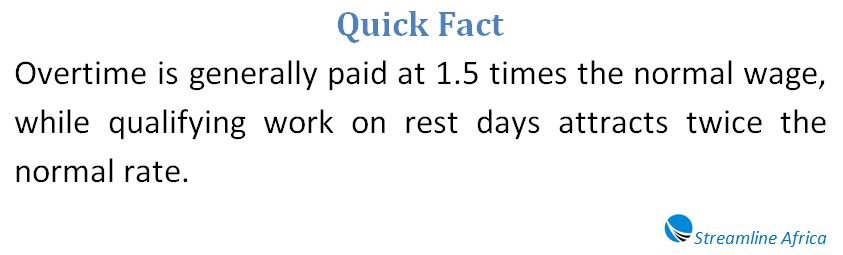
Work beyond ordinary hours may qualify as overtime. Overtime is generally paid at 1.5 times the employee’s normal rate and is limited to 10 hours per week and three hours per day. Work performed on applicable rest days attracts twice the normal rate.
These rules make accurate attendance and payroll records important. Employers need to know when ordinary working time ends and overtime begins, while employees should be able to understand how additional hours have been reflected in their pay.
Rest Periods and Annual Leave
Employees also need sufficient time away from work. Namibia’s working-time framework provides for at least 12 consecutive hours of daily rest and a weekly rest period of at least 36 consecutive hours.
For employees working a five-day week, annual leave is generally 20 working days under the conditions described in the source.
These entitlements form an important part of the employment relationship. Salary may receive most of the attention when someone accepts a job, but working hours, overtime arrangements, leave and rest periods can have just as much influence on the quality of employment.
Employers should therefore keep proper leave and attendance records, while employees should understand the basic conditions attached to their contracts.

Understanding Namibia’s Wage Position
Comparing Namibia with other countries can provide perspective, but international salary comparisons need to be handled carefully.
Exchange rates can change, and the same amount of money does not buy the same quantity of goods and services in every country. Housing, transportation, taxation and everyday living expenses can all influence the real value of earnings.
A salary that appears relatively low after a direct currency conversion may have greater local purchasing power than the conversion suggests. The reverse can also happen.
For this reason, employers considering regional salary benchmarks should look beyond simple currency conversions. Local labour conditions, living costs, skills shortages and industry practices provide a much stronger basis for setting pay.
What Employers Should Consider
For employers, wage compliance begins with identifying the correct rate for each employee. Businesses should also keep accurate records of hours worked, overtime, leave and other elements that affect remuneration.
Minimum wage compliance should not be the only consideration when developing a salary structure. A company that wants to attract and retain skilled employees may need to offer compensation above the legal minimum.
Internal fairness matters as well. Employees performing similar work with comparable responsibilities should have salary differences that can be reasonably explained by factors such as experience, qualifications, performance or additional duties.
Regular payroll reviews can help businesses identify outdated wage rates and inconsistencies before they become larger problems.
What Employees and Jobseekers Should Know
Employees should understand how their pay is calculated rather than focusing only on the final amount deposited into their accounts.
This includes knowing the applicable basic rate, ordinary working hours, overtime arrangements and leave entitlement. Payslips and employment contracts can provide important information about these conditions.
Jobseekers should also be cautious when they encounter a national “average salary.” Such figures provide general context, but they are not necessarily appropriate benchmarks for every occupation.
A more meaningful salary discussion considers the job itself, the employee’s experience, the industry, the location and the level of responsibility involved.
A Practical View of Pay in Namibia
Namibia’s wage environment becomes easier to understand when minimum wages, typical earnings and employment conditions are considered together.
The national minimum wage establishes a basic pay floor, while average and median earnings provide different views of the wider labour market. Working hours, overtime, rest periods and annual leave add another layer to the employment relationship.
For employers, the practical priority is to maintain compliant and transparent payroll practices while developing pay structures that reflect the realities of their workforce. For employees, understanding how wages and working conditions fit together makes it easier to assess an employment offer or existing job.
Ultimately, a salary figure means more when it is viewed in context. The type of work, industry, responsibilities, hours, location and living costs all influence what fair and sustainable compensation looks like in Namibia.
Important Questions and Answers
What is the average salary in Namibia?
The estimated average gross salary is around N$13,500 per month, although actual earnings vary considerably by occupation, industry, experience and location.
What is the median monthly income in Namibia?
The median monthly income is approximately N$4,000, meaning the midpoint of earnings is substantially below the national average.
Why is the average salary much higher than the median?
Higher earnings in sectors such as mining and financial services pull the average upward. As a result, the average does not necessarily reflect what a typical worker earns.
What is Namibia’s national minimum wage?
The general national minimum wage is N$18 per hour for workers covered by the standard rate.
How much can a full-time worker earn at the general minimum wage?
Using 195 working hours per month, N$18 per hour works out to approximately N$3,510 per month or N$42,120 over 12 months.
Do domestic workers receive the general minimum wage?
Domestic workers are moving towards the general rate through a phased transition. Their minimum rose from N$12 per hour in 2025 to N$15 in 2026 and reaches N$18 from 1 January 2027.
What is the minimum wage for agricultural workers?
Agricultural workers received N$10 per hour in 2025, rising to N$14 in 2026 and N$18 from 1 January 2027.
How many hours make up a standard working week?
Namibia generally has a maximum of 45 ordinary working hours per week, although the daily arrangement depends on the employee’s work schedule.
How is overtime paid?
Overtime is generally paid at 1.5 times the normal rate. The source states that overtime is limited to 10 hours per week and three hours per day.
What rest periods are workers entitled to?
Workers are generally entitled to at least 12 consecutive hours of daily rest and at least 36 consecutive hours of weekly rest.
How much annual leave does a worker receive?
An employee working a five-day week is generally entitled to 20 working days of annual leave under the conditions described in the source.
What should jobseekers consider when comparing salaries?
They should look beyond national averages. Industry, occupation, experience, responsibilities, location, working hours and living costs can provide a much more realistic picture of a job’s value.