
Nigeria has one of Africa’s largest and most diverse labour markets, but understanding what workers actually earn requires looking beyond a single national salary figure. Pay differs significantly between formal and informal employment, occupations, industries, states and levels of professional experience. Inflation and movements in the naira also mean that a salary that appears to have increased substantially in nominal terms may deliver only modest improvements in living standards.
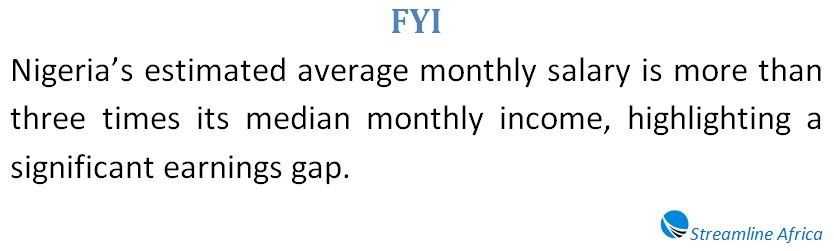
Available wage estimates place Nigeria’s average gross salary at approximately ₦339,000 per month, equivalent to about ₦4.068 million annually. However, the median monthly income is much lower, at roughly ₦100,000. This difference is important because the average is pushed upward by highly paid professionals, executives and workers receiving bonuses. The median often gives a more realistic indication of what a typical worker earns.
Nigeria’s statutory minimum wage is ₦70,000 per month, following the 2024 increase from ₦30,000. On an hourly basis, this is estimated at approximately ₦404. While the increase represented a major adjustment in cash terms, the wider question for employees and employers is how far these earnings stretch in an economy affected by high inflation and substantial regional differences in living costs.
Understanding Nigeria’s Salary Landscape
Nigeria’s labour market cannot be assessed accurately by looking only at employees of large companies in Lagos, Abuja or Port Harcourt. A substantial share of economic activity occurs outside conventional formal employment arrangements.
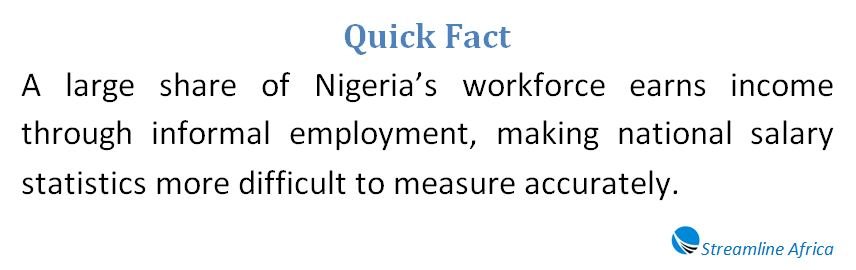
More than 60% of the workforce is estimated to participate in informal employment. This includes independent traders, small-scale farmers, transport operators, artisans, casual labourers and people working for microenterprises. Their incomes can fluctuate considerably and may not appear completely in conventional payroll-based salary statistics.
Consider two hypothetical workers. Chinedu works as a financial analyst for a medium-sized company in Abuja and receives a fixed monthly salary, pension contributions and performance-related benefits. Meanwhile, Amina operates a food-processing business in Kano and employs several casual workers whose earnings depend partly on production volumes. Both participate in Nigeria’s economy, but their income arrangements are fundamentally different.
Consequently, national salary averages should be treated as broad indicators rather than precise descriptions of what every Nigerian employee earns.
Average Salary Versus Median Income
The distinction between average and median earnings is particularly useful when analysing Nigeria.
The estimated average gross monthly salary of ₦339,000 translates to approximately ₦4,068,000 annually. Yet the median monthly income is around ₦100,000, or approximately ₦1.2 million annually. In simple terms, half of workers represented by the median measure earn below that level and half earn above it.
The large distance between these figures suggests considerable income inequality. Relatively high salaries in industries such as telecommunications, banking, energy, technology and specialised professional services can raise the national average considerably.
For example, a senior software engineer in Lagos may earn several times the income of a retail assistant in Ibadan or an agricultural worker outside Makurdi. Combining these employees into one national calculation produces an average that does not necessarily describe either worker’s economic circumstances.
For employers conducting compensation benchmarking, therefore, median salaries, occupational data and industry-specific benchmarks can be more informative than national averages alone.
Nigeria’s ₦70,000 Minimum Wage
Nigeria’s national minimum wage increased from ₦30,000 to ₦70,000 per month in 2024 after extended negotiations involving government, organised labour and other stakeholders. Based on standard working-hour assumptions, the current rate is equivalent to approximately ₦404 per hour and ₦840,000 annually.
The increase was substantial. Compared with the ₦18,000 monthly minimum introduced in 2011, the current rate represents nominal growth of approximately 289%.
The progression shows how minimum wages have periodically been adjusted to respond to changing economic conditions. Nigeria moved from ₦18,000 in 2011 to ₦30,000 in 2019 before adopting ₦70,000 in 2024.
Minimum wage reviews are expected to occur every three years rather than the previous five-year interval. Certain small employers with fewer than 25 workers are also exempt from the statutory requirement.
Implementation remains another consideration. Nigeria’s federal structure means that the practical application of wage adjustments can vary, particularly across state institutions and smaller organisations facing financial constraints.
Inflation Changes the Meaning of a Pay Increase
A large nominal salary increase does not automatically produce an equally large improvement in living standards.
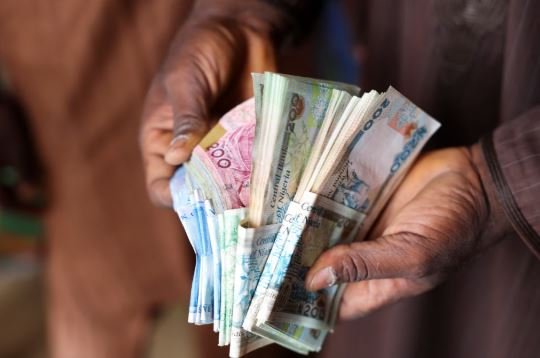
Nigeria experienced inflation above 30% during parts of 2024 and 2025. Rapid increases in food, transport, housing, electricity and other household expenses weakened the purchasing power of wages. As a result, workers receiving higher nominal salaries could still experience significant pressure on household budgets.
Imagine that Ngozi, an administrative employee in Enugu, receives a 25% salary increase. If her essential household expenses rise at a similar or faster rate, the additional naira may produce little improvement in her real standard of living.
This distinction between nominal and real wages is critical. Nominal wages describe the amount employees receive, while real wages reflect what that money can actually purchase.
For organisations designing compensation strategies, inflation therefore creates pressure to look beyond basic salary adjustments. Transport support, healthcare, meal allowances, performance incentives and other benefits can become increasingly important components of the overall employee value proposition.
What Nigeria’s Minimum Wage Can Actually Buy
Exchange-rate conversion provides one way of comparing wages internationally, but it does not tell the entire story.
At prevailing conversion assumptions, Nigeria’s ₦404 hourly minimum wage is roughly equivalent to $0.26 in nominal U.S. dollar terms. However, adjusting for differences in local prices produces an estimated purchasing-power equivalent of approximately $2.29 per hour in the United States.
Purchasing power parity attempts to answer a more practical question: how much locally available goods and services can a wage purchase?
This matters because identical dollar amounts can support very different lifestyles across countries. Housing, food, domestic transport and locally provided services may cost considerably less in one economy than another.
Even so, purchasing-power adjustments do not eliminate financial pressure. A worker earning ₦70,000 per month receives only about 21% of Nigeria’s estimated average gross monthly salary. This illustrates the substantial distance between the statutory wage floor and average formal-sector compensation.
Working Hours and Overtime Arrangements
Nigeria generally operates around a 40-hour standard working week, while the legal maximum is commonly cited at 48 hours.
Unlike jurisdictions where legislation automatically requires overtime to be paid at a fixed premium such as 1.5 times normal hourly earnings, Nigeria does not impose one universal statutory overtime multiplier applicable to every employment arrangement.
Overtime compensation is therefore often determined through employment contracts, collective agreements or workplace policies.
This makes clear contractual documentation particularly important. Employers should specify normal working hours, overtime eligibility, approval procedures and applicable compensation arrangements. Employees should similarly review these provisions rather than assuming that additional hours automatically attract a predetermined premium.
Salary Differences Across Nigeria
Location can significantly influence earnings.
Lagos remains the country’s largest commercial centre and contains major employers across financial services, technology, logistics, entertainment, telecommunications and professional services. Salaries for skilled employees may therefore be higher than in many smaller cities, although living expenses can also be considerably greater.
Abuja presents another distinctive labour market because of its concentration of government institutions, development organisations, diplomatic missions and professional services firms. Port Harcourt has historically benefited from energy-related employment, while cities such as Kano, Ibadan, Enugu and Kaduna have their own manufacturing, trading, agricultural and service-sector dynamics.
Consequently, a ₦250,000 monthly salary cannot be evaluated solely by its numerical value. Housing, transportation and other household expenses can determine whether the same income provides relatively comfortable or constrained living conditions in different locations.
Nigeria Compared With Other African Labour Markets
International comparisons place Nigeria toward the lower end of statutory minimum wages in Africa when measured using nominal U.S. dollar exchange rates.
Nigeria’s approximate $0.26 hourly equivalent is similar to levels reported in economies such as Madagascar and Ethiopia at about $0.27, the Democratic Republic of the Congo at approximately $0.31 and Uganda at around $0.21.
The estimated Nigerian average salary of about $220 per month is also below the cited African average of roughly $381.
However, these comparisons require caution. Exchange rates can move rapidly, while labour legislation, taxation, working hours and living expenses vary considerably between countries. A stronger dollar-equivalent wage does not automatically mean employees enjoy proportionately better living standards.
Purchasing power, inflation and the cost of essential goods should therefore accompany international salary comparisons.
What Employers Should Consider When Setting Pay
For businesses recruiting in Nigeria, statutory compliance should represent the starting point rather than the entire compensation strategy.
Companies competing for accountants, engineers, data professionals, sales specialists or experienced managers may need salaries substantially above the national minimum. Industry benchmarks, employee scarcity, geographic location, experience and organisational size can all influence market rates.
A manufacturing company recruiting a maintenance engineer in Ogun State, for example, may face different compensation expectations from a technology company hiring a cybersecurity specialist in Lagos.
Employers should also consider total rewards rather than salary alone. Pension contributions, medical insurance, transportation assistance, performance bonuses, flexible work arrangements, professional development and other benefits can influence both recruitment and retention.
What Nigeria’s Wage Figures Ultimately Reveal
Nigeria’s wage environment reflects a broader economic reality: headline salary numbers provide only part of the picture.
An estimated average annual salary of ₦4.068 million may initially suggest relatively strong earnings, yet the much lower median of about ₦1.2 million demonstrates how unevenly income is distributed. Similarly, the increase in the statutory minimum wage to ₦70,000 represented major nominal progress, but inflation has significantly reduced the improvement in real purchasing power.
Nigeria’s enormous informal economy further complicates salary measurement because millions of workers do not receive predictable monthly payroll income.
For employees, employers and investors, meaningful wage analysis should therefore combine minimum-wage requirements, median earnings, industry benchmarks, regional living costs, inflation and purchasing power.
Nigeria’s labour market is too diverse to be represented by one salary figure. The clearest understanding comes from examining not simply how much workers are paid, but where they work, what they do and, most importantly, what their earnings can actually buy.
Frequently Asked Questions about Nigeria’s Minimum Wage
What Is The Average Salary In Nigeria?
Nigeria’s estimated average gross salary is about ₦339,000 per month, or roughly ₦4.068 million per year. However, this figure is lifted by higher earners and does not reflect what most workers receive.
What Is The Median Salary In Nigeria?
The median monthly income is around ₦100,000, meaning half of workers earn less than this amount. For many readers, the median gives a more realistic picture of typical earnings than the national average.
What Is Nigeria’s Current Minimum Wage?
Nigeria’s statutory minimum wage is ₦70,000 per month. This replaced the previous ₦30,000 rate introduced in 2019.
Why Does The Minimum Wage Still Feel Low To Many Workers?
High inflation has reduced the real value of the wage increase. Even though the minimum wage rose sharply in nominal terms, higher prices for food, transport, housing and utilities have weakened purchasing power.
Why Is There Such A Large Gap Between Average And Median Income?
Higher salaries in sectors such as banking, telecommunications, energy, technology and professional services push the national average upward, while a large share of workers earn far less.
How Does Informal Employment Affect Salary Data?
A significant part of Nigeria’s workforce operates in informal employment, including trading, farming, transport and small businesses. Because these earnings are often irregular, national wage statistics can be difficult to measure precisely.
How Many Hours Do Employees Typically Work In Nigeria?
A standard working week is generally around 40 hours, while the legal maximum is commonly cited at 48 hours. Overtime arrangements are often determined by employment contracts or workplace policies.
Do Salaries Vary Significantly Across Nigerian Cities?
Yes. Workers in commercial centres such as Lagos, Abuja and Port Harcourt may earn more than those in smaller cities, but they may also face much higher housing, transport and everyday living costs.
How Does Nigeria’s Minimum Wage Compare With Other African Countries?
Nigeria sits toward the lower end of African statutory minimum wages when converted into U.S. dollars. However, exchange-rate comparisons should always be considered alongside purchasing power and local living costs.
What Should Employers Consider When Setting Salaries In Nigeria?
Employers should look beyond legal minimums and consider industry benchmarks, experience, skills scarcity, location, inflation and employee benefits. Competitive compensation often depends on the total rewards package rather than basic salary alone.