
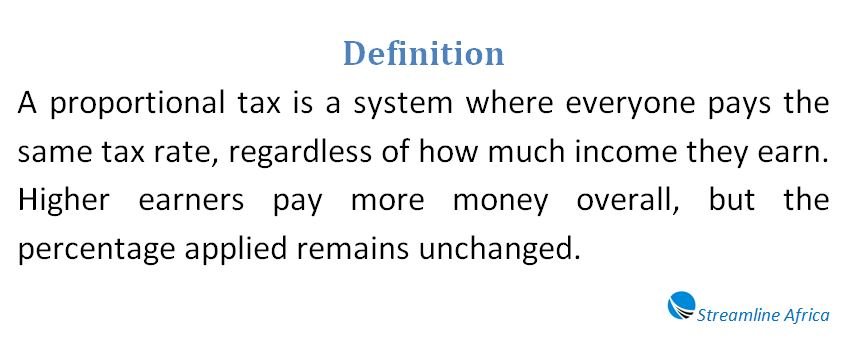
A proportional tax system applies a single tax rate to all taxpayers within the scope of the tax, regardless of differences in income. It is commonly referred to as a flat tax because the percentage charged does not increase as earnings rise. While taxpayers with higher incomes contribute more in absolute monetary terms, the proportion of income paid remains unchanged.
For students studying taxation, public finance, economics, or business administration, the most important feature to understand is the distinction between the tax rate and the amount of tax paid. If a proportional income tax is set at 12%, an individual earning $25,000 would pay $3,000, while another earning $100,000 would pay $12,000. The second taxpayer pays four times more tax because their income is four times larger, but both taxpayers face the same 12% rate.
This approach differs significantly from progressive taxation, where tax rates increase as taxable income moves into higher bands. It also differs from regressive taxation, where lower-income households may ultimately bear a larger tax burden relative to their financial resources.
How a Proportional Tax System Operates
The mechanics of proportional taxation are relatively straightforward. Tax authorities first determine the amount of income or transaction value that is subject to tax. The applicable flat rate is then multiplied by that taxable amount.
Consider a simplified economy where employment income is taxed at 15%. A graduate trainee earning $20,000 annually would owe $3,000. A senior manager earning $80,000 would owe $12,000, while an executive earning $200,000 would pay $30,000.
The calculation remains consistent across all income levels. This makes the system relatively easy for taxpayers, employers, accountants, and tax administrations to understand.
However, students should avoid assuming that every flat tax system is completely uniform. In practice, governments may introduce tax-free thresholds, personal allowances, business deductions, investment incentives, or credits. These provisions can reduce the effective rate paid by particular groups even when the official headline rate remains the same.
The design of these additional provisions is important because they determine how the tax system operates in practice rather than merely how it appears in legislation.
Why Governments May Consider Flat Tax Structures
One of the principal arguments supporting proportional taxation is administrative simplicity. Progressive tax systems frequently contain several income bands, marginal rates, exemptions, deductions, and special rules. A proportional system may reduce some of this complexity by applying one standard rate.
Simplification can potentially lower compliance costs for businesses and individuals. Employers may find payroll calculations easier, while taxpayers may have greater certainty about how additional income will be taxed. Tax authorities may also benefit from a clearer structure when administering assessments and communicating obligations.
Another frequently cited argument relates to economic incentives. Under a flat system, an individual who earns additional taxable income does not move into a higher statutory tax rate simply because their income has increased. Advocates argue that this feature may encourage employees to accept additional responsibilities, entrepreneurs to expand businesses, and investors to pursue profitable opportunities.
Nevertheless, tax policy decisions should not be assessed solely on administrative simplicity. Governments must also examine revenue requirements, income distribution, social policy objectives, and the overall effect on households.
Understanding the Debate About Tax Fairness
The concept of fairness is central to discussions about proportional taxation. Different approaches to fairness can lead to very different conclusions about whether a flat tax is desirable.
Supporters generally emphasise horizontal equality. Under this interpretation, taxpayers are treated consistently because the same percentage applies to everyone. A 10% rate remains 10% whether an individual earns $30,000 or $300,000.
Critics focus more heavily on the taxpayer’s ability to pay. They argue that equal percentages do not necessarily produce equal financial consequences.
For example, a student entering the workforce on a relatively modest salary may spend most of their income on accommodation, transportation, food, utilities, and other essential expenses. Losing 10% of that income to taxation may materially affect their living standard.
A wealthy taxpayer paying the same percentage could still retain substantial disposable income after meeting tax obligations and essential costs. Consequently, the statutory treatment may be identical even though the economic impact is very different.
This distinction helps explain why tax fairness is not simply a mathematical question. It also involves social, economic, and political judgments about how public expenditure should be financed.
Proportional Tax Compared With Progressive Tax
Progressive taxation applies increasing marginal rates as taxable income rises. Instead of taxing all income at a single percentage, a taxpayer’s earnings are divided into income bands.
Suppose a simplified progressive system charges 5% on the first $20,000, 10% on the next $30,000, and 20% on taxable income above $50,000. An employee earning $70,000 would not pay 20% on the entire amount. Only the income above the relevant threshold would be subject to the highest rate.
This distinction is particularly important for students because marginal tax systems are sometimes misunderstood. Moving into a higher tax bracket generally does not mean that all previous earnings are suddenly taxed at the higher percentage.
Progressive systems are closely associated with the ability-to-pay principle. Policymakers using this model generally assume that higher-income taxpayers can surrender a larger percentage of additional income while still maintaining a reasonable standard of living.
A proportional structure adopts a different philosophy. It places greater emphasis on rate consistency, predictability, and simplicity.
Proportional Tax and Regressive Tax Are Not the Same
Students should also distinguish proportional taxation from regressive taxation.
Under a proportional tax, the official rate remains constant as the tax base increases. Under a regressive arrangement, lower-income groups effectively bear a greater burden relative to their income than higher-income groups.
Consumption taxes help illustrate the complexity of this distinction. A sales tax may apply the same percentage to every customer purchasing a taxable item. At the point of sale, the tax therefore appears proportional because the rate does not change according to the customer’s salary.
However, lower-income households generally spend a larger proportion of their earnings on everyday consumption. As a result, sales taxes can have a regressive economic effect when measured against household income.
For this reason, many jurisdictions apply exemptions, reduced rates, or zero-rating to essential products such as selected food items, medicines, educational materials, or basic services. These measures are designed to reduce the burden on households with limited disposable income.
Key Advantages of Proportional Taxation
From a policy and advisory perspective, the strongest case for proportional taxation is its relative transparency. A single rate can make tax liabilities easier to estimate and communicate. Individuals entering employment may quickly understand how much of their taxable earnings will be payable to government.
Businesses may also benefit from more predictable calculations, particularly where payroll withholding and business tax obligations are linked to a straightforward rate.
A flat structure may reduce some opportunities for taxpayers to organise their affairs primarily to avoid moving into higher tax brackets. However, it would be misleading to suggest that one tax rate automatically eliminates tax avoidance. Avoidance and evasion are influenced by enforcement quality, administrative capacity, loopholes, exemptions, taxpayer behaviour, and the broader legal framework.
Proportional taxation may therefore support simplification, but effective tax administration remains essential.
Major Limitations and Policy Risks
The primary criticism of a flat tax relates to distributional impact. Without sufficient exemptions or allowances, lower-income households may experience significant pressure on disposable income.
Revenue adequacy is another important consideration. Governments depend on taxation to finance education, healthcare, infrastructure, security, public administration, and social programmes. If the proportional rate is set too low, the state may struggle to raise sufficient revenue. A very high rate, however, may discourage compliance, investment, or consumption.
Changes from progressive taxation to a flat structure can also alter how the total tax burden is distributed across society. If higher-income taxpayers receive substantial reductions, governments may need to compensate through spending cuts, borrowing, broader consumption taxes, or other revenue measures.
Students evaluating a tax reform should therefore look beyond the advertised tax rate. The wider fiscal consequences are equally important.
The Importance of Exemptions and Tax-Free Thresholds
A proportional tax can be modified to address concerns about affordability. One common approach is to exempt an initial portion of income from taxation.
For instance, a government could apply a 14% flat rate while allowing the first $15,000 of annual income to remain tax-free. This would provide greater protection to people on lower incomes while maintaining one principal rate above the threshold.
Tax credits can achieve a similar objective. Governments may also introduce deductions for dependants, approved retirement contributions, housing expenses, education costs, or other recognised expenditure.
These features demonstrate that the fairness of a tax system cannot be assessed solely by examining the headline percentage. The definition of taxable income and the available reliefs can substantially influence the final liability.
Assessing Proportional Tax From a Policy Perspective
For students analysing proportional taxation, the most useful approach is to evaluate the system against several policy objectives rather than simply deciding whether it is good or bad.
A strong tax framework should generally be understandable, administratively workable, capable of generating sufficient government revenue, supportive of economic activity, and reasonably equitable across different taxpayer groups.
There are trade-offs between these objectives. A simpler tax structure may improve compliance but provide less flexibility for redistributing income. A highly progressive system may achieve stronger redistribution but create additional administrative requirements.
The appropriate structure therefore depends on a country’s economic conditions, institutional capacity, spending commitments, labour market, inequality levels, and development priorities.
Conclusion
Proportional taxation is based on a clear principle: taxpayers face the same statutory rate irrespective of their income level. Higher earners contribute more money because they have a larger taxable base, but the percentage applied remains constant.
Its principal advantages include simplicity, predictability, transparency, and potentially lower administrative complexity. Its main weakness is that an equal percentage can have very different consequences for households with different financial capacities.
For students, the key lesson is that tax systems should not be assessed only by their headline rates. Exemptions, thresholds, credits, enforcement, government expenditure, and the distribution of income all influence whether a tax structure achieves its intended objectives.
A proportional tax can therefore be an efficient policy instrument in some circumstances, but its effectiveness ultimately depends on how it is designed and how well it fits within the wider economic and fiscal strategy of a country.
Proportional Tax – Frequently Asked Questions
Why is proportional tax also called a flat tax?
It is called a flat tax because one standard rate generally applies across the taxable income range rather than increasing as income rises.
How is proportional tax calculated?
Taxable income is multiplied by the applicable flat rate. For example, at a 10% rate, someone earning $40,000 would pay $4,000 in tax.
What is the main advantage of a proportional tax system?
Its biggest advantage is simplicity. Taxpayers can more easily estimate their liabilities, while governments and employers may face fewer complications when administering the tax.
Why do supporters believe flat taxes can encourage economic activity?
Supporters argue that people are not exposed to higher statutory tax rates when their earnings increase. This may encourage additional work, investment, entrepreneurship, and business expansion.
Why do critics question the fairness of proportional taxes?
Critics argue that the same percentage can affect households differently. A lower-income household may feel the loss of 10% of income much more severely than a high-income household.
How is proportional tax different from progressive tax?
A proportional system maintains the same rate across income levels, while a progressive system applies higher marginal rates as taxable income increases.
Is proportional tax the same as regressive tax?
No. A proportional tax applies a constant rate, while a regressive tax places a relatively heavier burden on lower-income taxpayers when measured against their income.
Can a flat tax include exemptions or allowances?
Yes. Governments can introduce tax-free thresholds, deductions, credits, or exemptions to reduce the burden on lower-income taxpayers while retaining a single main tax rate.
What should students consider when evaluating a proportional tax system?
Students should look beyond the headline rate and consider revenue generation, fairness, administrative efficiency, exemptions, household impact, economic incentives, and government spending needs.