

Understanding the Quality of Earnings Ratio
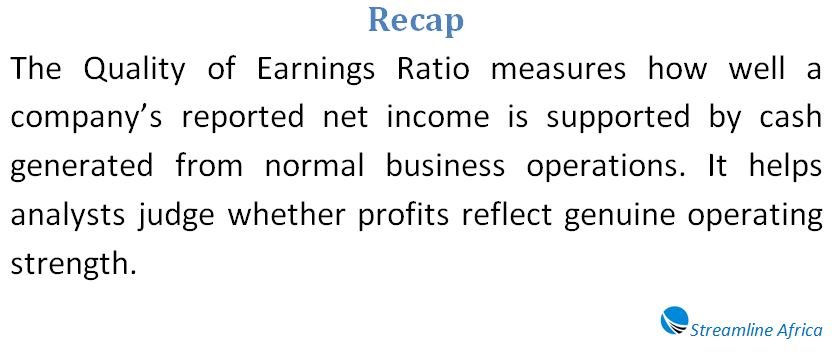
A company may report impressive profits, but those figures do not always reflect the amount of cash being generated through its normal business activities. The Quality of Earnings Ratio, commonly called the QoE ratio, helps analysts assess whether reported net income is strongly supported by operating cash flow.
The ratio is particularly useful when examining the credibility and sustainability of earnings. Investors, lenders, corporate finance teams, auditors, and acquisition advisers often use it as an initial screening tool when reviewing financial statements.
The central idea is straightforward: profits backed by cash are generally considered more dependable than profits created largely through accounting estimates, accruals, or one-off adjustments.
Because accounting profit and cash flow are calculated differently, comparing the two provides valuable insight into the economic substance of a company’s reported performance.
Why Reported Profit May Differ From Cash Generation
Financial statements prepared under accrual accounting recognize income and expenses when economic activity occurs rather than simply when cash changes hands. This approach provides a broader picture of business performance, but it can create significant differences between reported profit and actual cash movement.
For example, a company may record revenue after delivering goods to customers even though those customers have not yet paid. The sale increases net income, but cash remains outstanding as accounts receivable.
Similarly, expenses such as depreciation reduce accounting profit even though no cash leaves the business during the period in which the expense is recorded.
Management judgments can also influence earnings. Estimates relating to asset useful lives, provisions, inventory valuation, expected credit losses, revenue recognition, and impairment assessments may alter reported profit without creating an equivalent cash movement.
Consequently, net income should not always be interpreted as a direct measure of cash-generating ability.
How the Quality of Earnings Ratio Works
The QoE ratio compares cash generated from operating activities with net income reported on the income statement.
The formula is:
Quality of Earnings Ratio = Cash Flow from Operations ÷ Net Income
Cash flow from operations is reported in the operating section of the statement of cash flows. It generally begins with accounting profit and adjusts for non-cash expenses, non-operating items, and movements in working capital.
A simplified reconciliation may be expressed as:
Cash Flow from Operations = Net Income + Non-Cash Expenses ± Other Adjustments – Increase in Working Capital
Net income, meanwhile, represents the company’s remaining accounting profit after operating expenses, financing costs, taxes, and other recognized items have been reflected.
Comparing these figures allows analysts to see how closely reported earnings correspond with cash generated from the company’s underlying operations.
Interpreting a High Quality of Earnings Ratio
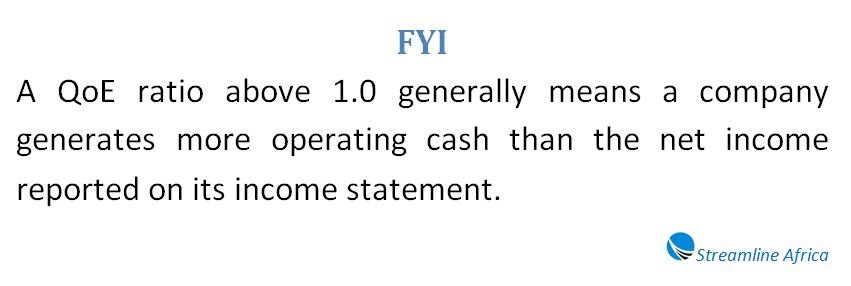
A QoE ratio above 1.0 generally means operating cash flow exceeds reported net income. This is usually interpreted positively because the company’s accounting profit is supported by an even larger amount of operating cash.
Consider a distribution company reporting net income of GHS 12 million while generating GHS 15 million in cash from operations.
Its QoE ratio would be:
GHS 15 million ÷ GHS 12 million = 1.25x
This result suggests that the company’s earnings are strongly backed by operating cash generation.
A ratio above 1.0 does not automatically prove that a business is financially healthy, but it may indicate conservative accounting, substantial non-cash expenses, favourable working-capital movements, or strong collection of customer balances.
Consistently strong cash conversion can improve confidence in financial forecasts because historical earnings appear more closely connected to actual business cash generation.
What a Low QoE Ratio May Indicate
A ratio below 1.0 means operating cash flow is lower than reported net income.
For instance, suppose a manufacturing business records GHS 20 million in net income but produces only GHS 11 million in operating cash flow.
Its QoE ratio would equal:
GHS 11 million ÷ GHS 20 million = 0.55x
This difference deserves further investigation.
One explanation could be rapidly increasing accounts receivable because customers are taking longer to pay. Another possibility is that the company has accumulated large inventories, consuming cash even though the related costs have not yet reduced earnings.
A low ratio may also arise from aggressive revenue recognition, unusual accruals, or management estimates that increase reported profit ahead of cash realization.
Therefore, a ratio below 1.0 should be viewed as an analytical warning signal rather than automatic evidence of manipulation.
Adjustments That Can Affect Earnings Quality
Several accounting items can create differences between net income and cash flow.
Depreciation and amortization are common examples. These expenses reduce accounting earnings but do not normally require a current-period cash payment. They are therefore added back when operating cash flow is calculated using the indirect method.
Changes in working capital can also have a substantial effect. Rising receivables generally reduce operating cash flow because revenue has been recognized without corresponding customer payments. Increasing inventory can similarly consume cash.
Non-recurring expenses may also distort comparisons. Asset write-downs, impairment charges, restructuring expenses, and losses on asset disposals may lower net income without producing equivalent operating cash outflows during the reporting period.
Analysts therefore need to understand the composition of both earnings and cash flow rather than relying entirely on the ratio itself.
Practical Quality of Earnings Calculation
Assume Meridian Foods Ltd. reports the following figures for its latest financial year:
Net income is GHS 40 million. Depreciation and amortization amount to GHS 7 million. Net working capital increases by GHS 3 million. The company records a GHS 5 million impairment charge and recognizes a GHS 1 million loss on the disposal of equipment.
To estimate operating cash flow, the non-cash expenses are added back while the increase in working capital is deducted.
Cash Flow from Operations = GHS 40 million + GHS 7 million – GHS 3 million + GHS 5 million + GHS 1 million
Cash Flow from Operations = GHS 50 million
The QoE ratio therefore becomes:
GHS 50 million ÷ GHS 40 million = 1.25x
This indicates that Meridian Foods generated GHS 1.25 of operating cash for every GHS 1.00 of reported net income.
The result suggests relatively strong earnings quality, although analysts would still need to investigate whether the adjustments are sustainable.
Why Quality of Earnings Matters in Financial Analysis
The QoE ratio is particularly relevant during investment analysis, credit assessment, business valuation, and mergers and acquisitions.
Lenders may examine earnings quality when assessing whether a borrower generates enough real operating cash to service debt. Investors may use the measure when determining whether reported profitability is sustainable.
During acquisitions, advisers frequently conduct more detailed quality-of-earnings reviews to determine whether historical profits accurately represent the company’s normalized earning capacity.
Such reviews can identify unusual transactions, aggressive accounting practices, customer concentration, working-capital abnormalities, non-recurring expenses, and other factors that may affect valuation.
The ratio therefore acts more as an analytical starting point than a complete due-diligence process.
Limitations of the Quality of Earnings Ratio
No single QoE threshold should be applied to every business.
Seasonal companies may experience large working-capital changes during particular reporting periods. Fast-growing businesses may also produce weaker operating cash flow because they are investing heavily in inventory and customer acquisition.
Different industries naturally exhibit different cash-conversion patterns. Comparing a supermarket with a construction company, for example, may provide little meaningful information because their collection cycles and working-capital requirements differ substantially.
Analysts should therefore examine several years of results and compare businesses operating under similar commercial conditions.
Temporary movements should also be separated from recurring patterns.
Using the QoE Ratio Effectively
The Quality of Earnings Ratio provides a useful way to test whether accounting profit is being converted into operating cash.
A ratio above 1.0 usually suggests stronger cash support for reported income, while a ratio below 1.0 may justify deeper analysis of receivables, inventories, accruals, revenue recognition, or other accounting adjustments.
However, the ratio should never be interpreted alone.
The strongest analysis combines QoE with cash-flow trends, working-capital ratios, margins, leverage measures, accounting policies, and industry comparisons.
Ultimately, high-quality earnings are not simply profits that appear attractive on an income statement. They are profits supported by sustainable operations, reasonable accounting assumptions, and consistent cash generation.
Frequently Asked Questions
How Is the Quality of Earnings Ratio Calculated?
The formula is:
Quality of Earnings Ratio = Cash Flow from Operations ÷ Net Income
It compares operating cash flow from the cash flow statement with net income from the income statement.
What Does a QoE Ratio Above 1.0 Mean?
A ratio above 1.0 generally suggests stronger earnings quality because operating cash flow exceeds reported net income. This indicates that accounting profits are well supported by actual cash generation.
What Does a QoE Ratio Below 1.0 Suggest?
A ratio below 1.0 means the company is generating less operating cash than its reported profit. This may result from rising receivables, inventory buildup, aggressive revenue recognition, or other accounting adjustments.
Why Can Net Income Differ From Operating Cash Flow?
Net income follows accrual accounting, meaning revenue and expenses may be recorded before cash is received or paid. Non-cash expenses such as depreciation and changes in working capital can therefore create differences between profit and cash flow.
Why Is Earnings Quality Important to Investors and Lenders?
High-quality earnings can make financial performance more dependable. Investors use earnings quality when evaluating profitability and valuation, while lenders may examine it when assessing whether a company can generate sufficient cash to repay debt.
Is a High Quality of Earnings Ratio Always Good?
Not necessarily. A high ratio may result from temporary working-capital movements or unusually large non-cash expenses. Analysts should examine the reasons behind the ratio instead of relying on the number alone.
What Is the Best Way to Use the QoE Ratio?
The ratio is most useful when reviewed across several years and alongside other financial measures. Analysts should combine it with working-capital trends, profitability ratios, leverage measures, accounting policies, and industry comparisons.