
Understanding the Retention Ratio
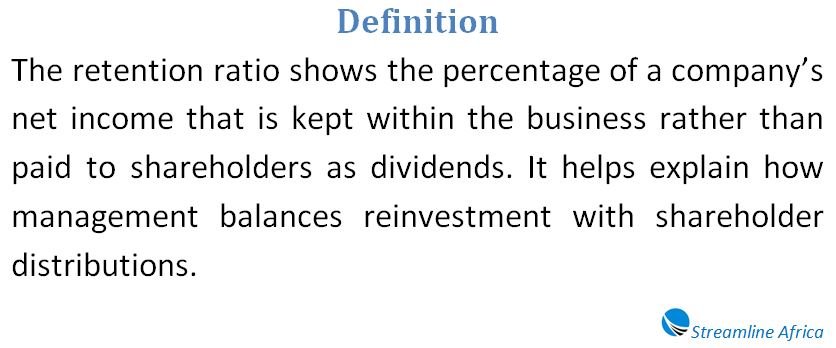
The retention ratio is a corporate finance metric that measures the proportion of net income a company retains after distributing dividends to shareholders. It provides insight into how management allocates earnings between immediate shareholder returns and reinvestment in the business.
The ratio is particularly relevant when assessing dividend policy, internal financing capacity, and long-term growth strategy. A company that retains a significant share of its earnings may be preparing to fund expansion, strengthen its balance sheet, invest in productive assets, reduce debt, pursue acquisitions, or support other strategic initiatives.
Conversely, a lower retention ratio generally indicates that a larger proportion of profits is being returned to shareholders through dividends. This approach may be more common among mature businesses with stable cash flows and limited requirements for incremental investment.
Accordingly, the retention ratio should be interpreted as part of a broader assessment of how effectively management deploys capital.
How Earnings Retention Supports Corporate Strategy
Once a company generates positive net income, management must determine how those earnings should be allocated. The decision normally involves balancing two competing priorities: reinvesting in the enterprise and distributing returns to shareholders.
Retained earnings can provide an important source of internal financing. Instead of raising additional debt or issuing new shares, a company can use accumulated profits to finance capital expenditure, product development, technology upgrades, market expansion, recruitment, acquisitions, or working capital requirements.
This approach can be particularly advantageous where management identifies investment opportunities capable of generating attractive returns.
However, retaining earnings does not automatically create shareholder value. The financial benefit ultimately depends on whether the company can reinvest those funds at returns that justify withholding additional dividend distributions.
Retention Ratio Formula
The retention ratio is calculated by subtracting dividends from net income and dividing the remaining earnings by net income.
Retention Ratio = (Net Income − Dividends) ÷ Net Income
The resulting percentage represents the share of annual earnings that remains within the company.
For example, assume Meridian Consumer Products reports net income of GH¢10 million and distributes GH¢3 million in dividends. The company retains GH¢7 million.
Its retention ratio is therefore:
Retention Ratio = GH¢7 million ÷ GH¢10 million = 70%
The result indicates that Meridian Consumer Products retains 70% of its earnings and distributes the remaining 30% to shareholders.
Relationship With the Dividend Payout Ratio
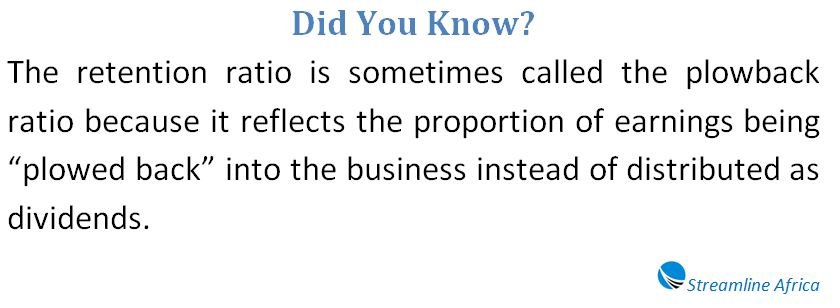
The retention ratio is directly related to the dividend payout ratio. Whereas the retention ratio measures the portion of earnings preserved within the company, the payout ratio measures the portion distributed as dividends.
The relationship can be expressed as:
Retention Ratio = 1 − Dividend Payout Ratio
Using the previous example, a 30% payout ratio corresponds to a 70% retention ratio.
This relationship is useful in financial modelling because companies often disclose dividend policies or target payout ranges more explicitly than earnings retention targets. Analysts can therefore derive the expected retention ratio directly from dividend assumptions.
In normal circumstances, the retention ratio and dividend payout ratio should collectively equal 100%.

Illustrative Retention Ratio Analysis
Consider Atlas Manufacturing Ghana Ltd., which reports annual net income of GH¢25 million and declares dividends of GH¢5 million.
The company therefore retains GH¢20 million.
Its dividend payout ratio is:
GH¢5 million ÷ GH¢25 million = 20%
The corresponding retention ratio is:
GH¢20 million ÷ GH¢25 million = 80%
An 80% retention ratio indicates that management is preserving a significant proportion of earnings for internal use.
From an analytical perspective, however, the percentage alone does not determine whether the policy is appropriate. Further assessment is required to understand how management intends to deploy the GH¢20 million and whether those investments are expected to generate acceptable returns.
A high retention ratio can therefore be attractive when supported by credible growth opportunities, but less compelling when the company lacks productive uses for excess capital.
Forecasting Retained Earnings
Retention assumptions are frequently incorporated into financial forecasting and valuation models.
The retained earnings balance can generally be projected using the following relationship:
Ending Retained Earnings = Beginning Retained Earnings + Net Income − Dividends
Assume a company expects net income of GH¢40 million next year and maintains a dividend payout ratio of 25%. The corresponding retention ratio would be 75%, meaning GH¢30 million of earnings would remain within the business.
If net income increases to GH¢45 million in the following year but the dividend payout ratio rises to 50%, retained earnings generated during that period would decline to GH¢22.5 million.
This demonstrates that growth in net income does not necessarily result in higher retained earnings. Changes in dividend policy can materially affect the amount of profit preserved within the company.
Key Factors Influencing the Retention Ratio
A company’s retention ratio is influenced by several strategic and financial considerations, including its stage of development, investment requirements, capital structure, cash generation, and industry characteristics.
Growth-oriented businesses often maintain relatively high retention ratios because they require substantial capital to support expansion. Funds may be allocated toward new facilities, technology, additional employees, sales capabilities, product development, distribution infrastructure, or entry into new geographical markets.
Established companies may retain a smaller proportion of earnings where operating cash flows are stable and reinvestment opportunities are limited. In such circumstances, shareholders may place greater value on predictable dividend distributions.
Nevertheless, company maturity should not be viewed as the sole determinant of retention policy.
Why Mature Companies May Retain Significant Earnings
Mature businesses can maintain high retention ratios for several legitimate reasons.
Capital-intensive companies, particularly those operating in sectors such as energy, telecommunications, manufacturing, mining, transportation, and infrastructure, may require substantial reinvestment merely to maintain existing operating capacity.
Other companies may preserve earnings to finance mergers and acquisitions. A business pursuing inorganic growth may prefer to accumulate cash for the acquisition of competitors, suppliers, technologies, or complementary businesses.
Companies exposed to cyclical markets may also retain additional profits during stronger periods to strengthen financial resilience. Maintaining larger internal reserves can provide protection during periods of lower demand, reduced commodity prices, economic contraction, or unexpected operational disruption.
The appropriate retention ratio should therefore be assessed within the specific commercial and industry context of the company.
Assessing What Constitutes an Appropriate Retention Ratio
There is no universally optimal retention ratio.
A high-growth company may reasonably retain most of its earnings if management can deploy capital into opportunities that generate attractive returns. By contrast, a highly mature company with limited investment opportunities may be better positioned to distribute a larger proportion of profits to shareholders.
The central analytical issue is therefore not simply how much profit is retained, but whether retained capital is being used efficiently.
This assessment can be strengthened by examining complementary performance measures such as return on invested capital, return on equity, and return on assets.
For example, a company that consistently retains 85% of its earnings but produces declining returns on invested capital may be allocating capital inefficiently. Shareholders could potentially receive greater value if a larger portion of those earnings were distributed.
Alternatively, a company with a high retention ratio and consistently strong returns on incremental investments may have a compelling case for continuing to reinvest profits.
Strategic Interpretation of the Retention Ratio
From a corporate finance perspective, the retention ratio provides useful insight into management’s capital allocation priorities. It can indicate whether a company is emphasizing internal reinvestment, liquidity preservation, balance sheet strengthening, acquisitions, or shareholder distributions.
Nevertheless, the metric should not be interpreted independently.
A comprehensive assessment should consider the company’s growth prospects, competitive environment, investment pipeline, capital expenditure requirements, financial leverage, dividend history, industry structure, cash generation, and returns on capital.
A high retention ratio should therefore not automatically be interpreted as evidence of superior growth potential, just as a low ratio should not automatically indicate weak prospects.
Ultimately, the effectiveness of an earnings retention strategy depends on management’s ability to convert retained profits into sustainable operating performance, stronger cash flows, and long-term shareholder value.
FAQs
How is the retention ratio calculated?
The formula is:
Retention Ratio = (Net Income − Dividends) ÷ Net Income
It can also be calculated as:
Retention Ratio = 1 − Dividend Payout Ratio
Why is the retention ratio important?
The ratio helps investors and analysts understand how much profit a company is retaining to support growth, capital expenditure, acquisitions, debt reduction, working capital, or other strategic priorities.
What does a high retention ratio indicate?
A high retention ratio usually means the company is keeping a large portion of its earnings for reinvestment. This can be positive when management has attractive projects capable of generating strong returns.
Is a low retention ratio necessarily a bad sign?
No. A low retention ratio may simply reflect a mature and financially stable company that has fewer reinvestment needs and therefore returns more profits to shareholders through dividends.
How does the retention ratio relate to the dividend payout ratio?
The two ratios are opposites. If a company pays out 35% of earnings as dividends, it retains the remaining 65%. Together, the retention ratio and dividend payout ratio generally equal 100%.
What factors influence a company’s retention ratio?
Key factors include growth opportunities, capital expenditure requirements, industry conditions, cash flow stability, acquisition plans, debt levels, economic cycles, and management’s broader capital allocation strategy.
Can mature companies have high retention ratios?
Yes. Mature companies may still retain substantial earnings if they operate in capital-intensive industries, pursue acquisitions, need to strengthen liquidity, or want to maintain financial reserves against future downturns.
What is considered a good retention ratio?
There is no single ideal percentage. A good retention ratio is one that supports value creation. Analysts should therefore consider whether retained profits are generating strong returns through measures such as ROIC, ROE, and ROA.