
Businesses around the world invest enormous amounts of money in marketing every year. Whether through digital advertising, social media promotions, television campaigns, sponsorships, email marketing, or influencer partnerships, organizations continually seek ways to attract customers and strengthen their brands. Global marketing expenditures now reach into the trillions of dollars annually, making advertising one of the most significant business expenses across industries.
For executives, shareholders, and analysts, an important question remains: Is that spending generating meaningful returns? While marketing is often viewed as essential for business growth, its financial impact can be difficult to quantify. This challenge has led to the growing importance of Return on Marketing Investment, commonly known as ROMI.
ROMI serves as a financial measurement that connects marketing activities with business outcomes. It helps organizations determine whether their promotional efforts are creating value and provides investors with insights into how efficiently management allocates marketing resources. By understanding ROMI, investors gain a clearer picture of a company’s operational effectiveness, growth potential, and competitive strength.
What Is Return on Marketing Investment?
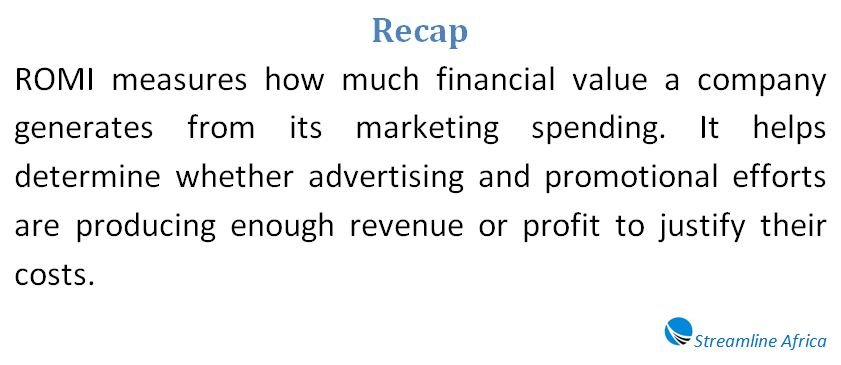
Return on Marketing Investment is a performance indicator used to evaluate the financial benefits generated by marketing expenditures. It measures the return received from marketing activities relative to the amount spent on those activities.
In simple terms, ROMI answers a practical business question: How much value does a company receive for every dollar invested in marketing?
Unlike traditional marketing assessments that focus solely on engagement metrics such as clicks, impressions, or social media interactions, ROMI emphasizes financial outcomes. It links marketing initiatives directly to revenue generation, profitability, and business growth.
The concept gained popularity as companies demanded greater accountability from marketing departments. Historically, marketing expenses were often viewed as unavoidable overhead costs. Over time, businesses began applying investment principles to marketing decisions, requiring evidence that promotional spending was contributing to measurable financial results.
Today, ROMI has become a key metric for organizations seeking to optimize marketing strategies and improve resource allocation.
Why Investors Should Pay Attention to ROMI
Although ROMI is commonly used by marketing professionals, it is equally valuable for investors. Understanding how effectively a company converts marketing spending into revenue can reveal important information about management quality and long-term business prospects.
Companies with strong marketing returns typically demonstrate an ability to attract customers efficiently and strengthen brand recognition without excessive spending. Such businesses often enjoy healthier margins and stronger competitive positions.
Conversely, companies that continually increase marketing budgets without producing proportional revenue growth may be experiencing strategic weaknesses, declining brand relevance, or operational inefficiencies.
For investors, ROMI serves as an indirect indicator of management effectiveness. It highlights whether leadership teams are deploying capital wisely and generating sustainable value from discretionary spending.

Understanding the Basic ROMI Formula
The calculation of Return on Marketing Investment is relatively straightforward. The goal is to compare the financial benefits generated by marketing efforts against the costs incurred.
The standard formula is:
ROMI = (Revenue Generated by Marketing – Marketing Cost) ÷ Marketing Cost
The resulting figure is typically expressed as either a percentage or a ratio.
For example, suppose a company spends $500,000 on a marketing initiative that generates an additional $1.5 million in revenue. The net gain attributable to the campaign is $1 million. Dividing that gain by the original marketing investment produces a ROMI of 200%.
This means that for every dollar invested, the company generated two dollars of additional return beyond recovering its initial expense.
Revenue-Based vs. Profit-Based ROMI
Although the basic formula appears simple, organizations often use different versions depending on their objectives.
Some companies calculate ROMI using revenue figures because sales data is readily available and easy to track. However, revenue alone may not accurately reflect profitability.
A more refined approach uses gross profit instead of revenue. By accounting for production costs and other direct expenses, profit-based ROMI provides a clearer picture of actual value creation.
Other organizations go even further by incorporating contribution margins, operating profits, or customer lifetime value into their calculations. Each method offers unique insights and may be more suitable depending on the business model.
Investors should therefore understand the methodology behind reported ROMI figures before drawing conclusions about performance.
The Attribution Challenge
One of the most complex aspects of ROMI analysis is determining which marketing activities deserve credit for a sale.
Modern consumers often interact with brands through multiple channels before making a purchase. A customer might first discover a company through a social media advertisement, later visit its website through a search engine, subscribe to an email newsletter, and finally make a purchase after receiving a promotional offer.
In such situations, assigning revenue to a single marketing touchpoint becomes difficult.
This process, known as attribution, is one of the most debated areas in marketing analytics.
Several attribution models are commonly used. First-touch attribution assigns full credit to the initial interaction that introduced the customer to the brand. Last-touch attribution gives credit to the final interaction before the purchase. Multi-touch attribution distributes value across multiple customer interactions throughout the buying journey.
More advanced organizations employ statistical modeling, controlled experiments, and machine-learning techniques to estimate the true impact of various marketing efforts.
When evaluating a company’s ROMI claims, investors should consider whether its attribution methods are transparent, logical, and consistently applied.
Different Approaches to ROMI Analysis
ROMI can be evaluated at various levels depending on the information a company seeks to uncover.
Campaign-Level Analysis
Campaign-level ROMI focuses on individual marketing initiatives. This may include a product launch campaign, seasonal promotion, influencer partnership, or advertising event.
By examining specific campaigns separately, companies can identify which efforts generate the strongest returns and which fail to meet expectations.
This level of analysis is especially useful for optimizing future marketing decisions and eliminating ineffective tactics.
Channel-Level Analysis
Channel-level ROMI evaluates the effectiveness of broader marketing categories such as search advertising, social media marketing, television advertising, email campaigns, or content marketing.
Comparing returns across channels enables businesses to shift resources toward the most productive platforms while reducing investments in underperforming areas.
This approach helps organizations improve budget allocation and maximize overall marketing efficiency.
Company-Wide ROMI
The broadest form of analysis examines the return generated by the entire marketing function.
For investors, this is often the most relevant perspective because it reveals whether the company’s total marketing spending contributes meaningfully to business growth and profitability.
Comparing overall marketing effectiveness across industry competitors can provide valuable insight into relative performance and competitive advantage.
ROMI as an Indicator of Brand Strength
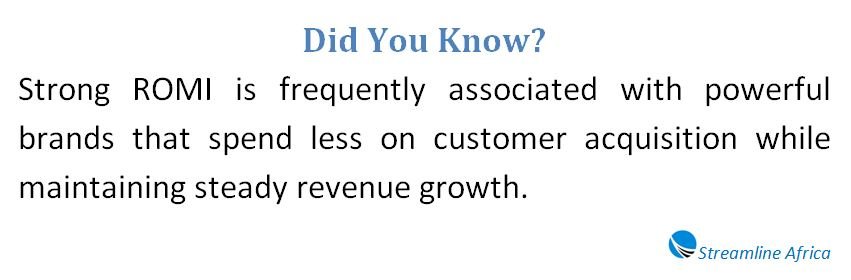
Strong brands often achieve higher marketing efficiency because they require less promotional spending to attract customers.
When consumers already recognize and trust a brand, the company can generate sales with lower acquisition costs. Existing reputation, customer loyalty, and word-of-mouth recommendations help drive demand without requiring excessive advertising expenditure.
As a result, businesses with consistently high ROMI frequently possess significant brand equity and pricing power.
On the other hand, companies that must continually increase promotional spending simply to maintain sales volumes may be facing weakening brand influence or intensifying competition.
For investors, ROMI can therefore serve as an indirect measure of brand health and market positioning.
Assessing Management Discipline Through ROMI
Marketing budgets often represent one of the largest discretionary expenses within a company’s income statement.
Because management has considerable flexibility over how these funds are spent, marketing efficiency can reveal much about leadership quality.
Executives who consistently generate strong returns from marketing investments demonstrate disciplined decision-making and effective resource management. They understand customer behavior, allocate budgets strategically, and focus spending where it delivers the greatest impact.
Monitoring ROMI trends over several years can help investors determine whether management’s effectiveness is improving or deteriorating.
A rising ROMI often signals better operational execution, while a declining trend may suggest inefficient spending or strategic missteps.
ROMI and Future Growth Potential
Marketing efficiency is closely tied to a company’s ability to expand profitably.
When marketing investments consistently produce strong returns, management can scale spending with confidence, knowing that additional investment is likely to generate meaningful revenue growth.
This creates a powerful growth engine capable of supporting expansion into new markets, customer segments, or product categories.
Weak ROMI, however, may indicate diminishing returns. In such cases, achieving future growth could require increasingly large marketing expenditures, potentially compressing margins and reducing profitability.
Investors seeking sustainable growth opportunities often favor businesses capable of generating strong revenue expansion without proportionally increasing marketing costs.
Using ROMI to Compare Industry Competitors
ROMI becomes especially useful when evaluating companies operating within the same sector.
Two businesses may report similar sales growth, but their marketing efficiency can differ significantly. If one company achieves comparable results while spending substantially less on marketing, it may possess superior brand recognition, stronger customer loyalty, or more effective management practices.
Industry comparisons can help investors identify companies with structural advantages and more sustainable business models.
However, comparisons should always be made within similar industries because marketing requirements vary greatly across sectors. Consumer goods companies, software providers, retailers, and luxury brands often operate under very different marketing dynamics.
Limitations of ROMI
Despite its usefulness, ROMI is not a perfect measurement.
Many marketing activities produce benefits that unfold gradually over years rather than months. Brand-building campaigns, sponsorships, and reputation-enhancing initiatives often generate long-term value that cannot be fully captured through short-term calculations.
Attribution challenges can also distort results. Different measurement approaches may produce vastly different conclusions regarding campaign effectiveness.
Furthermore, companies may selectively define marketing costs or attribution models to present stronger performance figures.
Because of these limitations, investors should avoid relying exclusively on ROMI. Instead, it should be used alongside broader evaluations of profitability, competitive positioning, financial health, and business quality.
Practical Ways Investors Can Estimate ROMI
Since most companies do not disclose ROMI directly, investors often need to estimate marketing efficiency using publicly available information.
One useful method is comparing revenue growth and gross profit growth with increases in marketing expenses over time. If revenue and profits are growing faster than marketing spending, the company is likely generating favorable returns from its promotional investments.
Another approach involves monitoring the ratio of marketing expenses to revenue. A declining ratio may indicate improving efficiency, while a rising ratio could suggest growing competitive pressures or weakening customer demand.
Annual reports, earnings call transcripts, and investor presentations can also provide valuable insights into marketing strategies and performance trends.
Conclusion
Return on Marketing Investment offers a valuable framework for understanding how effectively a company transforms marketing expenditures into financial results. By linking promotional activities to revenue generation and profitability, ROMI provides investors with deeper insight into management quality, operational efficiency, and competitive advantage.
Although no single metric can fully capture business performance, ROMI helps reveal whether a company is creating lasting value through its marketing efforts or simply spending heavily without meaningful returns. Investors who incorporate ROMI into their analytical toolkit can better identify organizations with strong brands, disciplined leadership, and scalable growth potential.
When combined with traditional financial analysis, valuation metrics, and industry comparisons, ROMI becomes a powerful tool for making more informed and confident investment decisions.
Frequently Asked Questions
Why Is ROMI Important for Investors?
ROMI gives investors insight into how efficiently a company uses its marketing budget. Strong ROMI often indicates effective management, efficient customer acquisition, and a competitive advantage in the marketplace.
How Is ROMI Calculated?
ROMI is calculated by subtracting marketing costs from the revenue or profit generated by marketing activities and then dividing the result by the marketing cost. The outcome is usually expressed as a percentage.
What Is Considered a Good ROMI?
There is no universal benchmark for a good ROMI. The ideal figure depends on the industry, business model, and marketing objectives. Generally, a positive and improving ROMI is a favorable sign.
Why Is Attribution a Major Challenge in ROMI?
Customers often interact with multiple marketing channels before making a purchase. Determining which advertisement, email, or campaign actually influenced the sale can be difficult, making accurate attribution one of the biggest challenges in ROMI analysis.
How Can ROMI Reveal Brand Strength?
Companies with strong brands usually need less marketing spending to generate sales. High ROMI often suggests strong brand recognition, customer loyalty, and pricing power.
Can ROMI Help Predict Future Growth?
Yes. A company that consistently earns strong returns from marketing investments often has a scalable growth model. Efficient marketing allows the business to expand revenue without dramatically increasing costs.
What Are the Main Limitations of ROMI?
ROMI may not fully capture the long-term benefits of brand-building campaigns. Different attribution methods can also produce different results, making comparisons difficult if measurement approaches are inconsistent.
How Can Investors Estimate ROMI if Companies Don’t Report It?
Investors can compare trends in revenue growth, gross profit growth, and marketing expenses. If sales and profits are rising faster than marketing costs, it often signals improving marketing efficiency.