
South Africa’s National Minimum Wage (NMW) establishes the legal minimum that covered workers should receive for each ordinary hour worked. Introduced under the National Minimum Wage Act, the framework became effective on 1 January 2019 at R20.00 per hour for the general workforce.
The rate is reviewed regularly, meaning employers should pay attention not only to the current minimum but also to the effective date of each amendment. Sector-specific wage schedules may additionally prescribe different or higher rates for particular occupations.
Current National Minimum Wage in South Africa
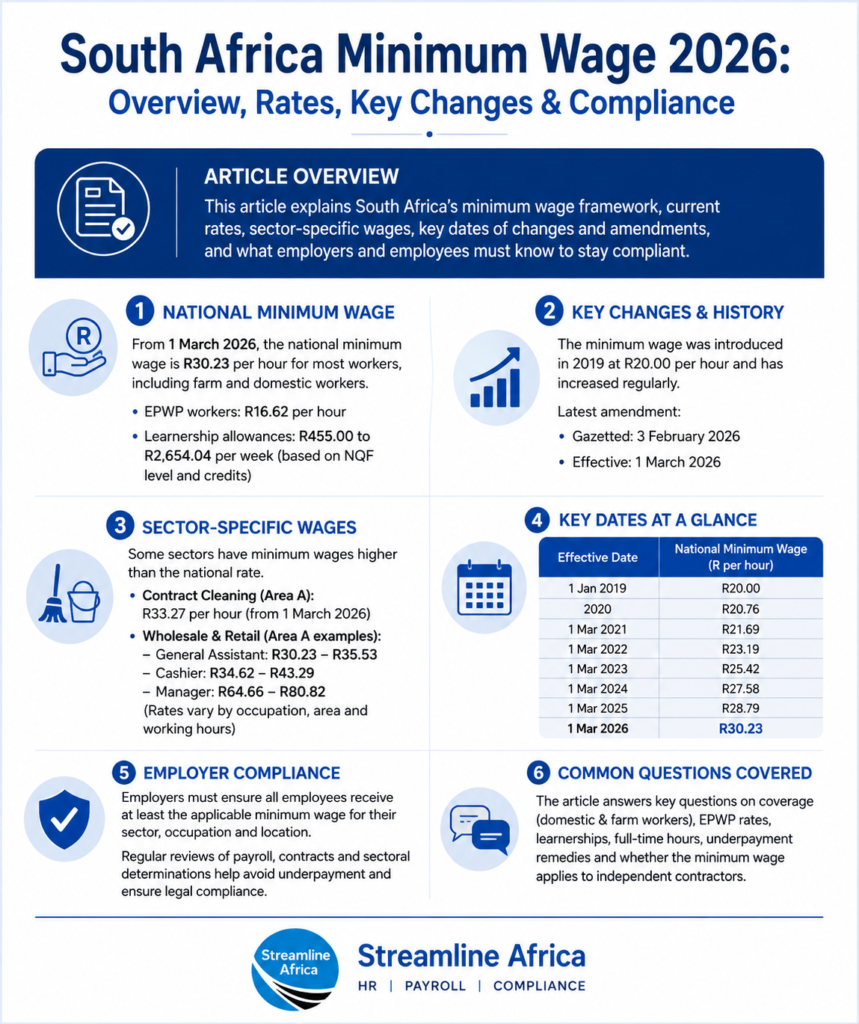
The current national minimum wage is R30.23 per ordinary hour worked, effective from 1 March 2026. It replaced the previous R28.79 hourly rate. The 2026 amendment was published in the Government Gazette on 3 February 2026 and became binding from the beginning of March.
Farm workers and domestic workers are also entitled to at least R30.23 per hour. These categories have been aligned with the general national minimum wage since 2022.
Workers employed through the Expanded Public Works Programme (EPWP) are subject to a special rate of R16.62 per hour from 1 March 2026.
Learners covered by qualifying registered learnership agreements receive prescribed weekly allowances rather than the ordinary NMW structure. Under the 2026 schedule, minimum weekly allowances range from R455.00 to R2,654.04, depending on the learner’s NQF level and credits already earned.
Key Minimum Wage Changes Since 2019
South Africa’s wage floor has increased substantially since the NMW framework was introduced.
On 1 January 2019, the general national minimum wage began at R20.00 per hour. At that time, separate lower rates applied to farm workers at R18.00, domestic workers at R15.00 and public works programme workers at R11.00 per hour.
The general rate subsequently increased to R20.76 per hour in 2020 and R21.69 in 2021. From 1 March 2022, it rose to R23.19 per hour, with domestic and farm workers becoming fully aligned with the national rate.
Further adjustments increased the minimum to R25.42 from 1 March 2023 and R27.58 from 1 March 2024.
From 1 March 2025, the rate increased by 4.2% to R28.79 per hour.
The latest amendment raised the rate by R1.44 to R30.23 per hour from 1 March 2026.
For reference, the progression is:
| Effective Date | General Minimum Wage |
|---|---|
| 1 January 2019 | R20.00/hour |
| 2020 | R20.76/hour |
| 1 March 2021 | R21.69/hour |
| 1 March 2022 | R23.19/hour |
| 1 March 2023 | R25.42/hour |
| 1 March 2024 | R27.58/hour |
| 1 March 2025 | R28.79/hour |
| 1 March 2026 | R30.23/hour |
This history is useful for payroll audits, employee claims and reviewing remuneration over earlier employment periods.
Contract Cleaning Sector Rates
Employers in contract cleaning must also consider the applicable sectoral wage determination. The 2026 amendment contains revised rates covering Areas A, B and C.
For example, the minimum for qualifying Area A contract-cleaning employees is R33.27 per hour from 1 March 2026. Because this exceeds the general R30.23 national minimum, employers must identify the applicable sector and geographical classification rather than automatically using the national rate.
Weekly and monthly equivalents should also be calculated according to the working-hour arrangements applicable to the sector.
Wholesale and Retail Sector Rates
The wholesale and retail sector has more detailed wage schedules covering different occupations and geographical areas.
From 1 March 2026, Area A rates include approximately R30.23 to R35.53 per hour for general assistants, R34.62 to R43.29 for cashiers and R64.66 to R80.82 for managers, depending on the applicable working-hour and occupational classification.
Employers should therefore determine an employee’s occupation, geographical area and working arrangement before selecting the appropriate statutory minimum.

Why Effective Dates Matter
Minimum wage amendments do not generally operate retrospectively simply because a new rate has been announced. Employers need to identify the rate legally applicable during the particular pay period.
For example, the R28.79 rate applied from 1 March 2025 until the 2026 adjustment became effective. The R30.23 rate became binding from 1 March 2026.
Maintaining a historical wage record is therefore particularly useful when conducting payroll audits, investigating underpayment claims or calculating outstanding remuneration.
Common Questions About South Africa’s Minimum Wage
What is the current minimum wage in South Africa?
The national minimum wage is R30.23 per ordinary hour worked from 1 March 2026.
When was the latest minimum wage amendment?
The latest adjustment was published on 3 February 2026 and became binding on 1 March 2026.
Are domestic and farm workers covered?
Yes. Both categories are currently entitled to the general national minimum wage of R30.23 per hour.
What is the minimum wage for EPWP workers?
EPWP workers have a special minimum rate of R16.62 per hour from 1 March 2026.
Does every industry use R30.23 per hour?
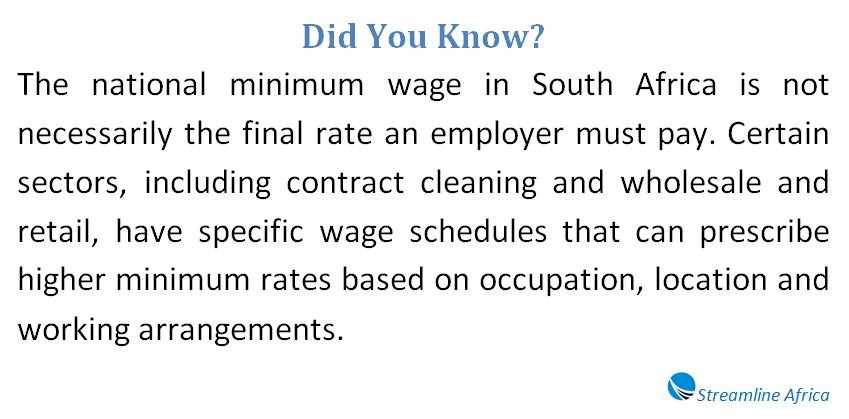
Not necessarily. Sectoral determinations, collective agreements or other applicable wage arrangements can establish higher minimum rates for particular industries and occupations.
What happens if an employer pays below the minimum?
The NMW is legally enforceable, and employers may face enforcement action for non-compliance. Employees who believe they are being underpaid can pursue the available labour dispute and enforcement procedures.
Keeping Minimum Wage Information Current
Employers should treat R30.23 as the applicable national rate from 1 March 2026, rather than as a permanent figure. South Africa’s National Minimum Wage Commission reviews the wage framework and makes recommendations on adjustments, taking factors such as inflation, living costs, economic conditions, employment and business sustainability into account.
For an evergreen compliance approach, businesses should record each amendment alongside its effective date, review sector-specific schedules and update payroll promptly whenever a new government determination becomes binding. This allows historical information to remain useful while ensuring that current remuneration decisions are based on the latest legally applicable rate.