
South Africa’s Value-Added Tax framework is a central component of the country’s fiscal system and an important compliance consideration for businesses operating across multiple sectors. Administered by the South African Revenue Service under the Value-Added Tax Act, the regime applies a standard rate of 15% to most taxable supplies, while selected transactions qualify for zero-rating or exemption.
VAT is structured as a non-cumulative tax. Registered vendors are generally required to charge VAT on taxable supplies and may deduct qualifying VAT incurred on business inputs. The resulting difference is either paid to SARS or claimed as a refund. This mechanism makes VAT a significant working-capital consideration, particularly for exporters, capital-intensive businesses and enterprises with long operating cycles.
The regime also extends beyond domestic transactions. VAT may arise on imported goods, imported services and certain supplies made by foreign enterprises. As a result, effective compliance requires businesses to assess not only the nature of each transaction, but also the location of the supplier, customer and underlying economic activity.
Revised VAT Registration Thresholds
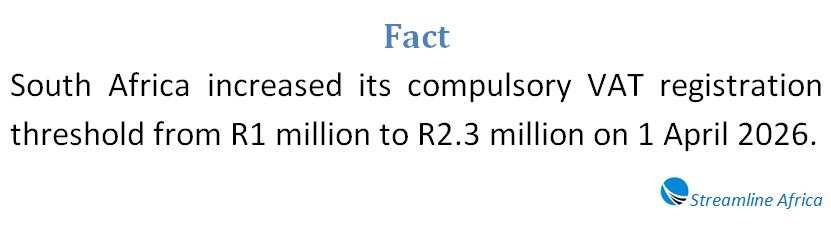
A major development took effect on 1 April 2026, when the compulsory VAT registration threshold increased from R1 million to R2.3 million in taxable supplies. The voluntary registration threshold also increased from R50,000 to R120,000.
These adjustments have important implications for small and medium-sized enterprises. Businesses that previously approached the compulsory threshold may now remain outside the VAT system for longer. However, companies should avoid viewing the higher threshold as an automatic reason to delay registration. Voluntary registration may still be commercially beneficial where a business incurs significant VAT-bearing costs, supplies mainly to VAT-registered customers or intends to expand rapidly.
Registration becomes compulsory when taxable turnover exceeds the prescribed threshold within the relevant period or where there are reasonable grounds to expect that the threshold will be exceeded. Written contracts, confirmed orders and other binding commercial commitments may be relevant in determining whether future turnover is sufficiently certain.
Management teams should therefore monitor taxable turnover continuously rather than relying solely on year-end financial statements. Delayed registration may expose a business to retrospective VAT liabilities, penalties and interest on supplies made after the date on which registration should have occurred.
Improvements to the VAT Registration Process
SARS introduced further registration process enhancements from 8 December 2025. These changes were designed to improve transparency, communication and efficiency for applicants.
Where an application fails to meet the legal requirements, SARS may issue a customised rejection notice identifying the specific reasons for the decision. This represents an improvement on more general rejection communications and should allow applicants to address deficiencies more effectively before submitting a new application.
Where supporting documents are incomplete, incorrect, outdated or missing, SARS may contact the applicant directly and issue a tailored written request. Applicants are generally given five business days to upload the outstanding information. If the required documents are not provided within the specified period, the application may be rejected automatically.
Businesses preparing to register should therefore conduct a detailed document review before submission. Banking records, registration documents, proof of address, identity documents and evidence of taxable activities should be complete, current and internally consistent.
Ongoing Responsibilities of VAT Vendors
VAT registration creates a continuing legal and administrative obligation. Registered vendors must levy output tax on taxable supplies, issue compliant tax invoices, maintain adequate records and submit VAT returns for each assigned tax period.
Input tax may generally be deducted where goods or services are acquired for the purpose of making taxable supplies and the vendor holds the prescribed evidence. The availability of a deduction depends not only on the business purpose of the expenditure but also on the quality and validity of the supporting documentation.
VAT incurred in relation to exempt supplies is generally not deductible. Specific restrictions may also apply to expenditure involving entertainment, passenger motor vehicles and certain recreational or membership costs, although limited exceptions exist.
Where an enterprise makes both taxable and exempt supplies, the business may be required to apportion input tax. The turnover-based method is commonly applied, although an alternative method may be approved where the standard formula does not produce a fair result. Businesses should also review the subsequent use of capital assets because changes from taxable to non-taxable use, or the reverse, may trigger VAT adjustments.
Tax Periods and Filing Requirements
VAT tax periods vary according to the size and nature of the vendor’s operations. Most businesses account for VAT on a two-month cycle. Vendors with annual taxable turnover above the relevant limit are generally assigned monthly periods, while certain qualifying farming enterprises may apply for six-month periods.
A twelve-month period may be available to qualifying companies and trusts involved in specific transactions with connected persons. However, these longer periods apply only in limited circumstances and should not be assumed without reviewing the relevant requirements.
Returns and payments must be submitted within the prescribed deadlines. Where electronic filing and payment are used, the deadline is generally the final business day of the month following the end of the tax period.
Late payment may attract a penalty of 10% of the outstanding VAT, together with interest. Understatements may also result in additional penalties determined by the seriousness of the conduct. Deliberate evasion or fraud may lead to criminal proceedings.
Businesses should implement monthly or bi-monthly VAT reconciliations even where returns are submitted less frequently. This allows management to identify invoice discrepancies, unsupported deductions and unexpected liabilities before the filing deadline.
Managing VAT Refunds
A vendor may claim a refund where deductible input tax exceeds output tax. Refunds are common among exporters, businesses making large capital investments and enterprises with significant upfront expenditure.
SARS may verify or audit a refund claim before making payment. Vendors should therefore ensure that all amounts are supported by valid tax invoices, customs documents, contracts and proof of payment where required.
Where a correctly completed refund is not paid within 21 business days and SARS was not prevented from conducting its review, interest may become payable. However, incomplete returns, unresolved verification requests or inadequate documentation may delay the process.
Refund management should form part of the business’s broader cash-flow strategy. Companies that rely heavily on VAT refunds should maintain detailed supporting schedules and respond promptly to SARS requests.
Qualifying tourists, foreign enterprises and certain non-resident purchasers may also claim VAT refunds on goods bought in South Africa and exported through designated channels. These claims are subject to strict documentary and procedural conditions, including removal of the goods within the prescribed period.
VAT Considerations for Farming Enterprises
Agricultural, pastoral and farming businesses operate under the general VAT framework but may benefit from selected sector-specific provisions.
Certain agricultural goods may be supplied at the zero rate where the prescribed conditions are satisfied. Smaller farming enterprises may also apply for six-month tax periods, which can reduce the frequency of return submissions.
However, longer tax periods may create cash-flow challenges where a farmer incurs substantial input tax before generating taxable sales. Management should therefore assess whether administrative convenience outweighs the potential delay in receiving refunds.
Farming businesses should also distinguish carefully between standard-rated expenses, zero-rated agricultural inputs, exempt activities and private expenditure. Mixed-use assets and expenditure may require apportionment or adjustments.
Domestic Reverse Charge on Valuable Metals
The domestic reverse charge on valuable metals has applied since 1 July 2022. The measure was introduced primarily to address VAT refund fraud in the second-hand gold and valuable-metals market.
Under this mechanism, the purchaser, rather than the supplier, is responsible for declaring and paying the VAT to SARS. The rule applies to prescribed standard-rated supplies of valuable metals between registered vendors.
The supplier must issue a tax invoice containing the required reverse-charge disclosures. The purchaser may claim input tax only after accounting for the corresponding output tax in the prescribed manner.
The purchaser must also provide the supplier with a written statement containing transaction details, including the invoice number, value of the supply, description of the valuable metal, gold content and confirmation that the VAT was accounted for.
Businesses operating in this sector should maintain specialised controls because ordinary VAT procedures may not adequately address the additional reporting requirements.
Schools Exiting the VAT System
Legislative amendments effective from 1 January 2026 changed the VAT treatment of schools and created practical consequences for institutions leaving the VAT system.
SARS issued dedicated frequently asked questions on 14 May 2026 to assist affected schools with registration cancellation, final returns, transitional adjustments and asset-related liabilities.
A school exiting the system must determine the correct cancellation date, complete outstanding returns and consider whether output tax is payable on assets held immediately before deregistration. Previously claimed input tax may also require adjustment.
The transition should be managed as a structured tax project rather than a routine administrative exercise. Schools with significant property, equipment, prepaid expenditure or ongoing contracts may face material liabilities if the exit is not planned carefully.
Cancellation of VAT Registration
A vendor may apply for cancellation where taxable supplies fall below the compulsory threshold, subject to the statutory requirements and SARS approval. Cancellation may become mandatory where the business ceases trading or no longer qualifies for voluntary registration.
Deregistration does not eliminate existing obligations. A vendor may be required to account for output tax on business assets held immediately before cancellation, generally by reference to the lower of cost or open market value.
The business must also submit final returns, settle outstanding liabilities and retain records for the prescribed period. No input tax may generally be claimed on expenditure incurred after the effective cancellation date.
Before applying for deregistration, management should model the expected tax cost and confirm that the commercial benefits outweigh the potential liabilities.
Disputes, Objections and Appeals
A vendor that disagrees with a SARS assessment or qualifying decision may lodge an objection within the prescribed period, generally 30 business days.
Where the objection is unsuccessful, the vendor may appeal. Depending on the value and complexity of the matter, the dispute may proceed through alternative dispute resolution, the Tax Board, the Tax Court or the higher courts.
Effective dispute management requires a clear legal position, detailed reconciliations and complete supporting evidence. Businesses should avoid relying on broad statements of disagreement. The objection should explain precisely why the assessment is incorrect and identify the legislative or factual basis for the alternative treatment.
Professional tax advice may be necessary where the dispute involves substantial amounts, complex interpretation issues or understatement penalties.
Strengthening VAT Governance
VAT compliance should be embedded within the organisation’s financial control environment. Supplier registration details should be verified through the available VAT vendor search facility before significant input tax deductions are claimed.
Businesses should also review invoices for all mandatory information, retain evidence of verification and assign responsibility for monitoring legislative developments, regulations, binding rulings and interpretation notes.
The 2026 threshold increases, revised treatment of schools and registration process enhancements demonstrate that South Africa’s VAT framework continues to evolve. Businesses must therefore maintain processes that are capable of responding to regulatory change.
A strong VAT governance framework should combine accurate transaction classification, timely reconciliations, complete documentation, defined review responsibilities and regular compliance assessments. When managed effectively, VAT becomes a controlled statutory process. When neglected, it can create material cash-flow pressure, penalties, disputes and operational disruption.

Frequently Asked Questions
What is the current VAT rate in South Africa?
South Africa applies a standard VAT rate of 15% to most taxable goods and services. Certain transactions may qualify for zero-rating or exemption.
When must a business register for VAT?
From 1 April 2026, compulsory registration applies when taxable supplies exceed R2.3 million within the relevant period.
Can a smaller business register voluntarily?
Yes. A business may apply for voluntary registration once its taxable supplies meet the R120,000 threshold, subject to SARS requirements.
What are the main responsibilities of a VAT vendor?
A registered vendor must charge VAT correctly, issue compliant invoices, maintain records, submit returns and pay any VAT due within the prescribed deadlines.
How is VAT payable calculated?
The vendor subtracts qualifying input tax paid on business purchases from output tax collected on taxable sales. The balance is either paid to SARS or claimed as a refund.
Can all business expenses support an input tax claim?
No. Input tax must generally relate to taxable business activities and be supported by valid documentation. Certain entertainment, vehicle and recreational expenses may be restricted.
How frequently must VAT returns be submitted?
Most vendors submit returns every two months. Monthly, six-month or twelve-month periods may apply depending on turnover, business activities and SARS approval.
When can a vendor receive a VAT refund?
A refund may arise when deductible input tax exceeds output tax. SARS may verify the claim and supporting documents before releasing the amount.
What VAT rules apply to farming businesses?
Qualifying agricultural enterprises may benefit from zero-rated supplies and longer tax periods. However, farmers must still separate taxable, exempt and private expenditure carefully.
How does the domestic reverse charge work for valuable metals?
For qualifying transactions between registered vendors, the purchaser accounts for the VAT instead of the supplier. Additional invoicing and reporting requirements also apply.
What happens when a school exits the VAT system?
The school may need to cancel its registration, submit final returns, review previously claimed input tax and account for VAT on certain assets held at deregistration.
Can a vendor challenge a SARS decision?
Yes. A vendor may lodge an objection and, where necessary, proceed to appeal through alternative dispute resolution, the Tax Board, the Tax Court or a higher court.