

As accounting professionals, we frequently see individuals and organizations struggle with financial clarity because too many transactions, objectives, and responsibilities are grouped into one account. Although a single balance may appear convenient, it can make reporting, budgeting, and decision-making unnecessarily difficult.
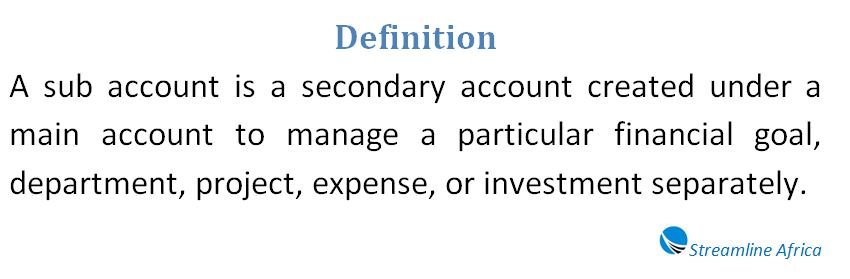
Sub accounts provide a structured solution. They are secondary accounts created beneath a primary account to separate funds, transactions, records, investments, or responsibilities according to a specific purpose. The main account serves as the central financial framework, while each sub account supports a distinct activity, goal, department, project, or investment strategy.
From an accounting perspective, the value of sub accounts lies in their ability to improve classification, control, transparency, and reporting. They allow users to maintain a consolidated financial view without losing the detail required for effective management.
How Sub Accounts Operate
A sub account is linked directly to a larger master account. The primary account holder or authorized administrator determines how the sub accounts are established, funded, monitored, and accessed.
Depending on the financial institution or accounting system, each sub account may have its own name, balance, transaction record, account code, reporting category, and access permissions. However, it remains connected to the wider account structure.
Consider a property management company responsible for several apartment buildings. The business may operate one central bank account while creating separate sub accounts for each property. Rental income, maintenance costs, utility payments, security expenses, and service charges can then be recorded independently for every location.
This arrangement allows the accounting team to evaluate the performance of each property while still preparing consolidated financial reports for the entire business. It also reduces the risk of assigning income or expenses to the wrong location.
Sub accounts may also operate under strict authorization rules. Where a power of attorney, trust agreement, or internal approval process applies, only designated individuals may be permitted to access or transfer funds. Such controls strengthen financial security and help ensure that money is used only for approved purposes.
Improving Business Accounting and Reporting
In our experience, one of the strongest applications of sub accounts is in corporate bookkeeping. Businesses often begin with broad financial categories, but these categories become less useful as operations expand.
For example, recording all operating costs under one general expense account may prevent management from understanding where money is actually being spent. Creating sub accounts for transportation, employee training, office supplies, repairs, utilities, marketing, and professional services produces far more useful information.
A manufacturing company may maintain one main operating-expense account supported by several sub accounts. The finance team can then compare actual spending against the approved budget for each category. If machinery repairs rise sharply, management can identify the issue immediately rather than discovering it after reviewing a broad annual expense total.
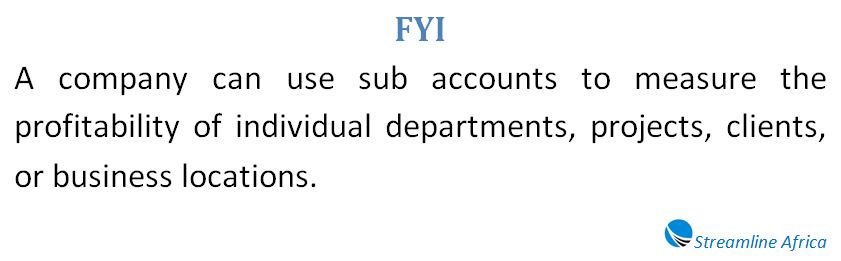
Sub accounts are also valuable in project accounting. A consulting company handling several client assignments may create a separate sub account for every project. Revenue, travel costs, outsourced services, staff time, software expenses, and administrative charges can then be assigned correctly.
This enables accountants to calculate project profitability, identify cost overruns, and prepare accurate client reports. It also prevents the financial results of one project from being mixed with another.
Departmental budgeting offers another practical use. Sales, human resources, information technology, operations, and administration may each operate through individual sub accounts. Department heads can monitor their spending, while senior leadership retains access to consolidated financial information.
From an internal-control standpoint, this structure improves accountability because responsibility for each budget is clearly assigned.
Strengthening Personal Financial Planning
Sub accounts are equally useful for personal financial management. We often advise individuals to separate savings by purpose rather than placing all funds into one general account.
When emergency savings, school fees, insurance payments, travel plans, and home repairs are combined, the total balance can create a false impression of available money. A person may spend funds intended for an important future obligation without realizing it.
For instance, an individual could maintain one main savings account with separate sub accounts for an emergency reserve, professional education, a family holiday, annual insurance premiums, and household improvements.
Each month, predetermined amounts can be transferred into the relevant categories. This makes it easier to measure progress and determine whether each goal is properly funded.
Sub accounts also support what accountants sometimes describe as purpose-based allocation. Every portion of the balance is assigned a specific function. Instead of viewing savings as one unrestricted amount, the account holder can see exactly how much is available for each objective.
This approach may improve financial discipline. People are often less likely to withdraw money from an account labelled “Emergency Fund” than from an ordinary savings account with no defined purpose.
Families can also use sub accounts to organize shared responsibilities. A household may create separate categories for rent, food, healthcare, transportation, childcare, education, and long-term savings. This improves visibility and supports more productive discussions about spending priorities.
Different institutions may refer to these features as savings pots, vaults, pockets, or buckets. Regardless of the label, the accounting principle is the same: funds are classified according to their intended use.
Sub Accounts in Retirement and Investment Planning
Sub accounts also play an important role in certain retirement and insurance products, especially variable annuities. In these arrangements, the term refers to investment options available within the main annuity contract.
A contract holder may allocate contributions among sub accounts that invest in shares, bonds, money market instruments, or other asset classes. Each option carries its own investment objective, expected return, level of risk, and fee structure.
For example, one sub account may focus on large-company stocks, another on government or corporate bonds, and another on short-term money market securities. The investor decides how to divide the funds based on financial goals, age, income needs, and risk tolerance.
This flexibility differs from a fixed annuity, where returns or future payments are generally based on predetermined terms.
However, we emphasize that investment sub accounts should not be confused with ordinary bank savings accounts. Their values may increase or decrease according to market performance. They may also involve management charges, contract fees, surrender penalties, and tax implications.
Before selecting these options, investors should carefully review the product documents and consider whether the risks align with their long-term retirement strategy.
Key Accounting Benefits
From our professional standpoint, the main benefit of sub accounts is improved financial visibility. They allow users to understand not only how much money exists, but also why it is being held and how it should be used.
For businesses, sub accounts support more accurate budgeting, cost control, departmental reporting, project analysis, and financial forecasting. They also strengthen audit trails because transactions can be traced to the correct purpose or responsibility area.
For individuals, they provide a disciplined structure for saving, planning, and monitoring financial goals.
They can also improve access control. Selected employees, advisers, family members, or authorized representatives may be allowed to view or manage only certain sub accounts. This protects sensitive information and reduces the risk of unauthorized transactions.

Potential Limitations to Consider
Although sub accounts offer many advantages, they must be managed carefully. Creating too many categories can make a financial system unnecessarily complicated.
An individual may find it difficult to maintain numerous savings targets, while a business may produce confusing reports if account names and classifications are inconsistent. Sub accounts should therefore be created only when they serve a clear reporting or management purpose.
Users should also review any bank fees, minimum-balance rules, transfer restrictions, withdrawal conditions, and tax consequences associated with the arrangement.
Businesses should establish consistent account codes and naming conventions. Regular reconciliations are also essential to confirm that the balance of each sub account agrees with the underlying transactions and that the combined totals match the primary account.
Our Professional Assessment
As a team of accounting experts, we view sub accounts as a practical and highly effective financial-management tool. They allow businesses and individuals to maintain central control while separating activities according to purpose.
When properly designed, sub accounts improve reporting accuracy, financial discipline, accountability, budgeting, and decision-making. They are particularly useful where several departments, projects, savings goals, properties, or investment choices must be managed within one broader financial structure.
Their success, however, depends on thoughtful setup and regular monitoring. Clear labels, appropriate access rights, consistent classifications, and routine reviews are essential.
Ultimately, sub accounts provide more than simple organization. They create a transparent framework that helps users understand where money is coming from, where it is going, and whether it is being used in line with established financial objectives.
Frequently Asked Questions
Why Are Sub Accounts Important?
They improve financial organization by showing how much money is assigned to each purpose instead of presenting everything as one combined balance.
How Do Businesses Use Sub Accounts?
Businesses use them to monitor departments, projects, properties, clients, operating expenses, and revenue streams while maintaining one consolidated financial structure.
Can Sub Accounts Improve Budgeting?
Yes. They allow individuals and organizations to compare planned spending with actual expenses and identify overspending more quickly.
How Can Individuals Use Sub Accounts?
Individuals can create separate savings categories for emergencies, education, vacations, insurance, home repairs, and other financial priorities.
Do Sub Accounts Strengthen Financial Control?
Yes. Access can be limited to authorized users, helping protect funds, reduce misuse, and ensure money is spent only for approved purposes.
Are Investment Sub Accounts the Same as Savings Accounts?
No. Investment sub accounts may hold stocks, bonds, or money market assets, meaning their value can rise or fall depending on market performance.
What Are the Main Risks of Using Sub Accounts?
Too many sub accounts can create confusion, especially when labels, account codes, access rights, and transaction classifications are poorly managed.
How Can Sub Accounts Be Managed Effectively?
They should have clear names, defined purposes, suitable permissions, consistent records, and regular reconciliations to ensure their balances remain accurate.