
The conversation around artificial intelligence in business has undergone a profound shift. Not long ago, companies rushed headlong into AI adoption, eager to experiment, pilot and deploy systems that promised faster decisions, sharper insights and a competitive edge. Success was defined by how quickly an organization could implement cutting-edge models or automate processes.
Today, that definition is changing. Increasingly, the organizations pulling ahead are not those with the most advanced algorithms, but those with the most disciplined approach to managing them. The true differentiator is no longer raw AI capability. It is governance.
From my experience advising startups and mid-sized firms navigating digital transformation, one truth has become clear: the gap between companies that scale AI effectively and those that stall is rarely technical. It is organizational. More specifically, it is about how well they govern their AI systems.
Governance As A Strategic Lever
For years, governance was treated as an afterthought—something reserved for compliance teams, introduced late in the process to manage risk or satisfy regulatory demands. It was reactive by design, often stepping in only when something went wrong.
That approach is no longer viable.
As AI systems become embedded in core business functions—customer service, operations, finance, marketing—the risks and responsibilities multiply. Decisions once made by humans are now influenced or even controlled by algorithms. Without clear structures guiding how those systems are used, monitored and improved, organizations quickly lose visibility and control.
Recent industry observations suggest that many companies still struggle in this area. A significant portion of leaders cannot accurately measure how widely AI is being used across their workforce. Others report fragmented policies, unclear accountability and difficulty linking AI initiatives to tangible business outcomes.
These are not failures of technology. They are failures of governance.
When leadership lacks visibility into AI usage or cannot assess its impact, decision-making suffers. Investments become guesswork, risks go unmanaged and opportunities are missed. Governance, in this sense, becomes not just a safeguard but a strategic enabler.

A Layered Approach To Control
Effective AI governance is not a single policy or framework. It operates across multiple layers of the organization, each with distinct responsibilities.
At the top level sits executive governance. This is where strategic intent is defined. Leaders must determine why AI is being deployed, what risks are acceptable and which decisions should never be delegated to machines. These are not technical questions—they are business and ethical ones. Without clear direction at this level, everything downstream becomes inconsistent.
The next layer involves system design governance. Here, organizations decide how AI systems function in practice. Which processes are fully automated? Which require human oversight? Where should approvals be mandatory? These decisions shape how AI interacts with real-world operations and directly influence both efficiency and risk exposure.
At the foundation lies frontline governance. This is where employees interact with AI tools daily. Workers need clarity about when to trust AI outputs, when to question them and when to intervene. Just as importantly, they need the authority to act without fear of repercussions if something appears wrong. Governance fails if the people closest to the systems feel powerless to challenge them.
These three layers must work together. A gap at any level creates vulnerabilities that can undermine the entire system.
The Challenge Of Scale
One of the most underestimated aspects of AI governance is how quickly it must evolve as deployments grow.
A company managing two or three AI tools can often rely on informal processes and manual oversight. Communication is straightforward, risks are easier to track and accountability is relatively clear. But as that number expands—ten systems, fifty, hundreds—the complexity increases exponentially.
Without scalable governance, organizations find themselves in chaos. Systems are deployed without proper review. Ownership becomes unclear. Risks overlap and go unnoticed. Teams duplicate efforts or work at cross-purposes.
This is why governance cannot remain static. It must be designed to scale alongside AI adoption.
A practical framework for doing so typically includes several core components: a comprehensive inventory of AI systems, clear classification of risks, defined ownership for each system, explicit decision rights and structured lifecycle management from development through deployment and monitoring.
When these elements are in place, governance shifts from reactive problem-solving to proactive infrastructure. It becomes something that supports growth rather than constrains it.
Embedding Governance Into Technology
Another critical evolution is the integration of governance directly into the tools and platforms organizations use.
Traditionally, governance has been layered on top of technology—policies applied after systems are built. This often leads to friction. Teams must pause innovation to seek approvals, navigate complex processes or retrofit controls into existing systems.
A more effective approach is to embed governance within the technology itself.
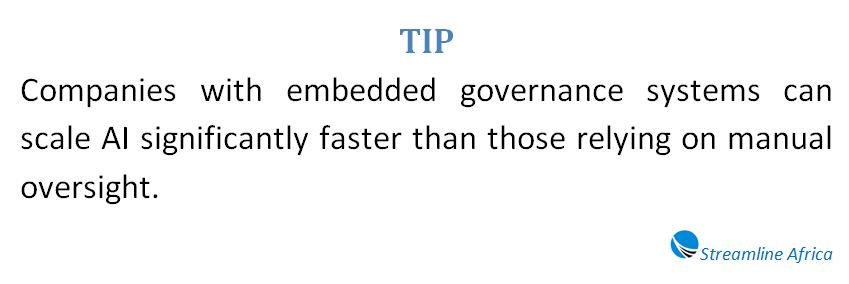
Modern platforms increasingly offer capabilities such as automated policy enforcement, model tracking, explainability features and built-in checkpoints for human review. These features allow organizations to maintain control without slowing down development.
The goal is not to create barriers but to establish guardrails. When governance is seamlessly integrated, teams can move quickly while staying aligned with organizational standards and risk tolerance.
This balance—between speed and control—is where many organizations struggle. Those that get it right gain a significant advantage.
Recognizing Maturity
How can leaders tell whether their AI governance is truly effective? Maturity tends to reveal itself through clarity, consistency and measurability.
Organizations with strong governance know exactly which AI systems are in use across the business, including those introduced informally by employees. They have clearly defined ownership, ensuring every system has someone accountable for its performance and risks.
Policies are not vague guidelines but actionable rules that govern how AI can be deployed, monitored and improved. Risks are systematically assessed across multiple dimensions, including privacy, bias, security and operational impact.
Controls are not optional. Human oversight, testing procedures, access management and documentation are standard practice. Compliance is regularly measured against internal standards and external requirements.
Monitoring is continuous, not occasional. Performance metrics, error rates and system behavior are tracked over time, allowing organizations to detect issues such as model drift or unexpected outcomes.
Transparency is also a key indicator. Decisions made by AI systems can be explained, data sources are understood and limitations are clearly communicated.
Finally, employees are not left in the dark. Training ensures that staff understand both the capabilities and the responsibilities associated with AI use.
When these elements come together, governance becomes visible—not as a constraint, but as a source of confidence.
The Competitive Reality
As we move deeper into the AI-driven era, the organizations that succeed will not necessarily be those with the most sophisticated technology. Instead, success will belong to those that can deploy AI reliably, responsibly and at scale.
This requires more than technical expertise. It demands a deliberate investment in governance as a core capability.
For businesses that still view governance as a burden, the implications are significant. Treating it as a box to check or a process to delay until later introduces risks that compound over time. It slows growth, erodes trust and limits the ability to scale.
On the other hand, companies that embrace governance as infrastructure position themselves to move faster with greater confidence. They create environments where innovation thrives within clear boundaries, where risks are managed proactively and where AI delivers measurable value.
The shift is subtle but powerful. Governance is no longer the background function few people notice. It is the engine that determines whether AI initiatives succeed or fail.
In the end, the question is not whether an organization will adopt AI. Most already have. The real question is whether they will build the systems and structures needed to manage it effectively.
Those that do will define the next phase of business leadership. Those that don’t may find themselves overwhelmed by the very technologies they hoped would give them an edge.
Key Highlights
Governance Is Now the Real Competitive Edge
AI success is no longer about who has the most advanced tools—it’s about who manages them best. Companies that treat governance as core strategy, not an afterthought, are pulling ahead.
Most AI Failures Aren’t Technical
When AI initiatives stall or fail, it’s rarely due to weak models. The real issue is lack of visibility, unclear ownership and poor decision frameworks.
Leadership Must Set the Direction
Executives play a critical role in defining why AI is used, what risks are acceptable and where human control must remain. Without this clarity, confusion spreads across teams.
Governance Happens at Every Level
Strong AI oversight isn’t just top-down. It must exist at the executive level, in system design and on the frontlines where employees interact with AI daily.
Scaling AI Without Governance Leads to Chaos
What works for a few AI tools quickly breaks down at scale. Without structured governance, organizations lose control as adoption grows.
Embedding Governance Into Tools Is a Game-Changer
The smartest companies build governance directly into their AI platforms—making compliance and oversight automatic instead of slow and manual.
Transparency Builds Trust and Performance
When teams understand how AI works, its limits and when to intervene, they use it more effectively and responsibly.
Governance Enables Faster Innovation
Contrary to common belief, good governance doesn’t slow companies down—it actually allows them to innovate faster with confidence and fewer risks.