

Understanding the Purpose of Transfer Pricing
Transfer pricing is the system used to determine the prices charged when companies under common ownership exchange goods, services, loans, intellectual property, or other forms of value. It matters most in multinational groups, where one company may manufacture a product, another may distribute it, and a third may own the brand, software, patent, or financing structure behind the business.
These transactions are legitimate, but internal prices affect where profits appear and where taxes are paid. If a price differs significantly from what independent businesses would have agreed, taxable income may shift between jurisdictions.
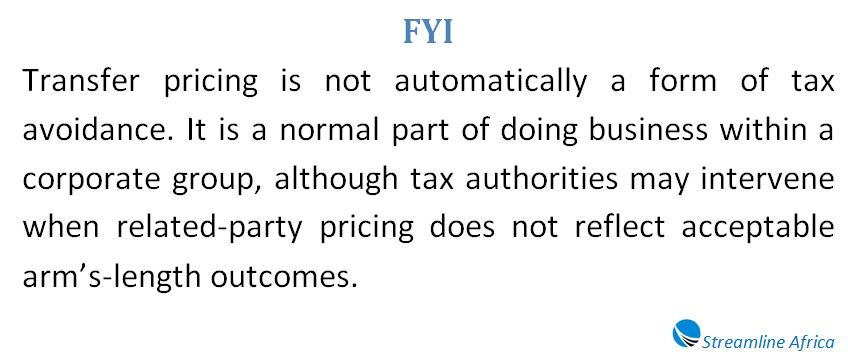
For this reason, many tax systems apply the arm’s-length principle. Related companies are expected to price their dealings as if they were independent parties negotiating under comparable commercial conditions. Tax authorities may adjust taxable income when the price used between related parties falls outside a reasonable arm’s-length outcome.
Why Transfer Pricing Matters
Transfer pricing can affect corporate income tax, customs duties, withholding taxes, financing costs, and the allocation of profit across countries.
Consider an African manufacturing group with a plant in Ghana, a distributor in Kenya, and a regional management company in Mauritius. The Ghanaian entity may sell finished products to Kenya, while the Mauritius company provides strategic support and licenses a trademark. Each charge should reflect the economic contribution of the entity providing the product, service, financing, or intangible asset.
Tax authorities particularly scrutinize arrangements that move profits into low-tax jurisdictions without matching economic substance. Yet transfer pricing itself should not be confused with fraud or false invoicing. A business can have transfer pricing obligations even where no tax avoidance is intended. The main question is whether related-party transactions can be commercially justified.
Applying the Arm’s-Length Principle
The arm’s-length principle does not always produce one exact price. In many cases, a range of acceptable prices or margins may exist because businesses operate under different contracts, market conditions, risks, volumes, credit terms, and strategies.
The analysis begins by reviewing each party’s functions, assets, and risks. A distributor with limited commercial responsibility should not necessarily earn the same return as a company that develops products, owns valuable technology, carries inventory, and assumes substantial market risk.
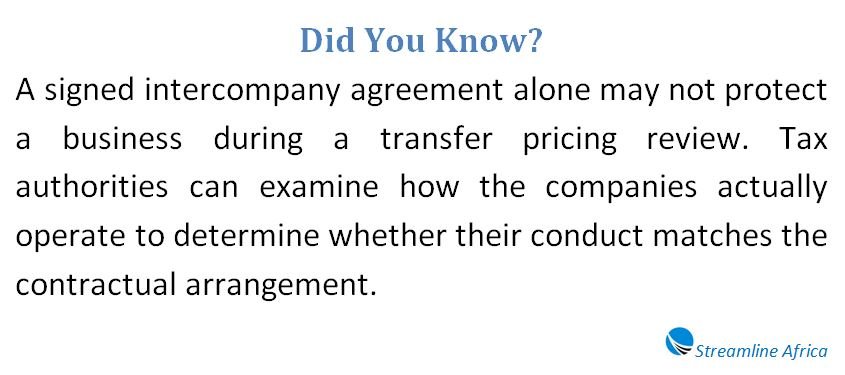
Economic substance also matters. Written agreements are important, but tax authorities may examine whether actual conduct matches them. If a contract says one entity bears a particular risk while another makes the decisions and absorbs the consequences, the tax analysis may follow the parties’ real behaviour.
Establishing Comparability
A strong transfer pricing analysis depends on finding reliable benchmarks. The objective is to identify transactions, companies, or financial results that are sufficiently similar to the related-party arrangement being examined.
Relevant factors include contractual terms, goods or services, functions, assets, risks, economic circumstances, and business strategy. Geography can also matter. A product sold in Accra may not earn the same margin in Lagos or Johannesburg because purchasing power, competition, distribution costs, regulation, and currency conditions differ.
Payment terms may also change the economics. A customer receiving 90 days to pay may reasonably face a different price from one paying immediately. Warranty coverage, volume, exclusivity, transportation responsibilities, and licensing duration may likewise affect comparability.
Material differences may require adjustments. If they cannot be addressed reliably, the proposed comparable may not provide a dependable arm’s-length benchmark.
Common Transfer Pricing Methods
Different transactions require different methods. The most suitable method is generally the one producing the most reliable arm’s-length result.
The comparable uncontrolled price method compares a related-party price with a similar price between independent parties. It is especially useful where highly comparable products or financial transactions exist. Commodity markets may provide external references, while internal comparables may arise when the same business sells similar products to related and unrelated customers.
The cost-plus method starts with the supplier’s costs and adds an appropriate markup. It is often considered for manufacturing or service arrangements where costs are identifiable and a reasonable margin can be benchmarked.
The resale price method begins with the price charged to an independent customer and deducts an appropriate resale margin. It may suit routine distributors that add limited value before resale.
Profit-based approaches are useful where direct price comparisons are weak. The transactional net margin method compares the tested party’s net profitability with that of comparable independent businesses. The profit split method may be more suitable where several related parties make unique and valuable contributions, particularly where important intangible assets are involved.
Selecting the Tested Party and Profit Measure
Under profit-based methods, the analysis commonly focuses on the entity whose activities are simpler and easier to compare with independent businesses. This entity is often called the tested party.
If one company owns valuable technology while another performs routine distribution, the distributor may be easier to benchmark because independent distributors with similar functions may exist.
A suitable profit level indicator must then be chosen. Depending on the facts, this may be operating profit as a percentage of sales, profit relative to costs, or return on assets. Adjustments may sometimes be required for differences in inventory, receivables, financing, or other factors that affect profitability.
Several years of data may improve reliability, although unusual events and changing market conditions still require explanation.
Intangible Assets and Intra-Group Services
Intangible assets create difficult transfer pricing questions because patents, trademarks, software, proprietary processes, customer relationships, and know-how may be unique. Reliable market comparables are often unavailable.
A group therefore needs to examine who developed the intangible, who funded it, who controls the related risks, and who uses it commercially. Royalty rates should not be justified solely by legal ownership. The economic contributions behind the asset also matter.
Intra-group services require similar discipline. A related company may charge another entity for accounting, legal, technology, human resources, procurement, marketing, or management support. Tax authorities may ask whether the service was actually performed, whether the recipient received a genuine benefit, and whether the amount charged is reasonable.
Routine support services may sometimes justify a cost-based approach, while strategic or core services may warrant a profit element depending on the functions and value involved.
Cost Sharing and Shared Development
Multinational groups may jointly fund the development or acquisition of assets, particularly intellectual property. Under a cost sharing or cost contribution arrangement, participants generally bear costs according to the benefits they reasonably expect to receive.
The allocation should have a commercial basis. Expected sales, gross margins, market size, usage, or another measurable factor may be appropriate depending on the arrangement.
Written agreements, financial records, forecasts, and periodic reviews are important because expected benefits and participants may change. These events can create buy-in, buy-out, or other compensating payments that also need arm’s-length support.
Documentation and Audit Risk
Transfer pricing documentation is a major compliance requirement in many jurisdictions. Businesses may have to explain their related-party transactions, functional analysis, selected method, comparables, calculations, and reasons for concluding that their pricing is arm’s length.
Documentation is stronger when prepared while facts are current rather than reconstructed after an audit begins. Some jurisdictions impose penalties for missing, late, or inadequate records, while others apply additional penalties where transfer pricing adjustments produce significant tax increases.
Requirements differ by country and may include local files, master files, country-by-country reports, related-party disclosures, or special reports. Multinational groups therefore need a coordinated policy that remains adaptable to local rules.
Advance Pricing Agreements and Disputes
Transfer pricing adjustments can create double taxation when one country increases the taxable income of one group company but the other jurisdiction does not make a matching adjustment.
Advance pricing agreements can reduce this uncertainty. Under an APA, a taxpayer and one or more tax authorities agree in advance on the methodology that will apply to specified transactions for a defined period. An agreement may be unilateral, bilateral, or multilateral.
APAs require substantial preparation but can provide greater certainty for complex or high-value transactions. Where disputes arise after an assessment, taxpayers may also use domestic appeals, court processes, treaty-based competent authority procedures, or other dispute resolution mechanisms available in the relevant countries.
Building a Practical Transfer Pricing Framework
Transfer pricing should not be treated as a year-end tax exercise. The strongest approach connects tax policy with the way the business genuinely operates.
A practical framework begins by mapping material related-party transactions. The group should identify which entities sell goods, provide services, lend funds, own intellectual property, assume major risks, and make strategic decisions. It should then select the most appropriate pricing method for each important arrangement and determine whether reliable comparables are available.
Intercompany agreements should reflect real activities, invoices should follow the agreed policy, and finance teams should monitor results during the year. If profitability moves outside an expected arm’s-length range, management should understand the reason before making adjustments.
Ultimately, transfer pricing is about aligning the allocation of income with economic activity. For multinational businesses, disciplined pricing, credible analysis, and clear documentation can reduce tax disputes while showing where real value is created across borders.
Important Questions and Answers About Transfer Pricing
Why is transfer pricing important for multinational businesses?
It influences how income, expenses, and ultimately taxable profits are distributed between related companies operating in different countries. A poorly structured arrangement can expose a business to tax adjustments, penalties, and disputes.
What is the arm’s-length principle?
The arm’s-length principle requires related companies to price transactions broadly as independent businesses would under comparable commercial circumstances. It is the foundation of many transfer pricing systems worldwide.
Can companies choose any price for related-party transactions?
Companies may establish their own internal pricing arrangements, but tax authorities can challenge prices that do not produce an acceptable arm’s-length result. Businesses should therefore be able to support their pricing with credible analysis.
What makes two transactions comparable?
Factors include the functions performed, assets used, risks assumed, contractual terms, characteristics of the goods or services, market conditions, geography, payment terms, and business strategies.
What are the main transfer pricing methods?
Common approaches include the comparable uncontrolled price method, cost-plus method, resale price method, transactional net margin method, and profit split method. The appropriate method depends on the transaction and available information.
Why are intangible assets difficult to price?
Assets such as trademarks, patents, software, technology, and proprietary know-how can be unique. Because comparable transactions may be difficult to find, determining a defensible arm’s-length price or royalty can require more detailed analysis.
Can one group company charge another for management services?
Yes, but the company should be able to demonstrate that the service was actually provided, that the recipient benefited from it, and that the amount charged is commercially reasonable.
What is a tested party in transfer pricing?
The tested party is generally the entity selected for benchmarking under certain profit-based methods. It is commonly the company with simpler functions and risks for which reliable independent comparables can more easily be identified.
Why is transfer pricing documentation important?
Documentation explains how related-party prices were established and why the company considers them arm’s length. Good records can strengthen a company’s position during a tax audit and help manage potential penalties.
What is an Advance Pricing Agreement?
An Advance Pricing Agreement, or APA, is an arrangement under which a taxpayer and one or more tax authorities agree in advance on how specified related-party transactions will be priced or tested for a defined period.
How can businesses manage transfer pricing risk effectively?
Businesses should map their related-party transactions, maintain appropriate agreements, select defensible pricing methods, monitor financial results, keep supporting documentation current, and ensure that written policies reflect what actually happens in practice.