
Business cycles describe the recurring fluctuations in the level of economic activity within a national economy. These movements typically alternate between periods of expansion and periods of contraction, affecting production, employment, household income, consumer expenditure, investment, and corporate performance.
Although business cycles follow a recognizable sequence, they do not occur at predictable intervals. The duration and intensity of each phase can vary substantially depending on monetary conditions, fiscal policy, business confidence, consumer behavior, global developments, financial conditions, and external shocks.
For business leaders, policymakers, and investors, understanding the business cycle is therefore less about predicting exact turning points and more about recognizing shifts in economic momentum and preparing appropriately for changing operating conditions.
The Four Phases of the Business Cycle
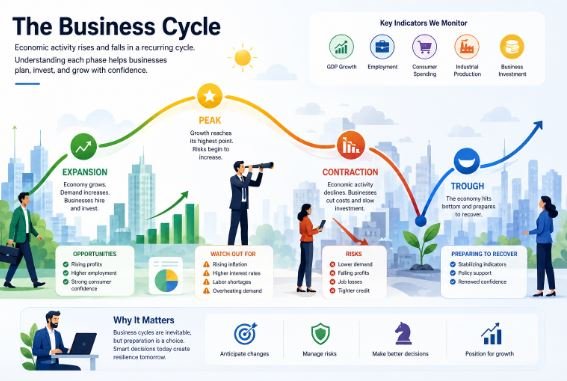
The business cycle is generally divided into four principal stages: expansion, peak, contraction, and trough. Each phase presents a different combination of economic conditions and strategic considerations.
An expansion is characterized by broad improvement in economic activity. Production increases, consumer demand strengthens, employment levels generally rise, and businesses often experience higher revenues and improved profitability. Stronger household income can further support consumption, reinforcing economic growth.
As the expansion matures, the economy may eventually reach a peak. This represents the highest point of economic activity before momentum begins to weaken. At this stage, businesses may continue to report strong performance, but pressures such as inflation, rising interest rates, labor shortages, higher input costs, or tighter financial conditions may begin to constrain further growth.
A contraction follows when overall economic activity starts declining. Businesses may experience slower sales, reduced investment, declining production, and pressure on margins. Employers may reduce recruitment, delay expansion plans, or restructure their workforces. If the decline becomes sufficiently broad and sustained, the economy may enter a recession.
The trough represents the lowest point of the cycle. Economic weakness stabilizes, and conditions begin to improve. As confidence returns, demand strengthens, production rises, and employment gradually recovers, creating the foundation for the next expansion.
Why GDP Is Only One Measure
Gross domestic product is one of the most widely used indicators of economic performance, but it does not provide a complete picture of the business cycle.
Real GDP measures the inflation-adjusted value of goods and services produced within an economy. Persistent declines in real GDP can signal deteriorating economic conditions, but broader analysis also considers employment, industrial production, household income, consumer spending, and business sales.
This distinction is important because economic weakness may initially emerge in specific sectors before spreading across the wider economy. Similarly, GDP may remain relatively stable while employment, consumer confidence, or industrial production begins to deteriorate.
In the United States, the National Bureau of Economic Research evaluates several economic indicators when determining whether the economy has entered or exited a recession. This approach reflects the view that recessions should be assessed using broad economic evidence rather than a single statistical threshold.
Assessing the Severity of Economic Contractions
A useful framework for evaluating recessions involves three dimensions: depth, diffusion, and duration.
Depth measures the magnitude of the decline in economic activity. Severe decreases in production, employment, income, and sales generally indicate a more significant downturn.
Diffusion considers how widely the weakness is distributed across the economy. A slowdown restricted to one industry may have limited national implications. However, simultaneous declines across manufacturing, retail, construction, services, and employment may indicate a broader economic contraction.
Duration measures how long the downturn persists. Some contractions are sharp but relatively brief, while others develop slowly and continue for extended periods.
Combining these three dimensions provides a more comprehensive assessment of economic conditions. It also helps organizations distinguish between temporary disruption and structural deterioration that may require significant strategic adjustment.
How Economic Recoveries Develop
Economic recoveries often strengthen through a series of interconnected improvements.
As demand begins to increase, businesses may raise production levels. Higher production can create additional employment opportunities, improving household income. Stronger household income, in turn, supports consumer expenditure, which can generate further demand for goods and services.
This relationship can produce a reinforcing cycle in which increased spending supports business revenues, stronger revenues encourage investment, and additional investment contributes to further employment and output growth.
The same mechanism can operate in reverse during a contraction. Declining sales may lead businesses to reduce production or employment, weakening household income and consumer spending. Lower spending can then place additional pressure on business revenues.
Understanding these feedback relationships is essential when assessing both emerging risks and early signs of recovery.
Determining Economic Turning Points
Identifying the precise beginning and end of an economic contraction is rarely straightforward.
Economic data is frequently revised after initial publication, and policymakers or research institutions may require several months of evidence before confirming that a turning point has occurred.
As a result, recessions are often identified retrospectively. An economy may already have been contracting for some time before the downturn is formally recognized. Similarly, an economic recovery may already be underway before official confirmation of the trough.
For organizations, this creates an important strategic challenge. Waiting for formal confirmation can result in delayed responses. Businesses should therefore monitor leading and coincident indicators alongside official economic classifications when making decisions.
Business Cycles and Financial Markets
Financial markets and the business cycle are closely connected, but they should not be considered interchangeable.
Equity markets are forward-looking. Share prices reflect investor expectations regarding future company earnings, interest rates, inflation, economic growth, and risk.
When investors expect weakening economic conditions, share prices may fall before a formal recession begins. Conversely, markets may recover before economic data has improved substantially if investors believe future conditions will strengthen.
This distinction is especially relevant for corporate planning and investment strategy. A decline in the stock market may reflect expectations of weaker economic conditions rather than evidence that a recession has already occurred.
Organizations should therefore assess market signals in combination with broader economic indicators rather than relying on financial market movements alone.
Why Economic Cycles Remain Difficult to Forecast
Despite extensive economic data and increasingly sophisticated forecasting tools, accurately predicting business-cycle turning points remains challenging.
Modern economies are influenced by a wide range of interconnected factors, including interest rates, inflation, employment, credit availability, commodity prices, consumer confidence, international trade, technological developments, government policy, and geopolitical events.
Unexpected developments can also change economic conditions rapidly. A financial shock, supply disruption, major policy decision, or global crisis can significantly alter the trajectory of an economy.
For this reason, organizations should avoid relying on a single economic forecast. Scenario planning, stress testing, and sensitivity analysis can provide a more resilient foundation for decision-making.
Strategic Implications for Businesses
Business cycles have direct implications for corporate strategy, investment, workforce planning, and financial management.
During periods of expansion, companies may pursue growth through recruitment, capital expenditure, acquisitions, product development, and geographic expansion. Strong demand and favorable financing conditions can support these initiatives.
However, rapid expansion can also create risks. Businesses that increase fixed costs significantly during strong economic conditions may become vulnerable if demand weakens.
During contractions, priorities often shift toward liquidity preservation, cost management, working-capital efficiency, customer retention, and operational resilience. Organizations may postpone discretionary investments, review staffing levels, renegotiate supplier arrangements, or reassess debt exposure.
Companies that integrate business-cycle analysis into strategic planning are generally better positioned to adjust their operating models as conditions change.
Implications for Households and Investors
Economic cycles also have significant consequences for households and individual investors.
During expansions, employment opportunities generally improve, wage growth may strengthen, and consumers may become more confident about spending and borrowing.
During contractions, employment security can weaken, financial markets may become more volatile, and household income may come under pressure.
Maintaining sufficient emergency savings, controlling excessive debt, diversifying investments, and planning for income uncertainty can improve financial resilience across different economic environments.
Investors should also recognize that markets frequently anticipate economic developments. Attempting to make major investment decisions based solely on confirmed recession announcements may therefore result in delayed reactions.
Building Resilience Across the Economic Cycle
The central strategic lesson of the business cycle is that economic growth is rarely linear.
Periods of expansion eventually slow, contractions ultimately reach a bottom, and recoveries create the conditions for renewed growth. What varies from one cycle to another is the duration, severity, and underlying drivers of each phase.
Businesses cannot control the economic cycle, but they can improve their preparedness. Effective responses include maintaining financial flexibility, monitoring economic indicators, developing alternative operating scenarios, managing debt carefully, and preserving the ability to adjust investment or staffing decisions when necessary.
Rather than attempting to forecast every economic turning point precisely, organizations should focus on building strategies that remain viable under multiple economic conditions.
Conclusion
Business cycles provide an important framework for understanding changes in economic activity and their potential impact on organizations, markets, and households.
The four phases—expansion, peak, contraction, and trough—occur repeatedly, although their timing and intensity are never uniform. Effective analysis therefore requires consideration of multiple indicators, including GDP, employment, income, industrial production, sales, and broader market conditions.
For corporate decision-makers, the value of business-cycle analysis lies in preparedness. Organizations that understand changing economic conditions, monitor relevant indicators, and maintain strategic flexibility are better equipped to manage downturns while positioning themselves to capture opportunities when growth returns.
Notable Highlights
Business Cycles Follow a Recognizable Pattern
Economic activity generally moves through expansion, peak, contraction, and trough, although the length of each stage can vary significantly.
Expansions Create Growth Opportunities
During expansion, businesses often benefit from stronger demand, higher revenues, increased hiring, and greater investment activity.
Peaks Can Signal Emerging Pressure
A peak may appear positive on the surface, but rising inflation, borrowing costs, and capacity constraints can indicate that growth is beginning to weaken.
Contractions Require Greater Financial Discipline
When economic activity slows, organizations often need to focus more closely on liquidity, cost control, workforce planning, and operational efficiency.
GDP Should Not Be Used in Isolation
Real GDP is important, but employment, income, industrial production, consumer spending, and business sales provide a broader view of economic conditions.
Recession Severity Has Several Dimensions
The seriousness of a downturn depends on how deep it is, how widely it spreads across the economy, and how long it lasts.
Recoveries Can Build Their Own Momentum
Higher demand can encourage production and hiring, which strengthens household income and spending and supports further economic growth.
Financial Markets Often Move Ahead of the Economy
Stock prices can decline before a recession is officially recognized and may recover before economic data clearly shows that conditions have improved.
Exact Turning Points Are Difficult to Predict
Business cycles are influenced by many interconnected variables, making precise economic forecasting challenging even with sophisticated analytical tools.
Resilience Matters More Than Perfect Forecasting
Businesses are generally better served by scenario planning, financial flexibility, prudent debt management, and adaptable strategies than by trying to predict every economic turning point.