

Fair value plays a crucial role in modern accounting and financial reporting. At its core, it represents a balanced estimate of what a good, service, or asset could reasonably fetch in the marketplace. Unlike arbitrary or outdated measures, fair value attempts to be both rational and unbiased, considering a blend of objective market realities and subjective elements such as risk and utility. By doing so, it provides a clearer picture of the present worth of economic resources and obligations.
This approach is not only used by accountants preparing balance sheets but also by investors, regulators, and analysts seeking transparency. Determining fair value means drawing upon production costs, replacement values, supply-and-demand dynamics, and sometimes even individual expectations about future benefits and risks. As such, it bridges the gap between theory and practice in financial decision-making.

The Economic Rationale Behind Fair Value
From an economic standpoint, fair value tries to answer a simple but powerful question: what would someone reasonably pay for an asset today? The answer depends not only on the intrinsic qualities of the asset but also on broader economic conditions. Interest rates, inflation, and market liquidity all play a role, as do perceptions of risk and return.
The efficient-market view maintains that in a transparent and well-functioning market, the price we see on the screen reflects fair value. New information is absorbed quickly, and prices adjust almost instantly to capture shifts in supply, demand, and expected utility. In this model, fair value and market price converge closely.
Behavioral economics, however, warns that human biases often distort markets. Emotions such as fear and greed, or tendencies like herd behavior, can push prices away from fair value—sometimes dramatically. Think of asset bubbles or panic-driven sell-offs. These deviations are usually unpredictable and, even when spotted, difficult to profit from consistently after considering costs. Thus, fair value remains an anchor even when actual market prices swing widely.
Market Value Versus Fair Value
A frequent source of confusion lies in distinguishing fair value from market value. Although related, the two are not identical. Market value refers to the price obtainable if an asset were sold in a competitive marketplace under normal conditions. Fair value, by contrast, asks what price would be “fair” between particular parties in a specific context.
For instance, in corporate mergers, the price deemed fair may exceed general market value because the buyer anticipates synergies—cost savings, expanded reach, or unique strategic benefits—that others cannot replicate. International Valuation Standards refer to this as “special value.” Market value, however, deliberately excludes such considerations, aiming to represent an impersonal, general benchmark. This subtle difference is crucial in due diligence, negotiations, and financial disclosures.
Fair Value in Accounting Practice
Accounting standards worldwide have embedded fair value deeply into reporting systems. Under US GAAP (ASC 820) and IFRS 13, fair value is defined as the price to sell an asset or transfer a liability in an orderly transaction at the measurement date. This means fair value is not hypothetical—it must reflect what willing, informed market participants would accept.
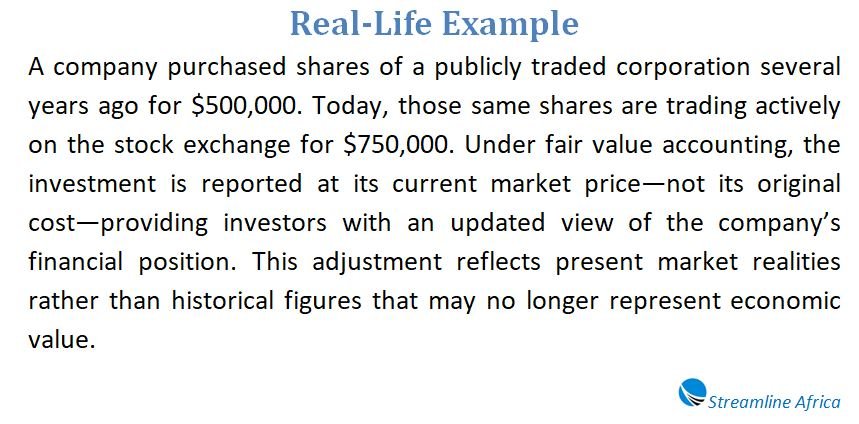
For assets actively traded—stocks, bonds, commodities—fair value mirrors the quoted market price. But many assets lack such easy reference points. A car, for instance, loses value the moment it leaves the dealership and is not continuously traded thereafter. A piece of machinery, custom-built production line, or even residential property may involve more complex estimations. Accountants must weigh specifications, age, wear, and available market data. When no clear comparisons exist, fair value becomes more judgment-based.
Consider a real-world example. A firm builds a commercial kitchen for $2 million. Five years later, there is no active market for selling such a facility. Estimating its fair value becomes challenging because it involves unobservable assumptions: what would another buyer realistically pay for a kitchen of this scale and age? Similarly, historical cost reporting of land purchased decades ago often understates value relative to present market conditions. Fair value accounting updates those numbers, making financial statements more useful to investors seeking current insight.
The U.S. Framework: ASC 820
In the United States, the Financial Accounting Standards Board (FASB) introduced guidance in 2006 through FAS 157, later codified as ASC Topic 820. Its purpose was to create consistency in how companies estimate fair value. The standard emphasizes that estimates should reflect the perspective of market participants, not management’s own preferences.
Topic 820 introduces a hierarchy of inputs:
- Level 1: Direct market quotes for identical assets or liabilities in active markets. This is the gold standard because it involves no guesswork.
- Level 2: Inputs that are observable but indirect—such as prices of similar assets, interest rates, or credit spreads. These require more interpretation.
- Level 3: Unobservable inputs, typically based on internal models and assumptions. These estimates must still attempt to reflect what an independent market participant would assume, but they carry greater subjectivity.
This layered system acknowledges that not all assets have liquid markets. While Level 1 ensures reliability, Level 3 introduces flexibility where no objective data exists. Yet with flexibility comes responsibility: preparers and auditors must guard against bias, ensuring neutrality in the process.
Methods of Valuation
ASC 820 also outlines three main approaches for calculating fair value:
Market Approach
This relies on comparing an asset to similar ones sold in the marketplace. It works best for securities, commodities, or real estate where active transaction data exists. For instance, valuing a corporate bond may involve looking at yields on comparable instruments.

Cost Approach
Here, the focus is on replacement cost. How much would it take to reproduce the asset’s service potential today? This might involve looking up blue book values for cars or calculating the costs of assembling a production line from scratch. Depreciation, obsolescence, and technological changes all factor in.
Income Approach
This projects future cash flows and discounts them back to present value. It is commonly used for intangible assets like patents or trademarks, where future earnings potential drives worth. Because it often relies heavily on assumptions, it tends to use Level 3 inputs. Discount rate selection, risk adjustments, and forecasts all significantly influence the outcome.
Each technique has strengths and weaknesses. Market data is reliable but not always available. Replacement costs may not reflect utility to a particular buyer. Cash flow models provide insight into future value but rest on fragile assumptions. In practice, accountants often use a combination to triangulate a fair estimate.
Fair Value in the Futures Market
Beyond corporate balance sheets, the concept of fair value also arises in derivatives trading. In the futures market, fair value represents the equilibrium between the spot price and the future contract price after factoring in interest rates, dividends, or carrying costs. Traders watch this closely because deviations create arbitrage opportunities. While seemingly technical, this reflects the same principle: fair value acts as a benchmark, guiding pricing and decision-making.
IFRS and International Application
The International Accounting Standards Board issued IFRS 13 in 2011, aligning global practices with the U.S. framework. Like ASC 820, IFRS defines fair value as the price for selling an asset or transferring a liability in an orderly market transaction. It stresses consideration of credit risk, meaning valuations must reflect the counterparty’s likelihood of default.
Yet differences remain. U.S. GAAP is stricter in prohibiting certain assets, like property, from being carried at fair value. IFRS allows more flexibility. For example, companies under IAS 16 may revalue property, plant, and equipment to fair value, reporting gains or losses in comprehensive income. Investment property under IAS 40 is even more closely tied to fair value, with firms required to either record or disclose such figures. These divergences mean that two companies with similar assets—one reporting under IFRS, another under U.S. GAAP—could present noticeably different financial pictures.

Why Fair Value Matters
The adoption of fair value has not been without controversy. Critics argue that it injects volatility into financial statements, as market swings directly impact reported values. Others worry about the subjectivity involved in Level 3 estimates, fearing manipulation. Proponents, however, stress its relevance. Investors care less about what a company paid for an asset decades ago and more about what it is worth now. Fair value provides that perspective, making financial information more transparent and decision-useful.
The financial crisis of 2008 reignited debates. Some blamed fair value accounting for deepening losses by forcing banks to write down assets in illiquid markets. Regulators later clarified that fair value does not mean fire-sale pricing but rather an orderly transaction assumption. Still, the controversy underscores how powerful and sensitive the concept is.
Conclusion: The Evolving Role of Fair Value
Fair value stands as one of the cornerstones of modern financial reporting. It seeks to capture the most reasonable current measure of what assets and liabilities are worth, balancing objectivity with necessary judgment. By providing a more accurate snapshot than historical cost alone, it empowers investors, managers, and regulators with insights grounded in present realities.
As markets evolve and financial products grow more complex, the importance of fair value will only expand. Whether in merger negotiations, balance sheet disclosures, or derivative pricing, fair value is not just an accounting rule—it is a language of economic reality. And while it will always involve both science and art, its ultimate aim remains clear: to bring clarity to the ever-shifting question of value.