

Withholding tax is an important part of Tanzania’s corporate tax system. Instead of waiting for the person receiving income to account for all tax later, the law requires the payer to deduct tax from certain payments and remit it to the Tanzania Revenue Authority.
For businesses, this means a routine payment can create an immediate tax obligation. A company in Dar es Salaam paying interest to a lender, a tourism operator in Arusha leasing equipment, or a mining business near Mwanza paying service fees may all need to consider withholding tax before releasing the full amount.
The correct treatment depends mainly on the type of payment, whether the recipient is resident or non-resident, and whether a tax treaty or statutory exemption provides relief.
Dividends and Interest
Dividend withholding rates vary according to the relationship between the shareholder and the company making the distribution.
A dividend paid to a resident company that controls at least 25% of the voting power and owns at least 25% of the shares attracts withholding tax at 5%. The corresponding rate for a non-resident recipient is 10%.
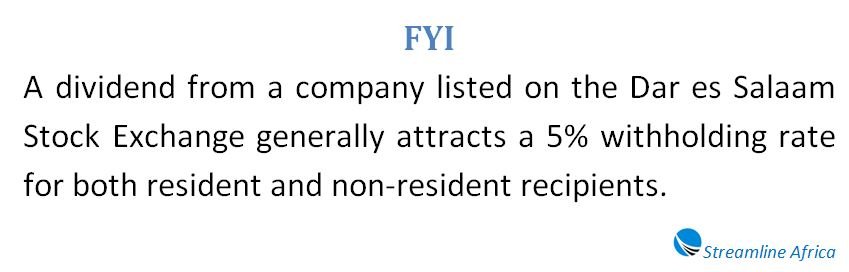
Dividends distributed by companies listed on the Dar es Salaam Stock Exchange generally attract a 5% rate for both resident and non-resident recipients. Other dividends are normally subject to 10%.
Interest payments generally carry withholding tax of 10%, whether the recipient is resident or non-resident. However, particular financing arrangements may qualify for exemptions, making it important to examine the nature of the loan before withholding tax is calculated.
Tax Treatment of Rental Payments
Tanzania applies different withholding rules depending on the asset being rented.
Rent for land and buildings is generally subject to a 10% withholding rate for both residents and non-residents. The same 10% rate applies to aircraft leases and payments for construction machinery or equipment.
Motor vehicle rentals also attract 10%.
The position differs for other assets. Where the recipient is resident, the applicable withholding rate is generally zero. A payment to a non-resident for the rental of another type of asset is normally subject to 10%.
For example, if a Dodoma-based business rents qualifying machinery from an overseas supplier, it should establish the relevant withholding obligation before paying the invoice.
Royalties and Natural Resource Payments
Royalties are generally subject to withholding tax at 15% for both resident and non-resident recipients. A special 10% rate applies where the payment concerns the use of cinematographic films, videotapes, sound recordings, or comparable media.
Natural resource payments are also generally taxed at 15%, regardless of whether the recipient is resident or non-resident.
These provisions can be particularly relevant to companies operating in mining, media, technology, entertainment and businesses that rely heavily on intellectual property.
Services, Directors and Digital Activities
Service fees paid to residents generally attract withholding tax at 5%. The rate rises to 15% when the recipient is non-resident.
Directors’ fees paid for duties other than full-time service are generally subject to a 15% withholding rate for residents and non-residents.
Tanzania’s withholding framework also covers newer forms of economic activity. Payments to resident digital content creators are subject to 5% withholding tax. Payments to owners of digital assets for their exchange or transfer attract a 3% rate. The digital-asset provision can also extend to payments involving non-residents.
These rules demonstrate how the withholding system has expanded beyond traditional payments such as dividends, rent and interest.
Commissions, Insurance and Government Purchases
Insurance premiums paid to resident recipients generally have a zero withholding rate, while payments to non-residents attract 10%.
Money-transfer commissions paid to agents are subject to 10%. Fees paid to commercial bank agents and digital payment agents similarly attract a 10% rate. A 10% rate also applies to commissions connected with gaming advertisements or promotions.
Government institutions must generally deduct 2% when making qualifying payments for goods.
A 2% withholding rate also applies to payments for precious metals, metallic minerals, industrial minerals, gemstones and other precious stones made to holders of primary mining licences or artisanal miners.
Payments for verified carbon-emission reductions are subject to withholding tax at 10%.
Situations Where Relief May Be Available
Not every transaction must ultimately bear the standard withholding rate. Tanzania provides relief in several specific circumstances.
Depending on the applicable conditions, concessions may be available to investors operating under Special Economic Zone or Export Processing Zone arrangements and to qualifying strategic investors.
Relief can also apply to particular financing instruments and projects. These may include certain government-project loans, corporate bonds, municipal bonds and qualifying Dar es Salaam Stock Exchange bonds with a maturity of at least three years.
Certain loans obtained by resident financial institutions from non-resident financial institutions or funds may also receive favourable treatment.
Businesses should therefore check whether an exemption applies before automatically deducting the headline rate.
How Double Tax Treaties Affect Withholding
Tanzania has double tax treaties with several countries. These agreements can alter the withholding tax imposed on cross-border income.
The countries covered in the referenced treaty framework include Canada, Denmark, Finland, India, Italy, Norway, South Africa, Sweden and Zambia.
Treaty rates vary considerably. For dividends, for example, Canada’s treaty provides rates of 20% or 25%, while India’s provides 5% or 10%. Italy provides a 10% rate, and South Africa provides rates of 10% or 20%. Sweden’s treaty contains rates of 15% or 25%.
The lower dividend rate under some treaties depends on the recipient’s ownership or voting interest in the company paying the dividend.
Treaty Rates for Interest and Royalties
Treaty provisions also cover interest and royalties.
Under the referenced framework, interest rates include 15% for Canada, Finland, Italy, Norway and Sweden; 12.5% for Denmark; and 10% for India and South Africa. The Zambia treaty indicates zero, subject to the applicable treaty conditions.
Royalty rates include 20% under treaties with Canada, Denmark, Finland, Norway and Sweden. India and South Africa provide 10%, while Italy provides 15%.
A treaty rate does not automatically replace Tanzania’s domestic rate. Where domestic withholding tax is lower, the domestic treatment may continue to produce the lower liability. Treaty relief becomes particularly relevant when the treaty produces a lower effective tax burden.
Management and Technical Fees
Cross-border management and technical services require careful review because treaty wording is not uniform.
The referenced treaty rates for management or technical fees include 20% for Canada, Denmark, Finland, Norway and Sweden. India’s treaty indicates zero, while Italy shows 15%.
South Africa’s agreement does not contain a dedicated management, technical or service-fee article. In practice, withholding tax is still generally deducted according to the applicable domestic rules and treaty interpretation.
For Zambia, the referenced treatment is zero, although domestic taxation can apply where the income is exempt from tax in Zambia.
Ownership Conditions Matter
Companies claiming treaty relief should look beyond the headline percentages.
Under the Canadian and South African arrangements, the lower specified dividend rate applies where the beneficial owner is a company controlling, directly or indirectly, at least 15% of the voting power of the company distributing the dividend.
India uses a 25% shareholding threshold for its lower dividend rate.
For Sweden, the recipient must generally own at least 25% of the shares during the six months immediately preceding the dividend payment to qualify for the lower treaty rate.
These conditions make ownership records and transaction documentation important parts of withholding-tax compliance.
Special Treatment of Government Borrowing
Another important exemption concerns certain government borrowing arrangements.
Withholding tax relief applies to interest, fees and other qualifying payments connected with loans made to the Tanzanian government by non-resident banks, financial institutions and foreign governments.
The exemption has retrospective effect from 1 June 2017.
This provision can significantly affect the tax treatment of large public-sector financing arrangements involving international lenders.
Managing Withholding Tax in Practice
For businesses operating in Tanzania, withholding tax should be reviewed before a payment is processed rather than after the money has already been transferred.
The first step is identifying exactly what the payment represents. The business should then determine the recipient’s residence, establish the domestic withholding rate and check whether an exemption applies. Cross-border transactions require an additional review of any relevant double tax treaty.
A company should also retain contracts, invoices, proof of residence, ownership information and documents supporting any exemption or treaty relief claimed.
This approach makes withholding tax more manageable. Rather than treating it simply as another percentage deducted from an invoice, businesses can view it as a transaction-level compliance process where the payment type, recipient, ownership structure and treaty position determine the final tax treatment.
FAQs
What withholding tax applies to dividends?
Dividend rates generally range from 5% to 10%, depending on factors such as residency, shareholding, voting control and whether the paying company is DSE-listed.
How is interest taxed?
Interest payments generally attract 10% withholding tax for both residents and non-residents, although qualifying exemptions may apply.
What rate applies to rent?
Rent on land, buildings, aircraft, construction equipment and motor vehicles generally attracts 10%. Other assets may receive different treatment depending on the recipient’s residence.
What is the withholding tax rate on royalties?
Royalties generally attract 15%. However, qualifying payments involving films, sound recordings and similar media are subject to a 10% rate.
How are service fees treated?
Service fees paid to residents generally attract 5% withholding tax, while payments to non-residents are generally subject to 15%.
Are digital content creators covered by withholding tax?
Yes. Payments to resident digital content creators are generally subject to 5% withholding tax.
What rate applies to digital asset transactions?
Payments to owners of digital assets for their exchange or transfer generally attract withholding tax at 3%.
Are government purchases of goods subject to withholding tax?
Yes. Qualifying payments for goods made by government institutions generally attract a 2% withholding tax.
Can investors qualify for withholding tax relief?
Yes. Relief may be available to qualifying SEZ/EPZ investors, strategic investors and certain financing or investment arrangements.
Can a double tax treaty reduce withholding tax?
Potentially. Where an applicable treaty provides more favourable treatment than Tanzania’s domestic rules, treaty relief may be available if the required conditions are satisfied.
What should businesses check before making a payment?
Businesses should identify the payment type, confirm the recipient’s residence, check the domestic rate, review possible exemptions and consider any applicable double tax treaty.