
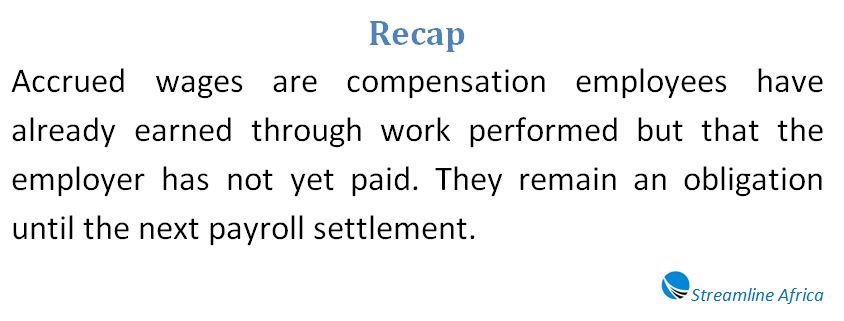
Accrued wages are employee compensation costs that a business has already incurred but has not yet paid by the end of an accounting period. They arise whenever employees perform work during one reporting period but receive their salaries, wages, overtime payments, commissions, or other qualifying compensation in a later period.
From an accounting perspective, the important issue is not when employees receive the money. What matters is when the business benefited from their work. If employees have already provided services, the associated labour cost belongs to that reporting period even when the payroll payment will occur several days or weeks later.
This treatment helps businesses present a more realistic picture of their financial performance. Without recognising accrued wages, expenses could be understated in one period and overstated in another simply because payroll dates do not perfectly correspond with month-end or year-end reporting dates.
Accrued wages therefore form part of a company’s short-term obligations and are normally presented as a current liability on the balance sheet.
Why Accrued Wages Arise
Payroll schedules rarely align perfectly with accounting periods. A company might pay employees every two weeks, twice a month, weekly, or monthly. However, financial statements are normally prepared according to specific reporting dates such as the end of a month, quarter, or financial year.
Suppose employees work during the final five days of March, but the company’s next payroll date falls on April 5. Although those employees have not received their money as of March 31, the organisation has already received the benefit of their labour. The wages connected with those five days are therefore an expense of March.
The unpaid amount becomes an accrued wage liability until payment is made.
The same concept may apply to unpaid overtime, performance incentives, commissions, bonuses, and certain payroll-related benefits, depending on when employees become entitled to receive them.
Accrued wages are therefore not necessarily the result of late payroll processing. In many businesses, they arise naturally because of differences between the payroll calendar and the accounting calendar.
The Role of Accrual Accounting
Accrued wages are closely connected to the accrual basis of accounting. Under this approach, businesses recognise economic activity when it occurs rather than waiting for cash to move between parties.
This differs from pure cash accounting, where an expense might only be recorded once money has actually been paid.
Consider an employee who performs work worth $2,000 during the final week of June but receives the payment during the first week of July. Under accrual accounting, the $2,000 expense belongs to June because that is when the employee’s work contributed to the company’s operations.
Recording the expense in July simply because the cash was paid then would distort both reporting periods. June expenses would appear lower than they actually were, while July expenses would appear unnecessarily high.
Accrued wage accounting solves this timing problem.
How the Matching Principle Applies
Another important accounting concept behind accrued wages is the matching principle. This principle aims to align expenses with the period in which the related economic benefits or revenues are generated.
Employees are often directly involved in producing goods, serving customers, managing operations, supporting sales, developing products, or carrying out administrative functions. Their labour contributes to the organisation’s activities during a particular period.
Consequently, the cost of that labour should generally be recognised in the same period.
Imagine a consulting firm completing a major assignment during the final week of December. Employees spend several days finalising the project, but the payroll relating to those days is not processed until January. Recording the employee costs in January would separate the labour expense from the period in which the project work was actually performed.
Accruing the wages at December 31 allows the financial statements to reflect both the economic activity and its associated cost more appropriately.

Where Accrued Wages Appear in the Financial Statements
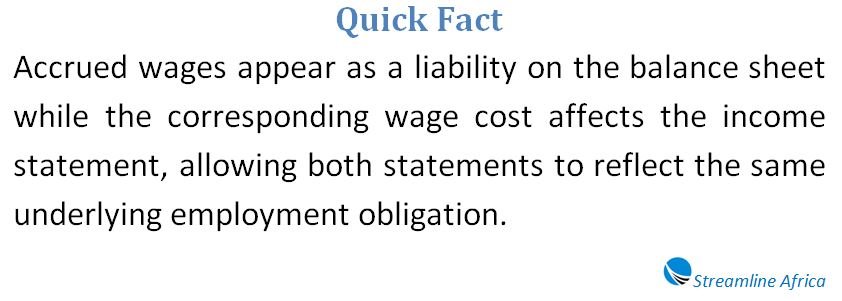
Accrued wages affect both the income statement and the balance sheet.
On the income statement, the company records the relevant salary or wage expense. This reduces operating profit because the organisation has consumed employee services during the reporting period.
At the same time, the company records an accrued wages liability on the balance sheet. This liability represents the amount that the organisation still owes employees.
Because payroll obligations are generally expected to be settled within a relatively short period, accrued wages are normally classified among current liabilities.
When payment eventually occurs, cash decreases and the liability is removed. The expense is not recorded again because it was already recognised when the employees performed the work.
This distinction prevents businesses from counting the same payroll cost twice.
Accounting Entry for Accrued Wages
The accounting treatment normally begins with an adjusting journal entry at the reporting date.
Suppose a company determines that employees have earned $18,000 in wages that will not be paid until the next accounting period.
The company would record:
Debit: Wages or Payroll Expense — $18,000
Credit: Accrued Wages Payable — $18,000
The debit recognises the labour cost in the income statement, while the credit creates the corresponding obligation on the balance sheet.
When the employees are eventually paid, the liability must be cleared. Depending on the company’s accounting procedures, this may be done directly during payroll processing or through a reversing entry at the beginning of the new period.
A reversing approach can simplify payroll accounting because the earlier accrual is cancelled before the actual payroll transaction is recorded.
Regardless of the method used, the objective remains the same: the employee expense must be attributed to the correct reporting period without duplication.
A Practical Payroll Example
Consider a manufacturing company that pays employees every second Friday. The final payroll period of December begins on December 27 and ends on January 9.
Employees work from December 27 through December 31 before the company’s financial year closes. However, payment for the entire payroll period will not be made until January.
Assume the company calculates that employees earned $32,000 for work completed between December 27 and December 31.
At December 31, the company should recognise the $32,000 as an employee compensation expense and establish an equivalent accrued wage liability.
The remaining payroll relating to January 1 through January 9 belongs to the new financial year.
This allocation is important because recording the entire payment in January would understate the previous year’s employment costs. The accrual ensures that each reporting period contains the expenses attributable to the work performed during that period.
Accrued Wages and Cash Flow
An interesting feature of accrued wages is that recognising the expense does not immediately require a cash payment.
When accrued wages increase, the company temporarily retains cash that it ultimately owes employees. From a working-capital perspective, an increase in accrued liabilities can therefore support short-term operating cash flow.
For example, if accrued wages rise by $50,000 during a reporting period, the company has recognised an additional $50,000 expense without yet paying that amount in cash. All else being equal, this creates a temporary positive adjustment when converting accounting profit into operating cash flow.
The relationship works in the opposite direction when accrued wages decline. A reduction usually means that the business has settled previously recorded payroll obligations, producing a cash outflow.
However, this temporary cash-flow benefit should not be interpreted as permanently available financing. Employee wages are obligations that generally need to be paid according to agreed payroll schedules and applicable employment requirements.
Why Businesses Should Monitor Accrued Wage Balances
Accrued wages can provide valuable information about payroll timing, operational activity, and short-term liabilities. Finance teams should therefore review changes in the balance rather than treating the figure as a routine accounting adjustment.
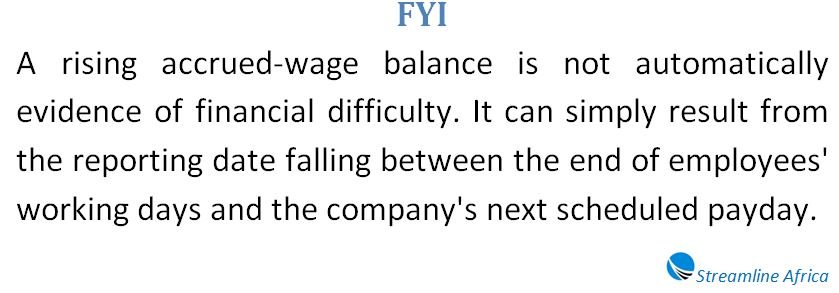
A higher accrued wage balance may simply reflect a reporting date occurring immediately before payday. It could also result from workforce expansion, increased overtime, higher salaries, performance bonuses, or seasonal labour requirements.
Unexpected movements, however, may deserve further investigation.
For example, a rapidly increasing balance could indicate payroll processing delays, inaccurate accrual calculations, unusual overtime costs, or unpaid compensation obligations. A declining balance may reflect recent payroll settlement, workforce reductions, or changes in payment timing.
Understanding the underlying reasons allows management to distinguish normal timing differences from potential operational problems.
The Difference Between Accrued Wages and Accounts Payable
Although both accrued wages and accounts payable represent obligations that have not yet been settled, the two liabilities arise differently.
Accounts payable generally relates to invoices received from suppliers for goods or services purchased on credit. The amount owed is normally supported by a supplier invoice containing an agreed payment amount and due date.
Accrued wages arise because employees have already performed work even though the related payroll payment has not yet occurred.
There may therefore be no external invoice associated with the liability. Instead, businesses calculate the amount using payroll records, employee salaries, hourly rates, attendance data, overtime information, commissions, or other compensation records.
Both balances affect working capital, but their operational causes and settlement processes are different.
Why Delaying Employee Payments Is Risky
Although accrued wages may temporarily preserve cash, organisations should not deliberately postpone employee compensation simply to improve liquidity.
Employees generally depend on predictable payroll schedules for their own financial commitments. Repeated or unexplained delays can quickly undermine confidence in the employer.
Payroll problems may contribute to employee dissatisfaction, grievances, reduced morale, absenteeism, disengagement, and higher turnover. Persistent failure to pay employees according to agreed arrangements can also create contractual, regulatory, and reputational consequences depending on the jurisdiction.
This makes accrued wages different from some supplier obligations. Businesses sometimes negotiate longer payment periods with vendors as part of normal commercial arrangements. Employee compensation, however, is usually governed by employment contracts, payroll schedules, workplace policies, and labour requirements.
The liability should therefore be treated as a genuine short-term obligation rather than an informal source of financing.
Accrued Wages and Workforce Management
The concept also has implications beyond accounting. Reliable payroll administration contributes significantly to employee trust.
Workers expect compensation to be calculated accurately and paid according to agreed timelines. Even when the accounting records properly recognise accrued wages, employees may become concerned if actual payments are regularly delayed.
For this reason, finance and human resources teams should work closely together. Payroll cut-off dates, attendance records, leave information, overtime approvals, commissions, salary adjustments, and employee exits can all influence the accuracy of accrued wage calculations.
Strong coordination reduces the likelihood of payroll errors while improving the reliability of financial reporting.
It also helps management identify unusual labour-cost movements before they become larger operational issues.
Calculating Accrued Wages Accurately
The calculation will depend on the organisation’s compensation structure.
For salaried employees, accountants may determine a daily wage rate and multiply it by the number of unpaid working days completed before the reporting date.
For hourly employees, the calculation may rely on confirmed hours worked multiplied by the applicable hourly wage.
Companies may also need to include overtime, shift allowances, commissions, bonuses, employer payroll taxes, or other employment-related costs where accounting policies require them to be accrued.
Accuracy is especially important around year-end because payroll accruals can materially affect reported operating expenses, liabilities, and profitability.
Businesses should therefore use reliable attendance records, approved payroll information, and consistent calculation methods when determining the amount outstanding.
What Accrued Wages Tell Decision-Makers
Accrued wages may appear to be a technical accounting item, but they provide useful information about the relationship between labour costs, payroll timing, and short-term cash obligations.
Investors and financial analysts may review movements in accrued liabilities when analysing working capital and operating cash flow. Management teams may examine them when forecasting payroll requirements and short-term liquidity. Finance teams rely on them to ensure expenses are recorded in the correct reporting period, while HR and payroll teams can use related information to identify compensation issues.
The balance becomes particularly important for businesses with large workforces, irregular payroll cycles, significant overtime, commission-heavy compensation structures, or rapidly changing staffing levels.
Building Stronger Accrued Wage Controls
Effective management of accrued wages requires more than simply posting an adjustment at month-end.
Companies should establish clear payroll cut-off procedures, maintain accurate employee records, reconcile payroll reports with the general ledger, investigate material month-to-month differences, and ensure that accrued liabilities are cleared once employees are paid.
Businesses should also periodically review their assumptions. If the workforce expands or compensation structures change, historical accrual percentages may no longer produce reliable results.
Automation can help by linking payroll systems, timekeeping records, and accounting platforms. However, management review remains necessary, particularly where bonuses, commissions, unpaid leave, overtime, or employee departures create unusual calculations.
Strong controls improve the reliability of financial statements while reducing the risk of payroll disputes.
Why Accrued Wages Matter
Accrued wages ensure that employee compensation is recognised when the underlying work occurs rather than simply when cash changes hands. This produces financial statements that more accurately reflect the organisation’s actual cost of operating during a reporting period.
The concept also illustrates an important distinction between profitability and cash flow. A company may recognise payroll expenses today while paying employees several days later, creating a temporary difference between reported earnings and cash movement.
For management, the objective should not be to maximise accrued wages as a source of short-term liquidity. Instead, the priority should be accurate reporting, disciplined payroll administration, sufficient cash planning, and timely payment of employees.
When properly calculated and managed, accrued wages support credible financial reporting, stronger working-capital analysis, effective payroll controls, and healthier relationships between organisations and the people whose work drives their operations.
Important Questions and Answers About Accrued Wages
Why do businesses record accrued wages?
Businesses record them so labour costs appear in the period when employees actually performed the work, rather than when cash happens to be paid. This produces a more accurate picture of expenses and profitability.
Are accrued wages an asset or a liability?
They are a current liability because they represent money the business owes employees and normally expects to pay in the near term.
How does the matching principle apply to accrued wages?
The matching principle requires businesses to recognise expenses in the appropriate reporting period. If employees work in December but are paid in January, the portion earned in December should generally be recognised as a December expense.
What is the journal entry for accrued wages?
At period-end, the business generally debits Wages or Payroll Expense and credits Accrued Wages Payable. This recognises both the employment cost and the outstanding obligation.
What happens when accrued wages are eventually paid?
The accrued liability is cleared when payment occurs. Businesses may also use reversing entries at the beginning of the following accounting period to simplify payroll processing and prevent double-counting expenses.
How are accrued wages different from accounts payable?
Accrued wages relate specifically to employee compensation already earned but unpaid. Accounts payable generally represents amounts owed to suppliers or vendors for goods and services purchased by the business.
Can accrued wages affect cash flow?
Yes. An increase in accrued wages means the company has recognised an expense while temporarily retaining the related cash. Once those wages are paid, cash leaves the business and the outstanding liability falls.
Why should companies closely monitor accrued wages?
Regular monitoring helps businesses identify payroll timing differences, unusual overtime, workforce-cost increases, inaccurate accruals, and potential payment problems before they become larger financial or employee-relations issues.
Can delaying accrued wages affect employees?
Yes. Repeated payroll delays can damage employee confidence, morale, engagement, and retention. Accrued wages should therefore reflect legitimate timing differences rather than become a strategy for postponing employee compensation.