

When evaluating the long-term financial strength of a business, one of the most useful tools available is the coverage ratio. This metric helps determine whether a company generates enough earnings or holds sufficient resources to meet its financial commitments over time. These commitments can include loan repayments, interest charges, lease obligations, and even dividend payments to shareholders.
Rather than focusing on short-term liquidity, coverage ratios take a broader view. They assess whether a company can sustain its operations while honoring its financial responsibilities. For investors, lenders, and analysts, this makes coverage ratios an essential part of understanding risk and stability.
What Coverage Ratios Reveal About a Business
At its core, a coverage ratio answers a simple but important question: can the business comfortably meet its obligations? A higher ratio generally suggests that the company has a healthy buffer between what it earns and what it owes. This buffer acts as protection during downturns or unexpected financial pressure.
On the other hand, a lower ratio may signal vulnerability. However, it is important not to jump to conclusions. A single low figure does not automatically mean distress. Businesses may temporarily show weaker ratios due to expansion, seasonal changes, or strategic investments. This is why reviewing trends over time provides more meaningful insight than relying on a single snapshot.

Why Coverage Ratios Matter to Investors and Analysts
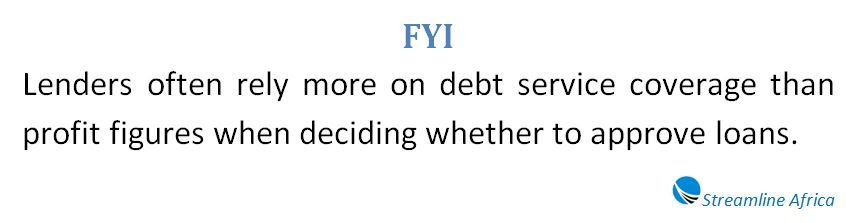
Coverage ratios are widely used in financial analysis because they offer a practical way to compare companies and assess their resilience. Investors often rely on these metrics to identify firms that are better positioned to survive economic uncertainty. Lenders use them to decide whether to extend credit and under what terms.
Comparisons become especially valuable when evaluating companies within the same industry. For instance, a manufacturing firm and a technology startup may operate under very different financial structures, making direct comparison misleading. However, comparing two firms in the same sector can reveal which one manages its obligations more effectively.
It is also worth noting that what qualifies as a “safe” ratio depends heavily on the industry. Capital-intensive sectors often carry higher debt levels, which naturally affects their ratios.
The Most Common Types of Coverage Ratios
Different coverage ratios focus on specific aspects of a company’s financial obligations. Understanding the distinctions between them helps build a more complete financial picture.
Interest Coverage Ratio
This ratio examines how easily a company can pay the interest on its outstanding debt using its operating income. It reflects how many times a company’s earnings can cover its interest expenses.
Interest Coverage Ratio=Interest ExpenseEBIT
A higher figure indicates that interest payments are well within the company’s ability to manage. Many analysts consider a ratio of two or more as a comfortable level, suggesting that earnings are at least double the interest obligations.
Debt Service Coverage Ratio
While the interest coverage ratio focuses only on interest payments, the debt service coverage ratio takes a broader approach. It evaluates whether a company can cover both principal repayments and interest using its operating income.
DSCR=Total Debt ServiceNet Operating Income
A value of one indicates that the company generates just enough income to meet its debt payments. Anything above one suggests a margin of safety, while a figure below one may indicate potential difficulty in meeting obligations.
Asset Coverage Ratio
Unlike the previous ratios that rely on income, the asset coverage ratio looks at the company’s balance sheet. It measures whether the company’s assets, after subtracting short-term liabilities, are sufficient to cover its total debt.
Asset Coverage Ratio=Total DebtTotal Assets−Short-Term Liabilities
This ratio is particularly useful for understanding what would happen if a company needed to liquidate assets to repay its obligations. Asset-heavy industries often aim for higher ratios to maintain confidence among lenders and investors.
Other Coverage Ratios Worth Knowing
Beyond the main categories, there are several additional coverage ratios that provide more specialized insights.
The fixed-charge coverage ratio expands on interest coverage by including other fixed costs such as lease payments. It helps determine whether a company can handle all recurring financial obligations, not just debt-related ones.
The loan life coverage ratio is commonly used in project finance. It evaluates whether expected cash flows over the life of a loan are sufficient to repay the outstanding debt.
Another useful measure is the EBITDA-to-interest ratio, which focuses on earnings before accounting for non-cash expenses. This provides a slightly different view of a company’s ability to meet interest payments.
Preferred dividend coverage is relevant for companies that issue preferred shares. Since these dividends are typically fixed, this ratio shows whether earnings can consistently support those payments.
In the banking sector, the liquidity coverage ratio plays a critical role. It ensures that financial institutions hold enough liquid assets to withstand short-term financial stress.
Lastly, the capital loss coverage ratio is used in more complex financial scenarios, often involving distressed assets. It indicates how much support is available to absorb losses during asset liquidation.
A Practical Illustration of Coverage Ratios
To better understand how these ratios work in practice, consider a hypothetical company called Cedar Valley Brewing. The company reports operating earnings of 300,000 dollars and pays 50,000 dollars in interest.
Using these figures, the interest coverage ratio is relatively strong, showing that earnings can cover interest payments multiple times. On the surface, this suggests financial stability.
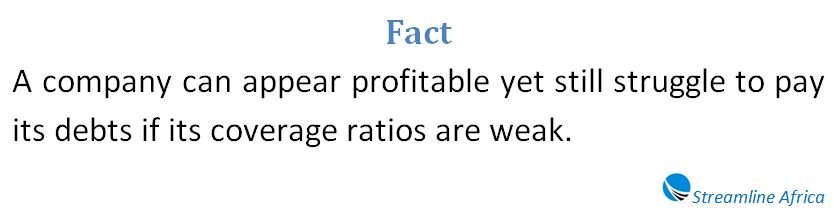
However, when looking at the broader picture through the debt service coverage ratio, the situation appears tighter. If the company must pay a total of 190,000 dollars in combined principal and interest, and its net operating income is 200,000 dollars, the margin becomes very slim.
This example highlights an important point: relying on a single ratio can be misleading. A company may appear financially secure in one area while facing pressure in another. Comprehensive analysis requires looking at multiple ratios together.
What Is Considered a Healthy Coverage Ratio?
There is no universal benchmark that applies to all industries, but many analysts use a ratio of two as a general guideline for comfort. This implies that the company generates twice as much income as needed to cover its obligations, providing a cushion against uncertainty.
However, acceptable levels vary widely. Utilities, for example, often operate with lower ratios due to their stable cash flows, while more volatile industries may require higher ratios to reassure investors.
Understanding the context is crucial. A ratio that seems low in one sector might be perfectly normal in another.
Alternative Names and Terminology
Coverage ratios are sometimes referred to by different names depending on the context. The interest coverage ratio, for instance, is also known as the times interest earned ratio. Despite the different terminology, both refer to the same concept: measuring how easily a company can meet its interest payments using operating income.
Being familiar with these terms helps avoid confusion when reviewing financial reports or analysis from different sources.
Final Thoughts on Coverage Ratios
Coverage ratios play a central role in evaluating a company’s financial durability. They provide insight into how well a business can manage its obligations using available income or assets. For lenders, they help determine creditworthiness. For investors, they offer a glimpse into potential risk and long-term viability.
No single ratio tells the full story, which is why a balanced approach is essential. By examining multiple coverage ratios and considering industry context, it becomes easier to form a clear and accurate view of a company’s financial health.
Ultimately, strong coverage ratios signal stability and confidence, while weaker ones call for closer examination. Either way, they remain an indispensable part of financial analysis and decision-making.
Commonly Asked Questions about Coverage Ratio
Why do investors pay attention to coverage ratios?
Investors use these ratios to understand risk. A company with strong coverage ratios is more likely to survive downturns and continue paying its debts, making it a safer investment.
Does a high coverage ratio always mean a company is healthy?
Not always. While a high ratio suggests strength, it could also mean the company is not using debt efficiently to grow. Context and industry standards matter.
What does a low coverage ratio indicate?
A low ratio can signal potential difficulty in meeting financial obligations. However, it might also reflect temporary conditions like expansion or seasonal fluctuations.
What is the difference between interest coverage and debt service coverage?
Interest coverage focuses only on interest payments, while debt service coverage includes both interest and principal repayments, giving a more complete picture of debt obligations.
Why is it important to compare companies within the same industry?
Different industries operate with different financial structures. Comparing similar businesses ensures the analysis is fair and meaningful.
What is considered a “safe” coverage ratio?
Generally, a ratio of two or higher is seen as comfortable. This means the company earns at least twice what it needs to cover its obligations.
How does the asset coverage ratio differ from others?
Unlike income-based ratios, asset coverage looks at whether a company’s assets can cover its debts if needed, offering a balance sheet perspective.
Can one coverage ratio give a complete financial picture?
No, relying on a single ratio can be misleading. A company might perform well in one area but struggle in another, so multiple ratios should be analyzed together.
How often should coverage ratios be reviewed?
They should be tracked over time rather than viewed once. Trends reveal whether a company’s financial position is improving or deteriorating.