

Eswatini is one of Africa’s smallest economies, but its commercial importance extends beyond the size of its population. The landlocked kingdom is positioned between South Africa and Mozambique, giving businesses access to regional transport corridors, established supply chains and larger consumer markets. Johannesburg is only a few hours away by road, while the ports of Maputo and Durban provide international shipping options for exporters.
This location makes Eswatini particularly suitable for export-oriented businesses. Companies can use the country as a compact production, processing or distribution base while targeting customers elsewhere in Southern Africa. Membership in the Southern African Customs Union also supports trade with South Africa, Botswana, Namibia and Lesotho.
However, Eswatini’s small domestic market means that investors must plan beyond local consumption. Manufacturing and large-scale agricultural projects are more likely to succeed when they are linked to regional or international buyers.
Economic Outlook and Growth Prospects
Eswatini’s economy has recently shown stronger momentum. Real gross domestic product grew by approximately 4% in 2025, compared with about 3% in 2024, supported by manufacturing, services and investments in roads, water and energy infrastructure. Growth is expected to remain close to 4% in 2026, although maintaining this performance will require economic diversification, improved public finances and greater private-sector participation.
The country remains vulnerable to external shocks because of its close economic relationship with South Africa and its dependence on revenue from the Southern African Customs Union. These customs receipts have historically represented a substantial share of government income and can fluctuate sharply from one year to another. The IMF expects SACU revenue to decline from the unusually high levels recorded in recent years, which could place additional pressure on public spending and fiscal management.
Public debt remains below 40% of GDP, but rising debt-servicing costs and future revenue uncertainty may limit the government’s capacity to finance development projects. Companies selling heavily to public institutions should therefore examine payment risks, budget priorities and procurement timelines carefully.
Agribusiness and Food-Processing Opportunities
Agriculture remains an important part of Eswatini’s economy. Fertile land, established commercial farming operations and access to irrigation support the production of sugar, citrus fruits, maize, livestock and forestry products. Sugar continues to be one of the country’s most important exports, but there is growing potential to expand into higher-value agricultural activities.
Investors can explore fruit and vegetable processing, dairy production, meat processing, animal feed, cold storage, packaging and agricultural logistics. Opportunities also exist in irrigation equipment, farm technology, seed production and climate-smart agriculture.
Greater value can be created when agricultural products are processed locally instead of being exported as raw materials. Facilities for refining, canning, drying, packaging and refrigerated storage could help farmers reach supermarkets, hotels and regional distributors while reducing post-harvest losses.
Manufacturing and Industrial Development
Manufacturing is one of Eswatini’s strongest investment prospects because of the country’s access to South African supply chains and regional trade agreements. Potential industries include textiles and apparel, food and beverages, timber products, chemicals, plastics, metal products, packaging materials and light engineering.
Eswatini may appeal to investors seeking a smaller production base with lower operating complexity than larger regional economies. However, competitiveness depends on reliable electricity, efficient borders, skilled labour and predictable access to raw materials.
Export-oriented manufacturers should evaluate transport costs, customs requirements and delivery times before choosing a site. Factories located near major roads or border crossings may benefit from easier access to South African distributors and Mozambican ports.
Digital Economy and ICT Investment
Eswatini’s digital economy is becoming more important to its long-term development. Opportunities are emerging in digital payments, financial technology, e-commerce, software services, cybersecurity, business-process outsourcing and government technology.
The World Bank has identified digital transformation as a major pathway for improving productivity, employment and economic resilience. Expanding affordable internet access, strengthening digital skills and modernising government services could enable businesses to operate more efficiently and reach customers beyond the country’s borders.
Investors may find demand for cloud services, online education, logistics platforms, digital accounting systems and mobile-based services. Companies entering this sector should nevertheless assess connectivity costs, data protection requirements, cybersecurity risks and the availability of specialised talent.
Tourism, Energy and Other Priority Sectors
Tourism offers potential through wildlife experiences, cultural attractions, festivals, eco-lodges, conference facilities and cross-border travel packages. Eswatini’s proximity to South Africa and Mozambique makes it possible to include the country in wider regional itineraries.
Renewable energy is another promising area. Solar power, biomass, energy storage and industrial power solutions could reduce dependence on imported electricity while improving energy security for businesses and communities.
The Eswatini Investment Promotion Authority also identifies mining, agribusiness, manufacturing, tourism, information and communications technology, and energy as priority sectors for investment.

Foreign Ownership and Business Establishment
Foreign investors may generally own and direct companies in Eswatini without being required to have a local shareholder. This provides flexibility for international businesses seeking full operational control.
Property rules are more restrictive. Noncitizens and foreign-owned companies cannot usually purchase residential land directly, although leasing arrangements are available. Agricultural, industrial and commercial land transactions may also require additional approvals depending on the location and classification of the property.
Before committing capital, investors should confirm land rights, lease duration, renewal conditions, zoning requirements and access to utilities. Local legal advice is essential, especially where traditional land authorities or government agencies are involved.
Corporate Tax and Investment Incentives
The standard company income tax rate was reduced from 27.5% to 25%. The change was presented in the government’s 2025 budget as part of broader efforts to improve competitiveness and encourage investment.
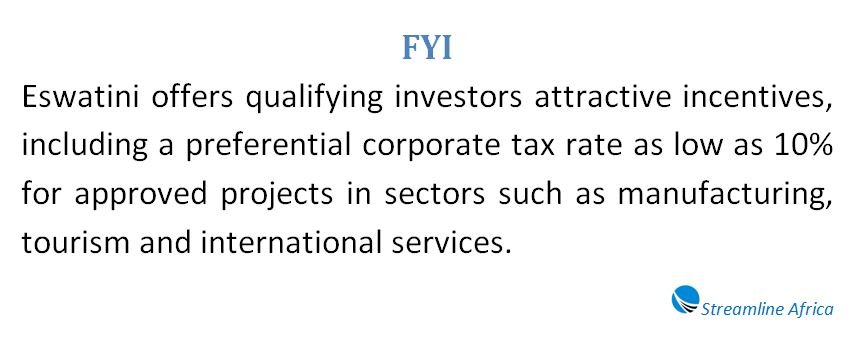
Approved projects in manufacturing, mining, international services and tourism may qualify for a reduced corporate tax rate of up to 10% for ten years. Eligible businesses may also receive exemptions from withholding tax on dividends during the concession period, accelerated capital allowances and relief on selected production-related imports.
These benefits are not automatic. Investors must meet qualifying conditions and obtain formal approval. Financial models should therefore use the standard tax rate until an incentive has been confirmed in writing.
Special Economic Zones and Industrial Facilities
Special economic zones can provide a more structured environment for export-oriented companies. Qualifying businesses may receive tax benefits, streamlined approvals and access to serviced industrial sites.
Investors should examine the availability of factory buildings, electricity, water, telecommunications, customs support and road connections before choosing a location. The cost of transporting goods to borders or ports should also be included in site-selection decisions.
Businesses operating in special economic zones must still comply with licensing, employment, environmental and reporting obligations. Investors should verify whether incentives apply to both new projects and expansions of existing operations.
Labour Market and Skills Development
Eswatini has a young labour force, but unemployment remains a major economic and social challenge. Overall unemployment was estimated at 34%, while youth unemployment reached approximately 58% in 2023.
The availability of unemployed young people creates a potential labour pool for manufacturing, agriculture, hospitality and digital services. However, investors may encounter shortages of experienced technicians, engineers, software professionals and senior managers.
Companies that introduce apprenticeships, vocational programmes and workplace training may be better positioned to build a reliable workforce. Partnerships with schools, technical institutions and community organisations can also improve recruitment and strengthen local support for investment projects.
Currency and Financial Considerations
Eswatini uses the lilangeni, which is linked at parity to the South African rand. The rand is also widely accepted, simplifying transactions with South African customers and suppliers.
The currency arrangement reduces some exchange-rate uncertainty in regional trade, but it also means Eswatini is influenced by South African monetary and financial conditions. Investors should examine banking costs, access to foreign currency, profit-repatriation procedures and cross-border payment requirements.
Companies importing equipment or raw materials from outside the rand area may still face foreign-exchange exposure and should consider appropriate risk-management measures.
Infrastructure, Logistics and Border Access
Road links with South Africa and Mozambique are important commercial assets. Exporters can access major markets and ports without crossing several countries, while extended border operations can support time-sensitive deliveries.
Nevertheless, logistics planning remains essential. Investors should assess border congestion, customs documentation, fuel costs, warehousing, cold-chain facilities and the reliability of transport providers.
Electricity availability, water supply and internet connectivity may vary by location. Agricultural processors and manufacturers should conduct technical assessments before investing in facilities that require uninterrupted power or large volumes of water.
Political, Governance and Security Risks
Eswatini remains an absolute monarchy with limited political competition and restrictions on civic freedoms. Periodic protests and violent confrontations have created uncertainty for employers, transport operators and investors.
Political unrest can disrupt border movements, employee attendance, supply chains and customer activity. Companies should develop business-continuity plans, emergency communication systems and alternative transport arrangements.
Governance is often viewed as opaque, increasing concerns about corruption, favouritism and inconsistent decision-making. Investors should maintain transparent procurement processes, strong financial controls and clear anti-bribery policies. Due diligence is especially important when working with politically exposed individuals, intermediaries or public institutions.
Violent crime is another practical concern. Employees and visitors should avoid isolated locations after dark, use trusted transport and follow suitable travel-security procedures.
Climate and Environmental Risks
Drought, changing rainfall patterns and water shortages pose risks to agriculture, food processing, manufacturing and power generation. Businesses dependent on irrigation or large water supplies should assess long-term availability rather than relying only on current conditions.
Investment opportunities exist in efficient irrigation, water recycling, reservoirs, solar energy, biomass and drought-resistant crops. Companies that incorporate climate resilience into their projects may reduce operating risks while meeting growing sustainability expectations.
Environmental permits and community impacts should be assessed at an early stage, particularly for mining, forestry, agriculture, energy and industrial projects.
Business Culture and Stakeholder Engagement
English is widely used in professional environments, making business discussions relatively accessible for international investors. However, commercial relationships are shaped by hierarchy, seniority and respect for traditional authority.
Meetings may be formal, and final decisions can require consultation with senior representatives. Investors should avoid overly aggressive negotiations and allow time for relationships to develop.
Community engagement is equally important. Projects involving land, employment or natural resources should explain how local people will benefit. Transparent recruitment, fair compensation and responsible environmental practices can help reduce resistance and protect a company’s reputation.
Practical Investor Checklist
Before entering Eswatini, investors should complete political, legal, tax and commercial due diligence. They should confirm ownership restrictions, land rights, sector licences, tax incentives and environmental requirements before committing funds.
Export routes should be tested in advance, while labour availability, electricity, water and internet reliability should be assessed at the intended project location. Companies should also establish anti-corruption controls, security procedures and business-continuity plans.
Eswatini offers credible opportunities in agribusiness, manufacturing, logistics, tourism, renewable energy and digital services. Its regional location, investment incentives and access to neighbouring markets are attractive, but commercial success requires an export-focused strategy, disciplined compliance and careful management of political, fiscal and operational risks.