

Algeria operates a broad tax framework covering corporate profits, individual earnings, consumption, property, investment income and commercial transactions. For investors, employers and businesses entering the market, tax compliance is closely linked to accounting, payroll, contracts and financial planning.
The financial year generally runs from 1 January to 31 December, and the country uses the Algerian dinar (DZD). Algeria’s system is largely declarative, meaning taxpayers are responsible for identifying, declaring and paying the taxes that apply to them. The system has evolved considerably since the 1990s as Algeria has expanded private-sector participation and opened more areas of the economy to foreign investment. A central principle remains that income arising from Algeria is generally taxable in Algeria, including certain income earned by non-residents.
Tax administration is overseen by the Direction Générale des Impôts, or DGI. For businesses, this means compliance depends not only on paying the correct amount of tax but also on meeting filing, documentation and withholding requirements throughout the year.
Read Also: Algeria Business Environment: Investment Opportunities, Market Risks and Strategic Growth Sectors
How Algeria’s Tax Framework Operates
Algeria imposes several direct and indirect taxes. These include global income tax, corporate profits tax, property tax, wealth tax, value-added tax, customs duties, registration charges, stamp duties and the single flat-rate tax.
The declarative nature of the system places substantial responsibility on taxpayers. Companies must maintain proper legal books, support their tax returns with the required information and pay close attention to withholding obligations.
Withholding is particularly important because employers may be required to deduct tax from salaries, while companies making dividend, interest, royalty or service payments may also have collection and payment responsibilities.
Tax reform has continued through successive finance legislation. The Finance Act 2022, for example, introduced measures affecting foreign non-resident companies, corporate taxation and professional activity taxation. The 2024 framework further clarified important tax rates and compliance obligations for individuals and businesses.
Determining Corporate Taxable Profit
Corporate taxation is generally based on net taxable profit, broadly calculated as income earned by the company less eligible expenses incurred in generating that income.
The taxable result may include more than day-to-day trading profit. Transactions involving the disposal of assets and activities outside the company’s principal operations can also influence the final tax base.
Algerian rules additionally consider changes in net asset values between the beginning and end of an accounting period when determining profit.
Where a company carries out several activities that attract different corporate income tax rates, the profits attributable to each activity must be identified separately. Separate accounting is therefore important where one legal entity has manufacturing, construction, tourism or other commercial operations. Failure to maintain appropriate separation may expose the business to application of the 26% rate.
Corporate Income Tax Rates in Algeria
Algeria’s corporate income tax, or IBS, applies different rates depending on the nature of the business activity.
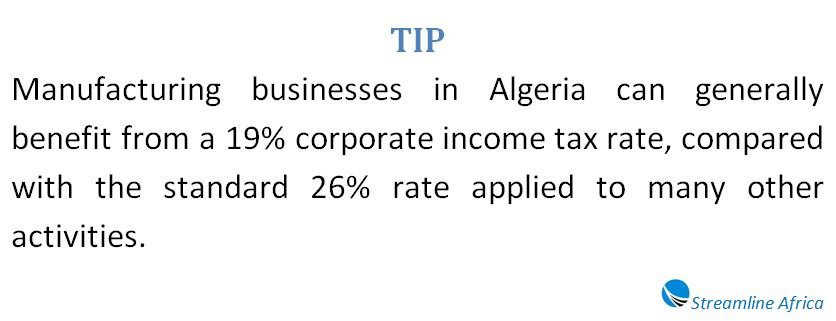
Manufacturing activities are generally taxed at 19%. Building, public works, hydraulics, tourism and thermal activities, excluding travel agencies, are subject to a 23% rate. Other activities are generally taxed at 26%.
This means the headline corporate income tax rate may be described as 26%, but the effective statutory rate for a specific company can be lower depending on its activity.
For example, a food-processing company in Blida may fall under the 19% manufacturing rate, while a general services company operating in Algiers could fall under the 26% category.
Where a business conducts mixed operations, taxable profits should be allocated according to the turnover associated with the relevant activities.
Corporate Tax Filing and Payment Timelines
Tax planning should also account for the timing of corporate tax filings and payments.
Under the 2024 framework, corporate income tax returns are generally due before 30 April of the year following the relevant fiscal year. Final corporate tax is generally payable before 20 May.
Estimated corporate income tax payments are typically made through instalments due on 20 March, 20 June and 20 November. Each instalment is generally calculated at 30% of the corporate income tax liability of the previous year.
These deadlines make tax forecasting a recurring financial-management responsibility rather than an exercise performed only at year-end.
Foreign Companies and Algerian-Sourced Income
Foreign companies may be exposed to Algerian taxation even where they do not operate through a conventional locally incorporated subsidiary.
The corporate tax framework can apply to Algerian-source profits earned through representative agents as well as businesses conducting a complete cycle of commercial activity in Algeria.
Non-resident companies are generally subject to a withholding tax regime. However, where a double taxation treaty applies, the treatment may depend on whether the foreign business has a permanent establishment in Algeria.
The source material also identifies a 30% withholding regime for certain foreign companies that do not maintain a permanent professional establishment but temporarily carry out activities under contracts in Algeria.
For an overseas engineering company undertaking a short-term infrastructure contract in Oran, tax exposure should therefore be assessed before pricing the project.
Double Tax Treaties and Withholding Tax
Algeria has entered into double taxation treaties with a number of countries. These treaties can alter the domestic tax outcome for cross-border payments and may reduce or eliminate certain taxes where treaty conditions are satisfied.
Under the 2024 framework, commonly cited withholding rates include 15% on dividends, 10% on interest and up to 30% on royalties or certain cross-border payments.
The underlying tax guide also records a 15% withholding rate for dividends and a 10% rate for income from receivables, deposits and guarantees.
Because treaty provisions can override or modify domestic rates, businesses should confirm whether a relevant double taxation agreement applies before automatically applying a headline withholding percentage.
Capital Gains Taxation
Capital gains realised by companies are generally incorporated into taxable income and taxed at the applicable corporate income tax rate.
The existing framework also provides potential relief depending on the period for which an asset has been held. The source identifies relief of 35% for certain assets held for up to three years and 65% for longer holding periods.
An exemption may also be available where qualifying gains from asset disposals are reinvested within a three-year period.
For individual taxpayers, 2024 guidance identifies a headline capital gains rate of 15% for residents and 20% for non-residents in the relevant categories. Businesses and individuals should therefore distinguish between corporate and personal capital gains rather than assuming that one uniform rate applies.
Individual Tax Residence
Determining tax residence is a key starting point for personal income taxation.
An individual may be considered tax resident where they maintain a qualifying dwelling in Algeria, undertake professional activity in the country or have their principal place of stay or centre of main interests there.
Spending more than 183 days in Algeria during a one-year period is also identified as an indicator of tax domicile.
Residents are generally taxed on worldwide income, while non-residents are subject only to tax on income sourced in Algeria.
This distinction is especially relevant for expatriate employees, consultants and executives who divide their working time between Algeria and other jurisdictions.
Personal Income Tax Brackets
Individual income tax in Algeria is progressive, meaning the applicable percentage rises as taxable income moves into higher bands.
For 2024, the personal income tax schedule is:
Income below DZD 240,000 is taxed at 0%.
Income from DZD 240,001 to DZD 480,000 is taxed at 23%.
Income from DZD 480,001 to DZD 960,000 is taxed at 27%.
Income from DZD 960,001 to DZD 1,920,000 is taxed at 30%.
Income from DZD 1,920,001 to DZD 3,840,000 is taxed at 33%.
Income above DZD 3,840,000 is taxed at 35%.
The headline personal income tax rate is therefore 35%.
These 2024 thresholds provide a more current reference point than older schedules and should be used when assessing that tax year. As with other progressive systems, moving into a higher tax band does not necessarily mean the taxpayer’s entire income is taxed at the highest rate.
Personal Income Tax Filing Deadlines
Individual taxpayers also need to account for statutory filing and payment dates.
For the 2024 framework, the personal income tax return is generally due by 30 April. Final tax becomes payable upon receipt of the relevant tax notification.
Where income is subject to periodic withholding or estimated payment, tax may be payable within 20 days following the month in which the income is paid.
Employers therefore play an important compliance role because salary and wage taxes are generally collected through payroll withholding. The broader Algerian framework specifically recognises withholding on salaries and wages.
What Types of Personal Income Are Taxable?
Global income tax, commonly referred to as IRG, can apply to several categories of income.
These include professional profits, rental income, agricultural income, salaries and wages, income from movable capital and capital gains from specified property transactions.
Taxable income is generally determined by combining the relevant net income categories after applying permitted exclusions and deductions.
Potential deductible items include alimony, certain interest costs, qualifying insurance expenses and specified social insurance contributions.
Allowances and Tax Incentives
Algeria provides a number of targeted allowances and exemptions.
Spouses who elect joint taxation are identified as receiving a 10% allowance on total income. Individuals taking out qualifying voluntary insurance for at least eight years may receive an allowance equal to 2% of the net premium paid, subject to a maximum of DZD 20,000.
Certain artistic, agricultural and socially oriented activities may also qualify for permanent exemptions.
Traditional artisans can benefit from a two-year exemption in qualifying circumstances, while projects established under selected youth investment and employment-support programmes may obtain exemptions lasting three years, with longer periods available in designated development areas.
Rental Income and Property Transactions
Rental income is taxed according to the type of property and its use.
The underlying tax guide identifies a 7% rate for certain collective residential rentals, 10% for individual-use residential dwellings and 15% for premises used for commercial or professional purposes.
Property investors should also consider taxes on disposal. The source identifies a 5% tax on certain capital gains arising from the sale of built or unbuilt property.
These rules mean that property tax planning should consider acquisition, rental income, ownership costs and eventual disposal rather than concentrating only on annual rental returns.
The Single Flat-Rate Tax
Smaller businesses and entrepreneurs may fall within Algeria’s single flat-rate tax regime, known as the IFU.
The source framework identifies qualifying commercial, industrial, craft and non-commercial activities where annual turnover does not exceed DZD 15 million. Certain investment promoters supported through designated programmes may also qualify.
The stated rates are 5% for sales and production of goods and 12% for other activities.
The IFU can simplify tax administration for eligible smaller enterprises, but businesses should monitor turnover closely because growth can change the tax regime under which they operate.
Value-Added Tax in Algeria
Algeria applies value-added tax, or TVA, to taxable transactions.
The standard VAT rate is 19%. A reduced rate of 9% applies to selected goods, services and transactions, including certain energy supplies and other qualifying categories.
The 19% standard rate is therefore the principal headline VAT rate businesses should consider when pricing goods and services.
Correct VAT classification is important because errors can affect invoicing, margins, tax recoverability and cash flow.
Payroll and Other Business Taxes
Corporate and personal income tax are only part of the wider compliance environment.
Personal income tax is withheld from salaries and similar remuneration after employee social security contributions, with rates reaching a maximum of 35%.
The source also identifies training tax and apprenticeship tax, each charged at 1% of payroll cost.
Businesses can additionally encounter registration charges, stamp duties, customs duties, property taxes and transaction-related taxes depending on their activities.
For growing employers, these secondary obligations should be included when calculating the true cost of employing staff and operating in Algeria.
What Businesses Should Take Away
Algeria’s tax environment is best understood as a collection of interconnected obligations rather than a single headline tax rate.
For 2024, the headline personal income tax rate is 35%, the maximum standard corporate income tax rate is 26% and the standard VAT rate is 19%. Manufacturing companies can benefit from a 19% corporate rate, while construction, public works, hydraulics and selected tourism-related activities are generally taxed at 23%.
Taxpayers also need to consider withholding tax, capital gains, payroll taxes, tax residence, filing deadlines, double taxation treaties and special regimes such as the IFU.
For investors, the practical lesson is that tax planning should begin before a transaction or investment is completed. A business operating a factory in Sétif, a consultancy serving Algerian customers from abroad and an individual earning rental income in Algiers may all face very different tax consequences.
Maintaining accurate accounting records, separating activities that attract different tax rates, identifying applicable treaties and monitoring filing deadlines can significantly reduce compliance risk. Algeria continues to refine its tax framework through finance legislation, making periodic review essential for businesses and individuals seeking to manage their obligations effectively.
Important Points Investors Should Know About Algeria’s Tax System
Algeria Uses a Declarative Tax System
Businesses and individuals are generally responsible for declaring and paying the taxes that apply to them. This makes accurate bookkeeping, timely filing and proper documentation especially important for investors.
Corporate Tax Rates Depend on Business Activity
Algeria does not apply one single corporate income tax rate to every company. Manufacturing activities generally face a 19% rate, construction and selected tourism-related activities 23%, while most other activities are taxed at 26%.
Mixed Business Activities Require Careful Accounting
A company operating across different sectors may be exposed to more than one corporate tax rate. Investors should maintain clear accounting records so profits can be properly attributed to each activity.
Foreign Companies Can Still Be Taxable in Algeria
A foreign business does not necessarily need a locally incorporated subsidiary before Algerian tax becomes relevant. Algerian-source income and certain temporary contractual activities can create local tax obligations.
Double Tax Treaties Can Reduce Cross-Border Tax Costs
Algeria has double taxation treaties with several countries. Depending on the investor’s home jurisdiction, treaty provisions may reduce withholding taxes or determine whether a permanent establishment exists.
Personal Income Tax Reaches 35%
For 2024, Algeria’s personal income tax system is progressive, with the highest rate reaching 35% on taxable income above DZD 3.84 million.
The Standard VAT Rate Is 19%
Most taxable goods and services fall under Algeria’s standard 19% VAT rate, although a reduced 9% rate applies to selected transactions. Investors should factor VAT into pricing and cash-flow planning.
Capital Gains Can Create Additional Tax Exposure
Corporate capital gains are generally taxed at the normal corporate income tax rate. Individual capital gains may attract different rates depending on residence and the type of transaction.
Withholding Tax Matters for International Payments
Dividends, interest, royalties and certain payments to non-residents may be subject to withholding tax. Cross-border contracts should therefore be reviewed before payments are made.
Tax Deadlines Affect Cash-Flow Planning
Corporate tax returns are generally due before 30 April, with final corporate tax payable before 20 May. Instalment payments during the year can also affect working capital requirements.
Smaller Businesses May Qualify for the IFU Regime
Eligible smaller enterprises may fall under Algeria’s single flat-rate tax system. The regime can simplify compliance, but businesses must monitor turnover because exceeding the qualifying threshold may change their tax treatment.
Tax Planning Should Begin Before Investment
Investors should assess tax consequences before choosing a business structure, signing contracts, hiring employees or purchasing assets. Early planning can reduce compliance risks and unexpected costs.