
Operating a business in Angola involves more than corporate income tax. Companies may encounter value-added tax, customs duties, excise duties, stamp tax, property tax, payroll obligations and special levies depending on their activities.
Consider a Luanda-based company called Kwanza Industrial Solutions, which imports equipment, employs local workers and leases commercial premises. Its tax responsibilities would extend across several areas. Understanding how these obligations interact is important for budgeting, pricing, contracting and maintaining compliance.
Angola’s system also places considerable emphasis on electronic reporting and documentation. Businesses therefore need reliable accounting procedures rather than treating tax compliance as an exercise performed only when a payment deadline approaches.
How VAT Works in Angola
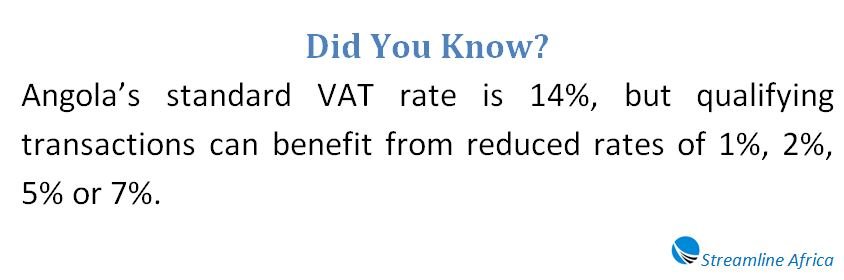
Angola applies a standard value-added tax rate of 14% across a broad range of taxable transactions. However, selected activities qualify for lower rates.
A 1% rate applies to certain imports and supplies of goods in Cabinda, while port services and public water distribution services in that province attract 2%. Certain food products and agricultural inputs covered by the VAT legislation are taxed at 5%.
Qualifying hotel and restaurant services may attract a 7% rate when specified conditions are satisfied, including requirements relating to business assets, electronic invoicing and tax-return compliance. The simplified VAT regime also effectively operates with a 7% rate under its particular calculation rules.
These distinctions make classification important. A business should establish the applicable treatment before issuing invoices rather than assuming every commercial transaction automatically attracts 14%.
Standard and Simplified VAT Regimes
Business size helps determine how VAT obligations are administered.
Entities with annual turnover or import activity exceeding AOA 350 million generally fall under the standard VAT regime. Manufacturing companies may enter this regime where their previous-year turnover or imports exceed AOA 25 million.
Standard-regime taxpayers charge VAT on taxable transactions, maintain accounting records under Angolan accounting standards and submit monthly VAT returns. The amount payable broadly reflects output VAT after allowable input VAT deductions.
Electronic reporting has become increasingly important. Information submitted through electronic invoicing systems and SAF-T files enables the tax administration to pre-populate parts of VAT returns.
Businesses with turnover or imports between AOA 25 million and AOA 350 million generally fall within the simplified regime. They issue invoices without VAT and submit monthly returns. Their liability is calculated using a 7% mechanism applied to qualifying receipts and certain other amounts, subject to the applicable deduction rules.
Eligible simplified-regime businesses can elect to enter the standard system when conditions concerning organised accounting, tax compliance, registration, certified billing software and electronic reporting are satisfied.
VAT Exemptions and Zero-Rated Transactions
Not every transaction creates a VAT charge.
Important exemptions cover areas such as recognised educational services, qualifying healthcare services, certain pharmaceutical products, medical equipment, books, passenger transport, life and health insurance, property sales and leases, and specified financial activities.
Relief may also apply to imported goods donated for philanthropic purposes or used in responding to disasters when the required recognition is obtained from the General Tax Administration.
Exemption should not be confused with zero-rating. Exports of goods are generally zero-rated, alongside certain supplies supporting commercial vessels and aircraft and qualifying international passenger transportation.
The distinction matters because the treatment of input VAT can differ depending on whether an activity is exempt or zero-rated.
VAT Withholding Through the Captivation System
Another feature businesses may encounter is VAT captivation.
Certain customers are required to retain part or all of the VAT appearing on suppliers’ invoices and report that amount through their own VAT processes.
The state, excluding public companies, and oil investment companies generally captivate 100% of supplier VAT. The National Bank of Angola, commercial banks, licensed telecommunications businesses, insurers and reinsurers generally captivate 50%.
Specific transactions fall outside these rules, including certain supermarket sales, hotel and restaurant services, water and energy supplies, banking services and qualifying ATM payments.
For suppliers, identifying whether a customer falls within the captivation framework is essential for accurate receivables management and VAT reconciliation.
Customs Duties on Cross-Border Trade
Importers must incorporate customs costs into their landed-cost calculations.
Angolan customs duties on imports generally range from 2% to 55%, depending on the goods concerned. This range means two businesses importing products of similar commercial value may face substantially different customs liabilities.
Certain exports can also generate customs obligations. Goods not produced domestically may attract a 20% export duty plus a 0.5% customs fee, subject to sector-specific exceptions.
Nationalised food, medicines, medical equipment and biosafety products exported from Angola may face a considerably higher customs duty of 70%.
Companies should therefore determine customs classification, origin, value and applicable exemptions before finalising import or export pricing.
Excise Duties on Selected Products
Excise duty applies to the production, importation and certain sales of specified goods. Rates range from 2% to 50%, depending on the product category.
Covered products include alcoholic beverages, sugar, tobacco products, vehicles, petroleum products, jewellery, pleasure craft, aircraft, plastic bags, straws and certain tyres.
For domestically manufactured goods, the taxable base is generally the transaction value. Imported products use customs value, while petroleum products are assessed according to production cost.
Some exemptions are available, including for qualifying education and healthcare goods and electric vehicles. Certain regulated products also require tax stamps or approved electronic measurement systems connected with tax administration requirements.
Stamp Tax on Commercial Transactions
Stamp tax remains relevant where transactions are not subject to VAT.
For example, receipts can attract a 1% charge in applicable circumstances. Financing transactions may be taxed at different rates depending on the duration of credit. Property acquisitions, leases, corporate capital transactions, insurance arrangements and various legal or commercial documents may also fall within the stamp-tax framework.
Businesses covered by the standard or simplified VAT regimes are generally exempt from the 1% stamp tax on receipts, although specific exceptions remain.
Consequently, companies should review the underlying transaction before determining whether VAT, stamp tax or another treatment applies.
Property Ownership, Rental Income and Transfers
Real estate creates another set of tax considerations.
Rental income is nominally taxed at 25%, but only 60% of rental income forms the taxable base because 40% is presumed to represent costs. This produces an effective property tax burden of 15% on rental income.
For non-leased property, the calculation depends on patrimonial value. Properties worth up to AOA 5 million attract a 0.1% rate. Different rules apply above that threshold, including a fixed amount within one band and a 0.5% rate on the relevant excess for higher-value property.
Transfers of immovable property generally attract a 2% property tax. Residential property transfers receive additional relief, including an exemption up to AOA 40 million and reduced taxation within the specified higher-value band.
Businesses paying rent may also have withholding responsibilities. Qualifying rents paid by Angolan companies or commercially active individuals are subject to 15% withholding.
Foreign Exchange and Tourism Levies
Cross-border payments can trigger the Special Levy on Foreign Exchange Operations, commonly referred to as CEOC.
It covers qualifying transfers associated with services, consulting, technical assistance, management, capital operations and unilateral transactions. The rate is 10% for companies and 2.5% for individuals.
Certain payments are excluded, including qualifying education and healthcare expenses, dividends, repayment of borrowed capital and associated interest.
Angola also imposes a Special Contribution for Tourism on qualifying international visitors over 12 years old. The contribution equals 5% of the daily accommodation rate and applies for a maximum of seven nights per stay. Accommodation providers collect and remit the levy.
Payroll Tax and Social Security Responsibilities
Employers must also incorporate employee taxation into payroll administration.
Employment income earned from services provided in Angola is generally subject to personal income tax at progressive monthly rates ranging from 0% to 25%. Employers operate withholding arrangements by deducting the appropriate amount from employee compensation.
Employees receiving only employment income generally do not need to submit separate annual income tax returns because their tax is withheld through payroll.
Social security creates an additional employment cost. Employees generally contribute 3% of gross income, while employers contribute 8%. A different employee rate applies to retired employees.
For a growing company, these percentages should be incorporated into workforce budgeting before salaries are agreed.
Building a Reliable Tax Compliance Process
Angola’s business tax framework demonstrates why tax management should be integrated into everyday financial operations.
A company importing products, renting property, employing staff and purchasing foreign professional services could encounter VAT, customs duties, property tax, payroll deductions, social security and CEOC during the same financial year.
Effective compliance therefore depends on accurate transaction classification, certified invoicing systems, organised accounting records and careful monitoring of filing and payment deadlines.
Businesses should also periodically review their turnover because growth can move an organisation from one VAT regime into another. Contracts involving property, imports or foreign payments should receive tax review before execution.
Ultimately, strong tax compliance is not simply about paying amounts when they become due. It requires businesses to understand how each transaction creates an obligation, maintain supporting records and build tax considerations into commercial decisions from the beginning.
Source: AGT
VAT in Angola; FAQs
What is the standard VAT rate in Angola?
The standard VAT rate is 14%. However, reduced rates apply to certain goods and services, depending on the transaction, location and applicable tax rules.
Read More: Angola Investment Opportunities 2026: Key Sectors, Market Potential and Business Entry Strategies
Which businesses fall under Angola’s standard VAT regime?
Businesses with annual turnover or import operations above AOA 350 million generally enter the standard VAT regime. Certain manufacturing businesses may qualify at a lower threshold. Pasted markdown
How does the simplified VAT regime work?
The simplified regime generally covers businesses with annual turnover or imports between AOA 25 million and AOA 350 million. Tax is calculated using a 7% mechanism on qualifying receipts and other specified amounts. Pasted markdown
Are any goods and services exempt from VAT?
Yes. Exemptions include qualifying healthcare and educational services, certain medicines and medical equipment, books, property transactions, passenger transport, and some financial and insurance activities.
What does zero-rated VAT mean for exporters?
Exports of goods are generally zero-rated. Certain supplies for commercial vessels and aircraft and qualifying international passenger transportation also receive zero-rated treatment. Pasted markdown
What is VAT captivation in Angola?
VAT captivation requires certain customers to withhold part or all of the VAT charged by suppliers. The state and oil investing companies generally captivate 100%, while specified financial, insurance and telecommunications entities captivate 50%. Pasted markdown
How much are customs duties in Angola?
Import customs duties generally range from 2% to 55%, depending on the goods. Businesses involved in international trade should therefore include customs costs when calculating landed prices and margins. Pasted markdown
Which products can attract excise duty?
Excise duty can apply to products such as alcoholic beverages, tobacco, vehicles, petroleum products, jewellery, plastic bags, straws and specified tyres. Rates vary according to product classification. Pasted markdown
When does stamp tax apply?
Stamp tax can apply to transactions that are not subject to VAT, including certain receipts, financing arrangements, property transactions, leases, insurance and corporate activities.
How is rental income taxed?
Property tax on rental income has a nominal rate of 25%, but only 60% of rental income forms the taxable base. This results in an effective rate of 15%. Pasted markdown
What is the Special Levy on Foreign Exchange Operations?
CEOC applies to certain foreign transfers involving services, consulting, technical assistance and other qualifying transactions. The applicable rate is 10% for companies and 2.5% for individuals. Pasted markdown
What payroll obligations do Angolan employers have?
Employers generally withhold personal income tax through payroll at progressive rates of 0% to 25%. Social security contributions are normally 3% for employees and 8% for employers.