

In the world of financial reporting, few topics create as much confusion among beginners as the treatment of dividends. Many assume that because dividends involve money leaving a company, they must be recorded as an expense. However, this assumption doesn’t align with how accounting actually works. To understand why, it helps to reframe the concept of dividends and explore how they interact with a company’s financial statements.
Understanding the Nature of Dividends
Imagine a mid-sized manufacturing firm based in Nairobi called GreenLine Textiles. After a profitable year, the company’s board decides to reward its shareholders by distributing a portion of its earnings. This distribution, whether in cash or additional shares, is known as a dividend.
Dividends are not payments for services, nor are they costs incurred to run the business. Instead, they represent a share of profits returned to the owners of the company. This distinction is crucial because accounting separates operational performance from profit distribution.
Why Dividends Are Not Expenses
Expenses are costs directly tied to generating revenue—things like salaries, rent, utilities, and raw materials. These are recorded on the income statement and used to calculate net profit.
Dividends, on the other hand, are distributed after profit has already been determined. For GreenLine Textiles, the income statement ends once net income is calculated. Any decision to distribute part of that income happens afterward and is not part of the company’s operating performance.
Because of this, dividends never appear as expenses on the income statement. Including them there would distort the true profitability of the business.
The Role of Retained Earnings
To fully grasp dividend accounting, it’s helpful to understand retained earnings. Think of retained earnings as a cumulative reserve of profits that a company has chosen to keep rather than distribute.
At GreenLine Textiles, profits from previous years accumulate in this account. Management can decide to reinvest these funds into expansion, pay off debt, or distribute them as dividends.
When dividends are declared, they are drawn from retained earnings—not from current operational costs. This is another reason they are not considered expenses.

Accounting for Cash Dividends
Let’s say GreenLine Textiles declares a cash dividend of $0.50 per share. This decision triggers a few accounting changes:
- Retained earnings decrease because profits are being distributed.
- Cash decreases when the dividend is paid.
- Shareholders’ equity declines overall.
These changes are reflected in the statement of changes in equity and the cash flow statement, not the income statement.
On the cash flow statement, the dividend payment appears as a cash outflow under financing activities. This classification reinforces the idea that dividends are related to how a company finances itself—not how it operates.
Stock Dividends: A Different Approach
Now consider a different scenario. Instead of paying cash, GreenLine Textiles issues additional shares to its investors. This is known as a stock dividend.
Unlike cash dividends, stock dividends do not involve any cash leaving the company. Instead, they redistribute value within shareholders’ equity:
- Retained earnings decrease.
- Common stock and additional paid-in capital increase.
The total value of equity remains the same, but its composition changes.
Because there is no outflow of resources, stock dividends are not considered expenses either. They simply represent a reshuffling of existing equity.
Impact on the Balance Sheet
Both types of dividends affect the balance sheet, but in different ways:
- Cash dividends reduce total assets (cash) and shareholders’ equity.
- Stock dividends increase the number of shares outstanding and adjust equity accounts without reducing total assets.
For GreenLine Textiles, issuing stock dividends might make the company appear larger in terms of share capital, even though its actual resources haven’t changed.
The Dividend Declaration Process
Dividends typically follow a structured process:
First, the company’s board announces the dividend, specifying the amount and type. This is known as the declaration date. At this point, a liability may be recorded for cash dividends.
Next comes the record date, which determines which shareholders are eligible to receive the dividend.
Finally, on the payment date, the company distributes cash or shares to those shareholders.
For investors, this process is important because it determines eligibility and timing. For accountants, it dictates when and how entries are recorded.
Investor Perspective on Dividends
From an investor’s point of view, dividends are often seen as a reward for holding shares. For example, a retiree in Cape Town might rely on dividend income for regular cash flow, while a younger investor in Lagos might prefer companies that reinvest profits for growth.
Companies with a consistent history of paying dividends are often viewed as stable and reliable. However, it’s important to note that dividends are never guaranteed. A company can reduce or eliminate them at any time without affecting its reported profit.
Do Dividends Affect Profit?
One of the most common misconceptions is that dividends reduce a company’s profit. In reality, they do not.
Profit is calculated before any dividends are considered. Once net income is determined, dividends are simply a distribution of that profit—not a factor in its calculation.
For GreenLine Textiles, whether it pays dividends or not, its net income remains the same. The decision only affects how that income is allocated.
Share Dilution and Stock Dividends
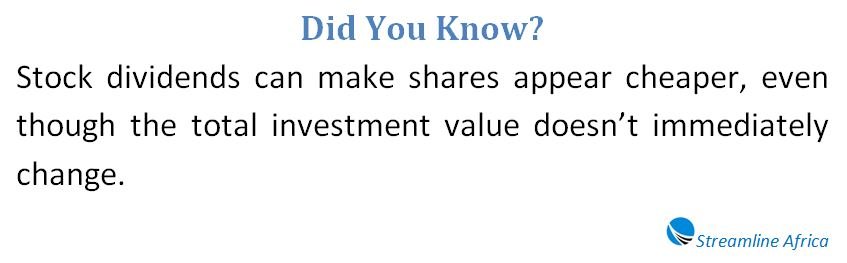
Stock dividends introduce another concept: dilution. When additional shares are issued, the total number of shares increases. This means each individual share represents a smaller portion of the company.
While the overall value of an investor’s holdings may remain unchanged initially, the value per share can decrease. This is why stock dividends are often viewed differently from cash dividends.
Strategic Considerations for Companies
Companies must carefully decide whether to distribute dividends or retain earnings. Each option has its advantages:
- Paying dividends can attract income-focused investors and signal financial strength.
- Retaining earnings allows for reinvestment, expansion, and long-term growth.
For a growing company like GreenLine Textiles, reinvesting profits might lead to higher future returns. For a mature company, consistent dividends might be more appropriate.
Final Thoughts
Dividends occupy a unique position in accounting. They are neither operational costs nor factors in profit calculation. Instead, they represent a distribution of earnings to shareholders, reflected in equity and cash flow—not in the income statement.
Understanding this distinction is essential for interpreting financial statements accurately. Whether in cash or stock form, dividends tell a story about how a company chooses to use its profits. For investors and analysts alike, that story can be just as important as the numbers themselves.
Frequently Asked Questions
Are dividends considered an expense in accounting?
No, dividends are not treated as expenses because they are distributions of profit, not costs incurred to generate revenue. They are recorded after net income is calculated.
Where do dividends appear in financial statements?
Dividends are reflected in the statement of changes in equity and the cash flow statement, not on the income statement.
How do cash dividends affect a company?
Cash dividends reduce both the company’s cash balance and retained earnings, leading to a decrease in overall shareholders’ equity.

What happens when a company issues stock dividends?
Stock dividends reallocate funds from retained earnings to share capital accounts, increasing the number of shares but not changing total equity value.
Do dividends impact a company’s net income?
No, dividends do not affect net income because they are distributed after profit has already been calculated.
What are retained earnings in simple terms?
Retained earnings are accumulated profits a company keeps for reinvestment, debt repayment, or future growth instead of distributing them to shareholders.
Why do companies choose to pay dividends?
Companies pay dividends to reward shareholders, attract investors, and signal financial stability, especially when they have consistent profits.
Can a company stop paying dividends anytime?
Yes, dividend payments are not mandatory. A company can reduce or stop them depending on its financial strategy without affecting reported profit.