

Access to growth capital remains one of the most important strategic challenges facing businesses across Africa. Companies traditionally turn to commercial banks, private equity firms, venture capital investors, or conventional public listings when they need significant funding. However, these channels may involve substantial financing costs, ownership dilution, restrictive conditions, or lengthy negotiations.
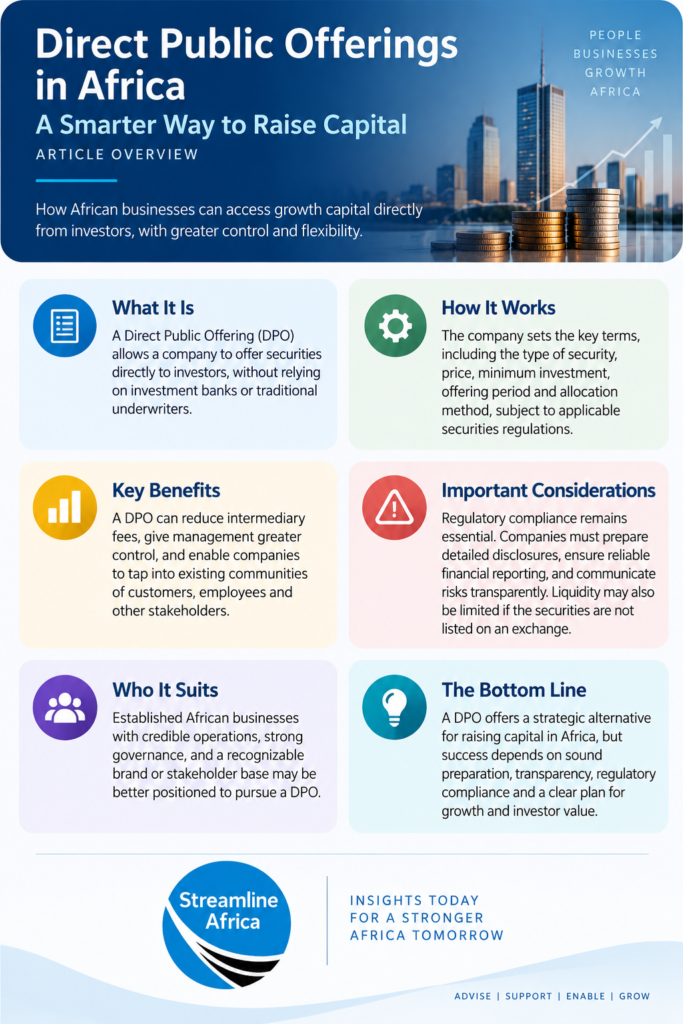
A direct public offering (DPO) provides another potential route. It allows an eligible company to offer securities directly to investors rather than relying heavily on investment banks and traditional underwriters to distribute the securities.
For African businesses with established operations, recognizable brands, credible financial records, and strong stakeholder communities, direct fundraising can potentially create a closer connection between the company and the people willing to finance its next stage of growth.
The model is particularly relevant when businesses already have communities of customers, employees, suppliers, distributors, professional partners, or other supporters who understand their commercial potential.
How a Direct Public Offering Works
Under a DPO structure, the company assumes greater responsibility for designing and managing its capital raise. Depending on applicable securities regulations, management determines important commercial terms such as the type of security offered, subscription price, minimum investment, fundraising target, offering period, and allocation arrangements.
The securities could include ordinary shares, preference shares, debt instruments, or another legally permitted investment structure.
Consider a Ghanaian agro-processing company seeking capital to establish additional processing facilities in northern Ghana. Rather than obtaining the entire amount through commercial borrowing, the company could explore a compliant direct offering that provides eligible investors with an opportunity to participate in its expansion.
This approach can potentially reduce dependence on a small group of institutional financiers while giving management greater influence over the fundraising structure.
Greater control, however, also creates greater responsibility.
Build the Investment Case Before Raising Capital
A company should not launch a DPO simply because it needs money. Management must first establish a credible investment proposition.
Prospective investors need to understand the business model, historical performance, growth opportunity, competitive environment, management capability, major risks, expected use of proceeds, and rights associated with the securities.
Suppose an Accra-based logistics company wants to raise capital to establish distribution centres in Kumasi and Takoradi. Simply communicating that the business intends to expand would be insufficient.
Management should demonstrate why additional facilities are commercially justified, how much capital is required, how the funds will be allocated, expected operating benefits, major implementation risks, and how expansion could contribute to long-term enterprise value.
Direct access to investors does not reduce the importance of financial credibility. In many cases, it increases it.
Financial Reporting Becomes Critical
Companies considering direct capital raising should strengthen their accounting and financial reporting systems before approaching investors.
Reliable financial statements allow prospective investors to assess revenue growth, profitability, debt levels, working capital, cash generation, assets, liabilities, and other indicators of financial health.
Weak bookkeeping can quickly undermine an otherwise attractive investment proposition.
Management should therefore review historical financial statements, reconcile major accounts, address unexplained balances, document significant liabilities, strengthen internal controls, and establish reliable management reporting before beginning the offering process.
Where audited financial statements are required or commercially appropriate, management should allow sufficient time for their preparation.
The objective should be straightforward: investors must be able to understand where the business stands financially before deciding whether to provide capital.
Regulatory Compliance Cannot Be Treated as Optional
Removing traditional underwriting intermediaries does not remove securities regulation.
Companies must determine whether their proposed offering requires regulatory approval, registration, prescribed disclosures, investor restrictions, or qualifies for an available exemption. Requirements differ considerably between jurisdictions and may also depend on the size and structure of the transaction.
A technology company operating from Nairobi, for example, should not assume that an online campaign inviting thousands of people to purchase shares can be treated like an ordinary product promotion.
Offering securities to the public can trigger significant regulatory obligations.
Businesses operating across several African markets face additional complexity because investors may be located in different jurisdictions.
Legal, accounting, tax, and investment advisers should therefore be engaged early enough to identify applicable requirements before promotional activities begin.
Preparing the Offering
Once the appropriate structure has been determined, management must prepare the information investors will use to evaluate the opportunity.
Depending on applicable regulations, this may involve an offering memorandum or prospectus, financial statements, corporate information, risk disclosures, subscription procedures, details of the securities, use-of-proceeds information, and relevant legal documentation.
Management should also establish the practical rules governing the offer.
For example, a food-processing company in Tema might establish a defined fundraising target, minimum subscription amount, maximum investor allocation, opening date, closing date, and procedures for dealing with excess demand.
These conditions should be communicated clearly before investors commit funds.
Transparency at this stage can reduce disputes and establish stronger expectations between the company and its future investors.
Marketing the Investment Opportunity
Companies using a DPO may communicate directly with prospective investors, subject to regulatory restrictions.
This creates opportunities to use existing commercial relationships as part of the fundraising strategy. Customers, employees, suppliers, distributors, business partners, professional networks, and other eligible investors may already understand the company better than completely unfamiliar investors.
Digital communication has expanded these possibilities.
Investor webinars, corporate websites, approved digital campaigns, business conferences, presentations, email communication, and stakeholder meetings can potentially support investor engagement.
Marketing, however, must remain factual.
Businesses should avoid exaggerated projections, unsupported return claims, or communications that understate material risks. Investment promotion should be based on credible financial and commercial information rather than advertising enthusiasm.
Managing Investor Demand
A well-structured offer should explain what happens when investor demand differs from expectations.
If a company establishes a minimum fundraising threshold and fails to reach it, the terms may require the transaction to be cancelled and investor funds returned.
Demand can also exceed the amount available.
For example, a company seeking GH¢20 million might receive valid subscriptions worth GH¢28 million. Management would then need to follow the allocation methodology established in the offering documents, which could involve proportional allocations or another compliant mechanism.
These procedures should be established before subscriptions begin rather than improvised after investor funds have been received.
Liquidity Requires Particular Attention
One of the most important issues prospective investors should understand is liquidity.
Completing a direct offering does not automatically mean investors can immediately trade their securities on a major stock exchange. Depending on the structure, secondary trading opportunities may be limited.
An investor could therefore own a valuable security but find it difficult to sell quickly.
Companies should communicate clearly whether the securities will be listed, whether another secondary market exists, what restrictions apply to transfers, and how investors may eventually exit their positions.
Liquidity risk should never be hidden behind the excitement of raising capital.
When a DPO May Make Strategic Sense
Direct offerings can be particularly attractive to businesses that already have credible operating histories and identifiable stakeholder communities.
Imagine a fictional Ghanaian company, Savannah Foods Limited, processing grains for retailers and institutional customers across West Africa. After several years of expansion, management requires GH¢30 million for a new processing facility, warehouse automation, and additional working capital.
Instead of financing the entire project with bank debt, Savannah Foods could assess whether a direct securities offering is commercially and legally appropriate.
Existing distributors, employees, suppliers, customers, professional investors, and other eligible participants could potentially become investors.
The business would still need appropriate financial statements, regulatory compliance, professional advice, investor disclosures, governance structures, and post-investment reporting.
The difference is that the company would have greater involvement in connecting its investment opportunity directly with its potential capital providers.
A Practical Readiness Framework
Before considering a direct offering, management should evaluate whether the organisation is genuinely investor-ready.
The business should have reliable financial information, clearly documented ownership, appropriate governance, credible growth plans, strong internal controls, realistic financial projections, identifiable risks, and a defensible valuation approach.
Management should also consider whether the organisation has sufficient administrative capacity to communicate with a potentially larger shareholder base after the transaction.
Raising capital is only the beginning. New investors may expect regular financial reporting, shareholder communication, governance discipline, and evidence that funds are being applied for their stated purpose.
The Strategic Perspective
A direct public offering can give businesses greater control over how they access investment capital while potentially reducing reliance on conventional financial intermediaries. The underlying concept is to connect the company more directly with investors rather than placing traditional underwriters at the centre of the transaction.
For African businesses, the opportunity should be approached strategically rather than simply as a cheaper alternative to an IPO.
A successful direct offering requires transparent financial reporting, strong governance, realistic valuation, regulatory compliance, credible investor communication, and disciplined use of the capital raised.
Companies that establish these foundations can broaden their financing options while building stronger relationships with the investors supporting their growth. Ultimately, the quality of the business, its financial credibility, and management’s ability to create sustainable value remain more important than the fundraising mechanism itself.
FAQs
Why would an African company consider a DPO?
A company may consider a DPO to reduce dependence on traditional intermediaries, potentially lower transaction costs, maintain greater control over offering terms, and connect directly with its investor community.
Is a DPO the same as an IPO?
No. A traditional IPO normally involves investment banks acting as underwriters, while a DPO generally places securities directly with investors without conventional underwriting.
What securities can a company offer?
Depending on the applicable regulatory framework and structure, a company may potentially offer equity, debt, preference shares, or other permitted securities.
Read Also: Initial Public Offerings In Africa: A Complete Guide To IPOs, Investment, Risks And Business Growth
Does a DPO eliminate regulatory requirements?
No. Direct fundraising does not mean unregulated fundraising. Companies must determine the registration, disclosure, approval, exemption, and investor-protection requirements that apply in the relevant jurisdiction.
What should a company prepare before launching a DPO?
The business should establish reliable financial reporting, appropriate governance, a compelling investment case, risk disclosures, realistic valuation, legal documentation, and a clearly defined use of the capital being raised.
Can customers and employees become investors?
Potentially, yes, subject to the applicable securities laws and offering structure. One attraction of direct offerings is the ability to reach established stakeholder communities, including customers, employees, suppliers, and other eligible investors.
Does completing a DPO mean the shares are publicly traded?
Not necessarily. Conducting a DPO does not automatically create an active secondary market for the securities. Investors should therefore understand their potential exit options before investing.
What are the main risks for investors?
Key considerations include limited liquidity, business failure, valuation uncertainty, weak financial disclosure, governance concerns, and the possibility of losing some or all invested capital.
Which African businesses may be better positioned for a DPO?
Established businesses with recognizable brands, credible financial records, clear growth strategies, sound governance, and strong communities of customers or other stakeholders may be better positioned than businesses without an established investor audience.
Can a DPO completely replace professional advisers?
Generally, no. Eliminating conventional underwriting does not eliminate the need for specialist support. Legal, accounting, tax, regulatory, valuation, and corporate-finance expertise may still be necessary.
What should management ask before pursuing a DPO?
The central question should not simply be, “Can we raise money directly?” Management should determine whether the company is investor-ready, whether the structure complies with applicable law, whether investors will understand the opportunity and risks, and whether the business can manage its obligations after receiving the capital.