
In financial analysis, understanding how effectively a business uses its long-term resources is essential for evaluating performance. One widely used metric for this purpose is the fixed asset turnover ratio. This ratio helps investors, managers, and analysts determine how efficiently a company converts investments in physical assets into revenue. It is particularly valuable in industries where large amounts of capital are tied up in machinery, equipment, and infrastructure.
Rather than simply looking at revenue figures alone, this ratio connects sales performance with the resources used to generate those sales. It answers a practical question: how much output is being produced from the company’s investment in fixed assets?
What the Fixed Asset Turnover Ratio Represents
The fixed asset turnover ratio measures the relationship between a company’s net sales and its investment in fixed assets such as buildings, machinery, and equipment. These assets are typically long-term in nature and are critical to the company’s production or service delivery process.
A higher ratio generally suggests that a business is using its fixed assets more efficiently to generate revenue. On the other hand, a lower ratio may indicate underutilization or inefficiencies in asset management. However, interpretation always depends on the context of the industry and the company’s operating model.
For example, a manufacturing firm that invests heavily in production equipment would expect this ratio to be closely monitored. In contrast, a service-based company with minimal physical assets may not rely heavily on this metric.
The Formula and Its Components
To calculate the fixed asset turnover ratio, two main figures are required: net sales and average fixed assets. Net sales represent total revenue after subtracting returns, discounts, and allowances. Average fixed assets are determined by taking the mean value of fixed assets at the beginning and end of a period.
Fixed Asset Turnover=Average Fixed AssetsNet Sales
This formula provides a clear numerical expression of how effectively assets are being used. The use of average fixed assets helps smooth out fluctuations that may occur during the accounting period.
It is also important to note that fixed assets are usually recorded net of accumulated depreciation. This means their value reflects wear and tear over time, making the calculation more realistic.

Why This Ratio Matters in Business Analysis
The fixed asset turnover ratio is a valuable indicator of operational efficiency. It provides insight into how well management is utilizing capital investments to drive revenue growth. Companies that achieve higher ratios are often seen as more efficient because they generate more sales from each unit of asset investment.
This metric is especially useful in capital-intensive sectors such as manufacturing, construction, and transportation. In these industries, businesses invest heavily in equipment and facilities, making it crucial to ensure those investments produce adequate returns.
Investors often track this ratio over several periods to identify trends. A rising ratio may indicate improved efficiency or better utilization of new equipment, while a declining ratio could signal operational challenges or overinvestment in assets.
Interpreting High and Low Ratios
A high fixed asset turnover ratio is generally considered favorable, as it implies that the company is making good use of its physical resources. It suggests that management is effectively converting asset investments into sales.
However, extremely high ratios should also be examined carefully. They may indicate that a company is operating with insufficient assets, which could limit future growth or lead to operational strain.
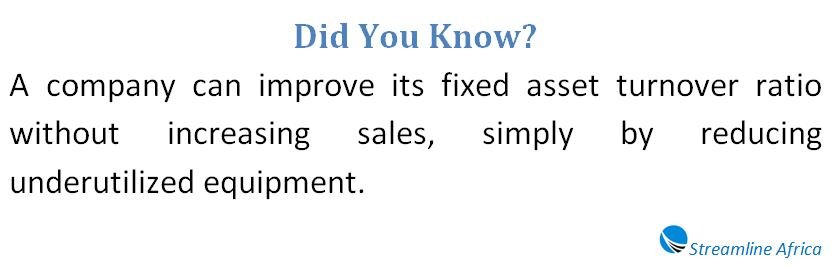
Conversely, a low ratio may point to inefficiencies, such as idle equipment or poor production planning. It could also reflect recent investments in assets that have not yet begun to generate significant revenue.
Therefore, interpretation should always consider the broader business context rather than relying solely on the number itself.
Comparing Fixed Asset Turnover with Total Asset Turnover
While the fixed asset turnover ratio focuses specifically on long-term physical assets, another related metric—the asset turnover ratio—takes a broader approach by including all assets. This includes current assets such as inventory, cash, and receivables.
Because total assets are typically larger than fixed assets alone, the asset turnover ratio is usually lower. The difference between these two metrics lies in their scope. The fixed asset turnover ratio isolates the efficiency of long-term investments, while the asset turnover ratio evaluates overall asset utilization.
Companies with significant investments in machinery and infrastructure often prioritize the fixed asset turnover ratio. On the other hand, businesses that rely more on inventory or short-term assets may find the broader asset turnover ratio more relevant.
Industry Differences and Practical Considerations
The usefulness of the fixed asset turnover ratio varies significantly across industries. Capital-intensive businesses tend to rely heavily on this metric because their performance is closely tied to how well they use their physical assets.
In contrast, industries such as technology or consulting typically have smaller investments in fixed assets. For these businesses, the ratio may not provide meaningful insights, as their value creation depends more on intellectual capital and human resources than on physical infrastructure.
Because of these differences, comparisons should be made carefully. It is more meaningful to compare companies within the same industry rather than across different sectors. Industry benchmarks provide a clearer picture of what constitutes a strong or weak ratio.
Limitations of the Fixed Asset Turnover Ratio
Although the fixed asset turnover ratio is a useful tool, it has several limitations that should not be overlooked. One key drawback is that it focuses only on sales and fixed assets, ignoring expenses. As a result, it does not provide a complete picture of profitability.
A company may generate high sales relative to its asset base but still struggle with high operating costs. In such cases, the ratio might suggest strong performance even though the business is not financially healthy.
Another limitation is the timing of cash flows. The ratio does not account for when revenue is actually collected or when assets are purchased. This can create discrepancies between reported efficiency and actual financial conditions.
Additionally, seasonal businesses may experience fluctuations in their ratios throughout the year. For this reason, it is more effective to analyze the ratio over multiple periods rather than relying on a single snapshot.
Outsourcing is another factor that can distort the ratio. Companies that outsource production may report higher turnover ratios because they own fewer fixed assets, even though their overall operations may not be more efficient.
Illustrative Example of the Calculation
To better understand how the fixed asset turnover ratio works, consider a hypothetical company that reports net sales of 500 million currency units during the year. Suppose its fixed assets were valued at 200 million at the beginning of the year and 300 million at the end.
First, calculate the average fixed assets by adding the beginning and ending values and dividing by two. This results in an average of 250 million.
Next, divide net sales by this average. The result is a fixed asset turnover ratio of 2.0. This means the company generated two units of sales for every unit invested in fixed assets.
This simple example illustrates how the ratio translates financial data into a meaningful measure of efficiency.
Evaluating What Makes a “Good” Ratio
There is no universal benchmark for what qualifies as a good fixed asset turnover ratio. The ideal value depends on factors such as industry standards, company size, and business strategy.
Instead of focusing on a single number, analysts typically compare a company’s ratio with industry averages and competitors. A ratio that exceeds these benchmarks may indicate superior asset utilization.
Tracking changes over time is equally important. Consistent improvement suggests that the company is becoming more efficient, while declining values may signal emerging issues.
Final Thoughts on Using the Ratio Effectively
The fixed asset turnover ratio is a powerful tool for assessing how efficiently a company uses its long-term assets to generate revenue. By linking sales performance with asset investment, it provides valuable insights into operational effectiveness.
However, like any financial metric, it should not be used in isolation. A comprehensive analysis should include other indicators such as profit margins, cash flow, and overall asset utilization.
When used alongside these measures, the fixed asset turnover ratio can help investors and managers make more informed decisions. It offers a clearer understanding of how well a company is leveraging its resources to drive growth and sustain long-term success.
Key Takeaways
Fixed Asset Turnover Ratio connects sales performance to long-term investments
The fixed asset turnover ratio shows how effectively a business turns investments in property, plant, and equipment into revenue, making it a direct link between operations and results.
Higher values usually signal stronger efficiency
When the ratio is high, it typically means the company is getting more output from its assets, indicating better management and utilization of resources.
It is most useful in capital-intensive industries
Businesses like manufacturing, construction, and logistics benefit most from this metric because they rely heavily on expensive equipment and infrastructure.
The formula focuses on net sales and average assets
By dividing net sales by average fixed assets, the ratio smooths out fluctuations and provides a clearer picture of performance over time.
Trends matter more than a single figure
Looking at how the ratio changes over several periods gives deeper insight than relying on a one-time calculation.
Industry comparisons provide better context
A “good” ratio depends on the sector, so comparing a company to its competitors or industry average is more meaningful than viewing it in isolation.
Fixed Asset Turnover Ratio does not measure profitability
Even if a company shows a strong ratio, it may still struggle financially if operating costs and expenses are too high.
Timing differences can distort interpretation
The ratio doesn’t consider when assets are purchased or when cash from sales is received, which can sometimes misrepresent actual efficiency.
Outsourcing can artificially inflate the ratio
Companies that outsource production may appear more efficient because they hold fewer fixed assets, even if their overall operations haven’t improved.
It works best alongside other financial metrics
To get a full picture of a company’s health, this ratio should be analyzed together with profitability, liquidity, and overall asset management indicators.