

Botswana generally taxes individuals according to where their income comes from. In practical terms, income connected to employment, business activities, professional services, investments, or other taxable sources within Botswana may fall within the country’s tax system.
This source-based approach can also extend to some work performed outside Botswana. For example, where an employee normally works in Botswana but occasionally travels abroad to carry out duties connected with that job, the related earnings may still be regarded as Botswana-sourced income.
Whether someone is considered a resident or non-resident is also important. Although both may pay tax on Botswana-sourced earnings, the personal income tax bands that apply to them are different.
Read Also: Investment in Botswana: Key Tips, Opportunities and Market Outlook
How Residents Are Taxed
Botswana uses progressive personal income tax rates for resident individuals. Instead of applying one percentage to a person’s entire income, taxable earnings are divided into bands.
Using the reference rate structure below, the first BWP 48,000 of annual taxable income falls within the zero-rate band.
| Annual Taxable Income | Tax Treatment |
|---|---|
| Up to BWP 48,000 | 0% |
| BWP 48,001–84,000 | 5% of the amount above BWP 48,000 |
| BWP 84,001–120,000 | BWP 1,800 + 12.5% above BWP 84,000 |
| BWP 120,001–156,000 | BWP 6,300 + 18.75% above BWP 120,000 |
| Above BWP 156,000 | BWP 13,050 + 25% above BWP 156,000 |
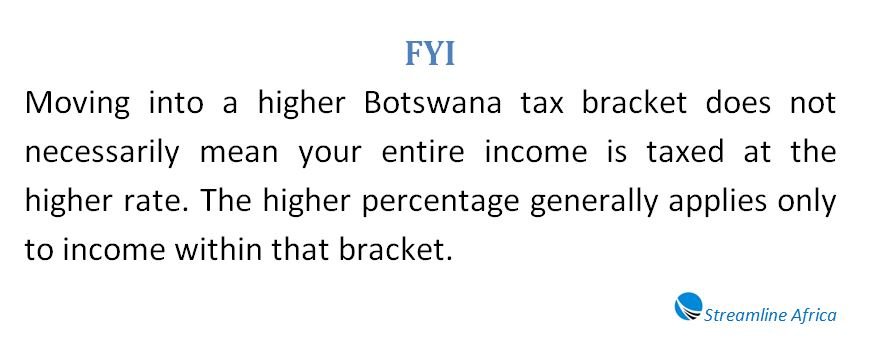
One point worth remembering is that entering a higher tax bracket does not mean all of a person’s income suddenly becomes taxable at the higher rate. Only the portion falling within that band attracts the higher percentage.
A Simple Resident Tax Example
Consider Naledi, a resident employee with annual taxable income of BWP 100,000. Her income falls within the BWP 84,001 to BWP 120,000 range.
Her estimated tax would be:
BWP 1,800 + 12.5% × (BWP 100,000 − BWP 84,000)
= BWP 1,800 + BWP 2,000
= BWP 3,800
Naledi would therefore have an estimated annual income tax liability of BWP 3,800. After income tax, she would have approximately BWP 96,200 remaining before any other deductions that may apply.
What Happens at a Higher Income Level?
Now consider Kabelo, whose annual taxable income is BWP 200,000.
Because the amount exceeds BWP 156,000, the calculation becomes:
BWP 13,050 + 25% × (BWP 200,000 − BWP 156,000)
= BWP 13,050 + BWP 11,000
= BWP 24,050
Kabelo’s estimated annual income tax would therefore be BWP 24,050, leaving approximately BWP 175,950 after income tax.
Although his highest marginal rate is 25%, he does not pay 25% on the entire BWP 200,000.
Practical Tax Calculations for Residents
The following examples show how the progressive system works across several income levels.
| Annual Taxable Income | Calculation | Annual Tax | Income After Tax |
|---|---|---|---|
| BWP 45,000 | Within zero-rate band | BWP 0 | BWP 45,000 |
| BWP 75,000 | 5% × BWP 27,000 | BWP 1,350 | BWP 73,650 |
| BWP 100,000 | BWP 1,800 + 12.5% × BWP 16,000 | BWP 3,800 | BWP 96,200 |
| BWP 140,000 | BWP 6,300 + 18.75% × BWP 20,000 | BWP 10,050 | BWP 129,950 |
| BWP 200,000 | BWP 13,050 + 25% × BWP 44,000 | BWP 24,050 | BWP 175,950 |
These examples are particularly useful when budgeting because they show the difference between taxable income and the amount remaining after personal income tax.
Monthly PAYE and Take-Home Pay Examples
Employees often find monthly figures easier to relate to than annual tax amounts. The table below converts the same examples into approximate monthly figures.
| Annual Taxable Income | Monthly Income | Annual Tax | Approx. Monthly PAYE | Approx. Monthly Income After Tax |
|---|---|---|---|---|
| BWP 45,000 | BWP 3,750.00 | BWP 0 | BWP 0 | BWP 3,750.00 |
| BWP 75,000 | BWP 6,250.00 | BWP 1,350 | BWP 112.50 | BWP 6,137.50 |
| BWP 100,000 | BWP 8,333.33 | BWP 3,800 | BWP 316.67 | BWP 8,016.66 |
| BWP 140,000 | BWP 11,666.67 | BWP 10,050 | BWP 837.50 | BWP 10,829.17 |
| BWP 200,000 | BWP 16,666.67 | BWP 24,050 | BWP 2,004.17 | BWP 14,662.50 |
These are simplified illustrations. An employee’s actual payslip may look different once other payroll deductions, adjustments, benefits, or taxable items are taken into account.
How Non-Residents Are Taxed
Non-residents who earn taxable employment income from Botswana are also taxed progressively, but they do not have the same initial zero-rate band available to residents.
Using the reference rates in this guide, the structure works as follows:
| Annual Taxable Income | Tax Treatment |
|---|---|
| Up to BWP 84,000 | 5% |
| BWP 84,001–120,000 | BWP 4,200 + 12.5% above BWP 84,000 |
| BWP 120,001–156,000 | BWP 8,700 + 18.75% above BWP 120,000 |
| Above BWP 156,000 | BWP 15,450 + 25% above BWP 156,000 |
For someone working across borders, establishing the correct residency and source position can therefore make a meaningful difference to the final tax calculation.
A Non-Resident Example
Suppose Daniel is a non-resident with BWP 140,000 in taxable Botswana employment income.
His estimated liability would be:
BWP 8,700 + 18.75% × (BWP 140,000 − BWP 120,000)
= BWP 8,700 + BWP 3,750
= BWP 12,450
Daniel would therefore pay approximately BWP 12,450 in personal income tax based on this example.
Comparing Residents and Non-Residents
Putting the two systems side by side makes the effect of residency easier to understand.
| Annual Taxable Income | Resident Tax | Non-Resident Tax |
|---|---|---|
| BWP 80,000 | BWP 1,600 | BWP 4,000 |
| BWP 100,000 | BWP 3,800 | BWP 6,200 |
| BWP 140,000 | BWP 10,050 | BWP 12,450 |
| BWP 200,000 | BWP 24,050 | BWP 26,450 |
This is why residency should be established before calculating an individual’s final liability rather than assuming that everyone earning the same amount will pay the same tax.
Withholding Tax on Certain Payments
Employment income is not the only type of income that can create a Botswana tax obligation. Certain payments made to non-residents may be subject to withholding tax rather than the ordinary employment income calculations illustrated above.
These payments can include interest, dividends, commercial royalties, management fees, consultancy fees, and entertainment-related income.
For example, imagine a non-resident consultant is paid BWP 50,000 for qualifying services and a 15% withholding tax applies.
BWP 50,000 × 15% = BWP 7,500
The payer would withhold BWP 7,500, leaving BWP 42,500 payable to the consultant, subject to any other relevant tax rules or treaty provisions.
Does Botswana Have Local Income Tax?
Individuals generally do not face a separate municipal or local income tax in addition to Botswana’s national personal income tax.
This means personal income tax obligations are mainly dealt with through the central tax system rather than through an additional layer of income taxation imposed by local authorities.
What Employees and Employers Should Keep in Mind
For employees, understanding the difference between gross income, taxable income, PAYE, and actual take-home pay can make personal budgeting much easier. A salary figure on an employment contract does not necessarily represent the amount that will eventually reach the employee’s bank account.
For employers, accurate payroll starts with identifying taxable earnings, applying the appropriate tax treatment, and withholding the correct amount from employees where required.
Non-residents and people working across several countries may need additional consideration because residency rules, income-source principles, and tax treaties can affect how particular earnings are treated.
Keeping the Guide Useful Over Time
Botswana’s progressive tax structure makes it important to understand how tax bands work rather than simply focusing on the highest percentage shown in a table. Higher rates generally apply to the portion of income falling within the relevant bracket, not automatically to every pula earned.
The figures used throughout this guide provide practical examples based on the reference tax bands presented above. Tax legislation can evolve, so rates, thresholds, exemptions, residency requirements, withholding rules, and treaty arrangements should always be checked for the tax period concerned.
For employees, employers, consultants, and anyone receiving Botswana-sourced income, confirming the current rules before preparing payroll, filing a return, accepting a cross-border assignment, or making a major financial decision remains the safest approach.
Important Questions and Answers
How does personal income tax work in Botswana?
Botswana generally follows a source-based tax system. This means individuals are mainly taxed on income earned from sources or activities connected to Botswana.
Who is required to pay personal income tax in Botswana?
Both residents and non-residents may have Botswana income tax obligations when they receive taxable income from Botswana sources.
Are residents and non-residents taxed the same way?
No. Residents and non-residents have different personal income tax bands. Residents generally benefit from an initial zero-rate band that does not apply in the same way to non-residents.
Is all of a resident’s income taxed at the highest applicable rate?
No. Botswana uses progressive tax bands. A higher rate generally applies only to the portion of taxable income that falls within that particular bracket.
What is the tax-free income threshold for residents?
Using the reference rates in this guide, the first BWP 48,000 of annual taxable income for a resident falls within the zero-rate band.
What is the highest personal income tax rate shown in the guide?
The highest marginal rate presented is 25%, applying to taxable income above BWP 156,000. The 25% rate applies to the excess above that threshold rather than the taxpayer’s entire income.
How much tax would a resident earning BWP 100,000 pay?
Based on the reference rates, annual tax would be approximately BWP 3,800. This is calculated as BWP 1,800 plus 12.5% of the BWP 16,000 exceeding BWP 84,000.
How much tax would a resident earning BWP 200,000 pay?
The estimated annual tax would be BWP 24,050. This consists of BWP 13,050 plus 25% of the BWP 44,000 earned above BWP 156,000.
What does PAYE mean for employees?
PAYE is the system through which income tax is generally deducted from employment earnings through payroll. It allows tax to be collected as employees receive their income rather than relying solely on a later annual payment.
Can non-residents pay withholding tax in Botswana?
Yes. Certain Botswana-sourced payments to non-residents, including qualifying interest, royalties, dividends, consultancy fees, management fees, and entertainment income, may attract withholding tax.
Does Botswana charge a separate local income tax?
Individuals generally do not pay an additional municipal or local income tax alongside national personal income tax. The central tax framework is the main system for taxing individual income.
Why should taxpayers check current tax rules?
Tax rates, thresholds, exemptions, residency rules, withholding requirements, and treaty arrangements can change. Employees, employers, and other taxpayers should therefore confirm the rules applicable to the relevant tax period.