

Kenyan companies may choose any financial year covering twelve months, although subsequent changes require approval from the Kenya Revenue Authority Commissioner. Resident businesses and permanent establishments of foreign companies must submit annual self-assessment returns, supported by financial statements, tax calculations and relevant schedules, within six months after their accounting year closes.
Instalments and Final Payments
Corporate instalments are calculated using whichever is lower: 110% of the preceding year’s tax liability or the estimated liability for the current year. Payments fall on the twentieth day of months four, six, nine and twelve of the company’s financial year.
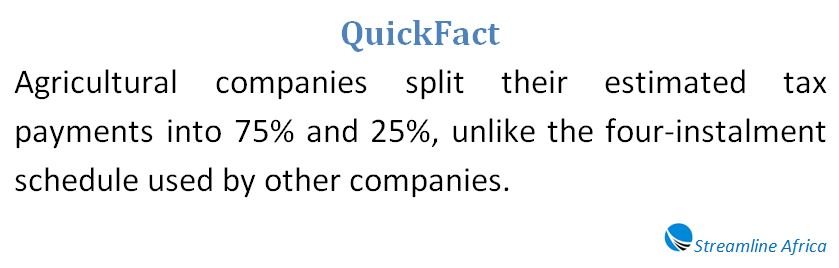
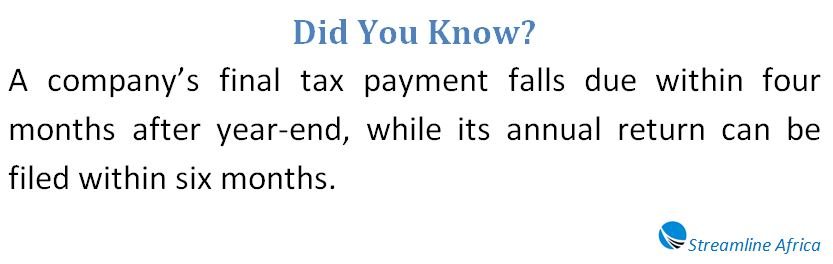
Agricultural businesses follow a different arrangement, paying estimated tax in portions of 75% and 25%. Any remaining annual liability must be settled within four months after year-end. Under the supplied guidance, taxes deducted from payments are remitted by the twentieth day of the following month.
Read More: Kenya Personal Income Tax Guide: Tax Rates, PAYE, Personal Relief and Rental Income Tax Explained
Common Procedures and Digital Records
Effective since January 2016, the Tax Procedures Act brings tax administration under a shared framework. Its objectives include simpler compliance, consistent procedures and stronger revenue collection. Businesses generally retain records for five years, although differences between individual tax statutes can still create practical interpretation challenges.
Legislation enacted in 2023 authorised electronic invoicing and stock recording systems for businesses, including foreign enterprises operating through Kenyan permanent establishments. The stated 2026 changes introduce penalties for electronic system failures: the higher of 5% of tax due or KES 100,000 for companies, with a KES 10,000 threshold for individuals.
Amnesty and Collection Relief
The supplied account of the 2026 amendments extends qualifying amnesty debts to those outstanding by 31 December 2025, with principal settlement required by 31 December 2026. This updates the earlier relief programme covering penalties, interest and fines.
Separately, recovery may be abandoned with written Cabinet Secretary approval where collection is impossible, disproportionately costly, contrary to public interest or likely to cause hardship. Gazette disclosures identifying affected taxpayers and reasons are required every four months.
Assessments, Refunds and Enforcement
Changes described for 2025 protect withholding agents from paying uncollected principal where recipients have already fully accounted for the tax. They also extend agency notices to taxable non-residents, require import certificates of origin and allow refunds to be determined within 120 days, or 180 days when audited. Relief may address penalties and interest caused by KRA system problems or incorrect registrations.
The stated 2026 provisions add anti-avoidance powers, information-based assessments, pre-populated returns, virtual asset reporting and international information exchange. They also require importers to retain export declarations or equivalent documents for five years and permit tax enforcement methods to recover certain other statutory charges.
Audits, Appeals and Assessment Deadlines
KRA selects audits using various triggers, typically requesting supporting records first. Reviews generally occur every two to four years, but no single prescribed audit procedure applies. Risk analysis and intelligence increasingly support efforts to identify evasion and fraudulent reporting.
Ordinarily, assessments must be issued within five years after a self-assessment return is filed. Suspected fraud can justify examining earlier periods. Audits have no fixed completion deadline, although straightforward cases are generally concluded within a reasonable period.
Since April 2015, the Tax Appeals Tribunal has provided a common forum for disputes across tax categories, replacing separate arrangements previously used for income tax and VAT. Businesses should therefore maintain accessible documentation that supports both routine compliance and any subsequent challenge to KRA findings. Clear reconciliations also help management explain differences before disputes become prolonged.
Frequently Asked Questions
Can a company choose its financial year-end in Kenya?
Yes. Companies can select a twelve-month accounting period, but changing it requires approval from the KRA Commissioner.
When must companies file their annual tax returns?
Within six months after their financial year ends, alongside financial statements, tax computations and supporting schedules.
How are corporate tax instalments calculated?
Businesses use the lower of 110% of the previous year’s tax liability or their estimated liability for the current year.
When are instalment payments due?
By the twentieth day of the fourth, sixth, ninth and twelfth months of the company’s financial year.
Do agricultural companies follow different payment rules?
Yes. They pay estimated tax in two instalments of 75% and 25%.
When should any outstanding annual tax be paid?
The remaining balance must be settled within four months after the financial year closes.
How long should businesses retain tax records?
Generally, five years. Keeping organised records also makes audits and tax disputes easier to manage.
What tax amnesty extension does the article describe?
It describes relief covering qualifying debts outstanding by 31 December 2025, with principal tax payable by 31 December 2026.
How far back can KRA issue tax assessments?
Generally, five years from filing the self-assessment return. Suspected fraud can allow KRA to examine earlier periods.
Where can businesses appeal tax disputes?
The Tax Appeals Tribunal handles appeals across tax categories, including corporate income tax and VAT.