
For companies operating in Libya, minimum wage compliance should be treated as more than a payroll requirement. It is part of a broader workforce strategy that affects labour costs, employee relations, recruitment competitiveness, and regulatory exposure.
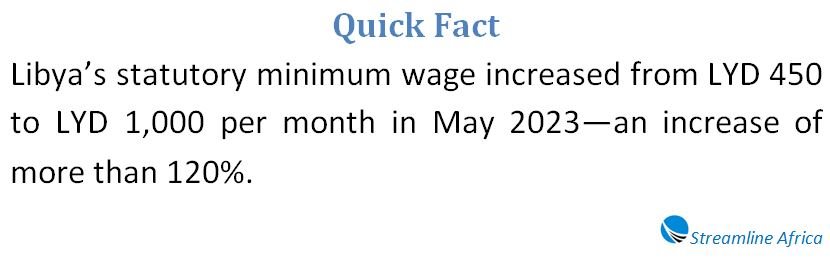
As of 2026, Libya’s statutory minimum wage remains LYD 1,000 per month. The rate took effect on 22 May 2023 under Law No. 16 of 2023 on Setting the Minimum Level for Salaries and Wages. It replaced the previous minimum of LYD 450 per month, representing a significant increase in the legal wage floor.
For African businesses assessing expansion into Libya, this change illustrates an important reality: statutory employment costs can shift quickly when governments respond to inflation, cost-of-living pressures, or broader economic reforms.
While LYD 1,000 establishes the minimum legal benchmark, employers should avoid using it as the sole basis for workforce budgeting. Market salaries in critical sectors can be several times higher.
How Libya’s Minimum Wage Framework Operates
Libya applies a national minimum wage rather than separate statutory rates for different cities or regions. This gives employers a relatively consistent compliance framework across the country.
In practical terms, an employer operating in Tripoli, Misrata, Benghazi, or another Libyan location will generally work from the same national wage floor, subject to any specific legal or contractual requirements that may apply to a particular employment arrangement.
The Ministry of Labour and Rehabilitation has responsibility for employment-related enforcement, while broader wage policy is influenced by legislation and national economic considerations.
This matters for businesses entering Libya from elsewhere in Africa. A Ghanaian logistics company establishing a local operation, a Nigerian engineering consultancy deploying technical staff, or a Kenyan technology business hiring local support personnel must all ensure that payroll structures satisfy Libyan legal requirements from the outset.
Accurate payroll records are therefore essential. Employers should be able to demonstrate what employees were paid, the periods covered, their employment status, and the basis used for salary calculations.
Statutory Minimum Wage Is Not the Same as a Competitive Salary
One of the most common compensation mistakes in new markets is treating the statutory minimum wage as a guide to what employees should actually be paid.
The minimum wage only establishes the legal floor.
Actual salaries are shaped by the labour market. Education, professional experience, technical expertise, location, sector demand, and the availability of skilled workers all influence compensation.
This distinction is particularly relevant in Libya, where specialised industries can offer salaries significantly above the statutory minimum.
For example, an African company recruiting administrative assistants for a basic support function may face a very different salary environment from an energy company competing for petroleum engineers.
The first question for management should therefore be: “What is legally required?”
The second should be: “What will the market require us to pay to attract and retain the right people?”
These are related questions, but they are not the same.
Understanding Average, Reasonable, and Market-Based Pay
Employers should also distinguish between minimum, average, and reasonable compensation.
Average wages provide a broad indication of what workers earn across a particular market or occupational group. They can be useful for benchmarking but may not accurately reflect the cost of hiring a specific role.
A reasonable wage, on the other hand, considers whether compensation is realistic in relation to employees’ living costs. Housing, transportation, food, inflation, and currency movements can all influence whether a salary remains attractive.
Market-based compensation focuses more directly on what competing employers are willing to pay for similar skills.
Consider an African construction company entering Libya to support an infrastructure project. Although the statutory wage may be LYD 1,000, experienced project supervisors, engineers, procurement professionals, and health and safety specialists are unlikely to be recruited successfully at that level.
A legally compliant salary can therefore still be commercially uncompetitive.
Full-Time Employee Minimum Wage
Full-time employees covered by the relevant wage rules should generally receive at least LYD 1,000 per month.
Employers may, of course, pay significantly more depending on the position.
For workforce planning purposes, the statutory minimum should be viewed as a compliance threshold rather than a recommended salary.
This approach is particularly important for businesses preparing tenders or project budgets. Underestimating salary requirements can weaken project margins later if the organisation discovers that skilled employees command substantially higher market rates.
Businesses should therefore budget on the basis of the actual talent required rather than simply multiplying the minimum wage by expected headcount.
How Part-Time Employees May Be Paid
Part-time compensation can be calculated proportionately based on the hours worked relative to a standard full-time schedule.
For example, assume a company considers 40 hours per week to be full time.
If a part-time employee works 20 hours weekly, the employee is working half the normal schedule.
Using the statutory minimum as the reference point:
20 ÷ 40 × LYD 1,000 = LYD 500 per month.
The calculation appears simple, but the underlying payroll documentation remains important.
Employers should maintain dependable working-hour records and ensure that employees are correctly classified. Poor timekeeping systems can create compliance difficulties, particularly where staff work irregular hours or move between full-time and part-time arrangements.

Interns and Trainees Require Careful Classification
Businesses should not assume that interns or trainees automatically fall outside minimum wage requirements.
According to the source framework, interns and trainees are generally covered unless they qualify for a legally recognised unpaid or reduced-pay arrangement.
Relevant arrangements may require registration or approval through the Ministry of Labour and Rehabilitation.
This issue is particularly relevant for African companies that use graduate programmes, industrial attachments, or management trainee schemes as part of their talent pipeline.
A business should clearly establish whether an individual is genuinely participating in a structured training arrangement or is effectively performing the responsibilities of a regular employee.
The distinction can have legal and payroll implications.
Domestic Workers and Expatriate Employees
Domestic workers are also described as falling within Libya’s standard minimum wage framework and should generally receive at least the applicable statutory minimum.
Foreign employees are similarly subject to Libyan employment rules.
This is particularly important for multinational and pan-African businesses that transfer employees into Libya from other countries.
For example, a company may deploy a finance manager from Ghana, an engineer from Egypt, or an operations specialist from Kenya while simultaneously employing Libyan nationals.
The employer must consider not only salary levels but also work permits, employment contracts, local labour obligations, immigration requirements, and any bilateral arrangements that may affect the employee.
Equal minimum wage protection does not necessarily mean that every expatriate employment package will look the same. Housing, transport, travel, hardship allowances, insurance, and other benefits may significantly affect total compensation.
What Higher-Skilled Roles May Earn
The statutory minimum wage bears little resemblance to compensation for many specialised roles.
According to the source material, petroleum engineers may earn approximately LYD 5,000 to LYD 7,000 per month.
Construction managers may fall around LYD 4,500 to LYD 6,500, while telecommunications specialists and IT managers may earn approximately LYD 4,000 to LYD 6,000.
Financial analysts and legal advisers are indicated at around LYD 3,500 to LYD 5,500, while project managers may earn approximately LYD 3,800 to LYD 5,800.
These figures reinforce an important compensation principle for businesses operating across Africa: statutory minimum wages rarely provide sufficient information for professional salary benchmarking.
An oil services company hiring petroleum engineers cannot structure its recruitment strategy around the same salary assumptions used for entry-level administrative roles.
Employers should therefore build separate market benchmarks for key job families.
The Cost of Minimum Wage Non-Compliance
Failing to meet wage requirements can create liabilities far greater than the value of the original payroll shortfall.
The Ministry of Labour and Rehabilitation may investigate businesses following employee complaints, random inspections, or industry-focused compliance exercises.
According to the source, minimum wage breaches can attract penalties ranging from LYD 200 to LYD 500 per violation. Serious breaches may potentially lead to further legal consequences.
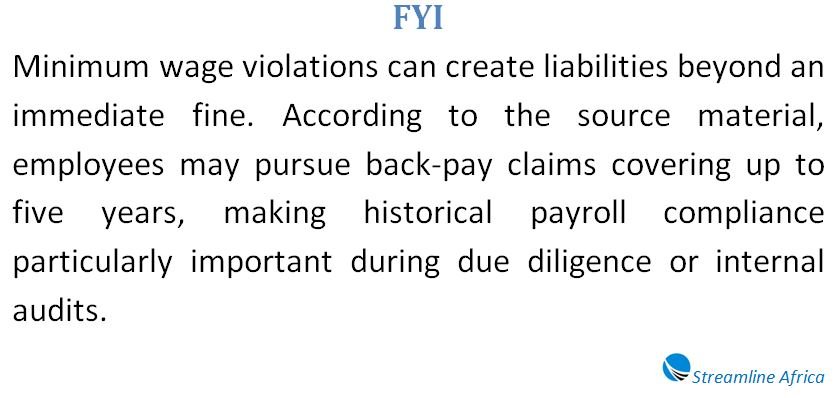
Back-pay claims may also extend for several years. The source indicates that claims can reach as far back as five years.
This can materially increase exposure.
For example, if a company underpays 30 employees each month, even a modest monthly discrepancy can become a substantial liability when multiplied across several years.
In some circumstances, directors may also face personal exposure where they are found to have participated in wage violations.
Minimum wage compliance should therefore be treated as part of enterprise risk management, not simply an HR administrative task.
Economic Conditions Will Continue to Influence Pay
Libyan wage policy does not operate in isolation from broader economic conditions.
Inflation, currency movements, political uncertainty, labour shortages, and rising household costs can all influence wage expectations.
Even where the statutory minimum remains unchanged, employees may demand higher salaries because the purchasing power of existing wages has declined.
This is a familiar issue across many African markets.
Companies operating in economies experiencing currency depreciation or persistent inflation often find that annual salary reviews become necessary even without changes to statutory minimum wages.
Employers in Libya should therefore monitor both legislative developments and market conditions.
A payroll structure that was competitive two years ago may no longer be sufficient to retain critical employees.
Sector Differences Matter
Different sectors face different labour pressures.
Oil and gas remains particularly significant because specialised technical skills are scarce and commercially valuable.
Construction employers may also experience pressure from infrastructure activity and project-based hiring.
Technology and telecommunications businesses increasingly compete for professionals whose skills can also be sold internationally or remotely.
For employers, this means a single company-wide salary philosophy may not always be appropriate.
A business may need different market positioning for engineers, finance professionals, technical managers, drivers, administrators, and entry-level staff.
African organisations expanding into Libya should conduct job-specific salary benchmarking before finalising workforce budgets.
Payroll Taxes and Employment Costs
The employee’s salary is only one component of employment cost.
Depending on the applicable legal requirements, employers may also face social security, insurance, taxation, employee benefits, allowances, and administrative costs.
The underlying source notes that some specific tax thresholds and contribution rates require further verification.
Businesses should therefore confirm current figures with official Libyan authorities or appropriately qualified local advisers before calculating final payroll costs.
This is especially important when preparing investment models.
If management budgets only for gross salaries and excludes employer contributions or statutory benefits, actual labour costs may exceed projections.
A better approach is to calculate total employment cost per position before approving recruitment.
What Employers Should Do in Practice
Businesses operating in Libya should establish a structured compliance process rather than reviewing minimum wage requirements only when legislation changes.
Payroll systems should be checked periodically to confirm that no employee has fallen below the statutory threshold.
Employment contracts should clearly state compensation arrangements.
Part-time calculations should be supported by reliable time records.
Internship and trainee programmes should be reviewed to determine whether reduced-pay arrangements are legally permissible.
Expatriate packages should also be assessed against both employment and immigration requirements.
Management should additionally monitor market salaries for positions where talent shortages create significant recruitment risk.
These practices are particularly important for regional African companies scaling across multiple jurisdictions. A payroll model that works in Accra, Lagos, Nairobi, or Johannesburg cannot simply be replicated in Tripoli without considering local employment requirements.
Strategic Takeaway for Businesses
Libya’s LYD 1,000 monthly minimum wage provides a clear statutory baseline, but effective workforce planning requires a much broader perspective.
Employers must consider legal compliance, market salaries, employee living costs, sector competition, payroll taxes, benefits, and long-term retention requirements.
The strongest compensation strategies therefore operate on two levels.
First, businesses ensure that every employee receives at least what the law requires.
Second, they determine what they must realistically pay to secure the talent required to execute their business strategy.
For African companies evaluating Libya as a destination for investment, project delivery, recruitment, or regional expansion, that distinction is critical.
Minimum wage compliance protects the organisation from legal exposure. Competitive compensation helps the organisation build a workforce capable of delivering sustainable growth.
Important Questions and Answers
What is the minimum wage in Libya in 2026?
Libya’s statutory minimum wage is LYD 1,000 per month. The rate became effective on 22 May 2023 under Law No. 16 of 2023 on Setting the Minimum Level for Salaries and Wages and remains the applicable rate stated in the source material for 2026.
What was Libya’s minimum wage before the current rate?
The previous minimum wage was LYD 450 per month. It was increased to LYD 1,000 as Libya responded to economic pressures, including inflation and the rising cost of living.
Does Libya have different minimum wages across regions?
No regional or sector-specific statutory minimum wage variations are identified in the source. This means employers generally work with the same national minimum wage when establishing their basic payroll compliance framework.
Does the minimum wage apply to part-time employees?
Yes, but part-time compensation may be calculated proportionately according to working hours. For example, where 40 hours represents a normal full-time week, an employee working 20 hours could receive LYD 500 per month based on the LYD 1,000 benchmark.
Are interns and trainees entitled to minimum wage?
Generally, yes. However, particular internship or training arrangements may qualify for unpaid or reduced-rate treatment. The source states that such arrangements should be registered with the Ministry of Labour and Rehabilitation for approval.
Does the minimum wage apply to expatriate employees?
Yes. Foreign workers are generally subject to the same minimum wage requirements as Libyan citizens. Employers should nevertheless examine work permit conditions and applicable bilateral agreements when structuring expatriate employment packages.
Are professional salaries in Libya usually higher than the minimum wage?
They can be considerably higher, particularly for skilled occupations. The source, for example, places petroleum engineers at approximately LYD 5,000–7,000 per month, construction managers at LYD 4,500–6,500, and IT managers at LYD 4,000–6,000.
What happens when an employer pays below the minimum wage?
Employers may face inspections, financial penalties, back-pay liabilities, and potentially more serious legal consequences. The source reports fines of LYD 200–500 per violation and indicates that back-pay claims can extend for up to five years.
What factors could influence future minimum wage changes?
Inflation, currency stability, economic conditions, political developments, government policy, and changes in living costs can influence wage policy. Employers should therefore monitor regulatory developments rather than assuming the existing rate will remain unchanged indefinitely.
Is minimum wage the same as a competitive salary?
No. Minimum wage establishes a legal compensation floor. Competitive salaries depend on factors such as occupation, experience, skill scarcity, industry conditions, and demand for talent. This distinction is particularly important in sectors such as oil and gas, construction, telecommunications, finance, and technology.
Should African companies use LYD 1,000 when budgeting for new employees?
It can serve as a legal starting point, but it should not automatically become the recruitment budget. Businesses entering Libya should benchmark salaries by occupation and calculate the broader employment cost associated with each position.
What should employers review before hiring in Libya?
Employers should examine minimum wage requirements, employment contracts, employee classification, working hours, expatriate requirements, statutory contributions, payroll processes, and prevailing market salaries. Where tax or contribution rates are required, current figures should be independently confirmed because the source notes that some of these details remain unverified.