

Mozambique applies withholding tax to various payments made to foreign businesses that earn income within the country. As a general rule, a non-resident company conducting economic activity in Mozambique without local taxpayer registration faces a final withholding tax of 20% on income regarded as Mozambican-sourced under the Corporate Income Tax framework.
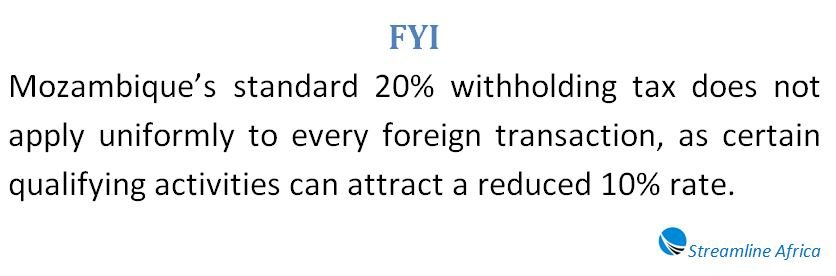
Certain activities benefit from a reduced 10% rate. These include international telecommunications and transportation services, including related equipment installation and assembly. The reduced rate also covers qualifying rural electrification projects involving the construction or rehabilitation of electricity production, transmission and distribution infrastructure.
Other activities falling within the 10% category include the chartering of maritime vessels for fishing and coastal operations, commissions earned by electronic money agents, and revenue generated from qualifying digital goods and digital services.
Capital Gains Require Different Treatment
Withholding tax is not the mechanism used for every type of income earned by foreign companies. Certain capital gains are instead dealt with through Mozambique’s corporate income tax system.
This treatment can apply when a foreign company sells real estate situated in Mozambique or disposes of shares in a business headquartered or effectively managed in the country. It may also cover transactions between two non-resident parties where shares, participation rights or similar interests are transferred and their value is directly or indirectly connected to assets located in Mozambique.
In these circumstances, the foreign entity generally needs to obtain non-resident taxpayer registration and appoint a local tax representative. The taxable gain is then subject to the standard 32% corporate income tax rate. Since January 2026, capital gains have been taxed autonomously.
Timing and Property Income
Mozambique’s corporate tax provisions also establish when withholding obligations arise. The relevant point is generally when the resident payer records the expense for tax purposes, rather than relying exclusively on the date when money is transferred to the foreign recipient.
Rental and other qualifying income arising from immovable property and paid by Mozambican tax-resident entities generally attracts withholding tax at 20%. Properly supported expenses may qualify for an annual deduction of up to 30%, although restrictions can apply, particularly to certain financing costs.
Double Tax Treaties Can Reduce Rates
Mozambique has double taxation treaties with several jurisdictions that can lower domestic withholding tax rates on dividends, interest and royalties. Treaty partners include Botswana, India, Italy, Macau, Mauritius, Portugal, South Africa, the United Arab Emirates and Vietnam.
The precise treaty rate depends on the jurisdiction, income category and, for some dividends, the recipient’s ownership percentage. For example, treaty dividend rates range from zero in qualifying circumstances to 15%, while treaty interest rates generally range between zero and 10%. Royalty rates commonly fall between 5% and 10%.
Capital gains on shares require particular attention. Some treaties allocate taxing rights differently depending on how much of the underlying company’s value comes from immovable property. Consequently, businesses should examine the relevant treaty provisions and ownership conditions before determining the applicable Mozambican tax treatment.
Practical Compliance Checklist
Managing withholding tax in Mozambique becomes much easier when businesses check the tax implications before making or recording a payment. A good starting point is to establish who is receiving the income, whether the recipient is based in Mozambique or overseas, and whether the payment is considered Mozambican-sourced income.
The type of payment also matters. Dividends, interest, royalties, rent, service fees, digital services and capital gains do not necessarily receive the same tax treatment. For payments to non-resident businesses, companies should first determine whether the standard 20% withholding tax applies or whether the transaction falls within one of the categories eligible for the reduced 10% rate.
It is also worth checking Mozambique’s double taxation treaties before applying the domestic rate. A treaty may provide a lower rate for dividends, interest or royalties. However, the reduced rate should not be applied automatically. The recipient’s country of residence, ownership percentage and other treaty requirements may need to be confirmed and properly documented.
Extra care is advisable when shares, property or other business interests are being sold. Some capital gains involving Mozambican assets are handled through corporate income tax rather than ordinary withholding tax. A foreign business may therefore need to register as a non-resident taxpayer, appoint a representative in Mozambique and account for tax on the resulting gain.
Timing should not be overlooked either. A withholding tax obligation can arise when the Mozambican payer recognises the relevant cost for tax purposes in its accounting records. Waiting until the actual payment date to consider withholding tax could therefore create an unexpected compliance problem.
Good documentation makes the entire process easier. Businesses should keep contracts, invoices, tax residency certificates, ownership information and records supporting any deductions or treaty benefits claimed. Rental property owners should also retain evidence of qualifying expenses where deductions are available.
Most importantly, withholding tax should be considered before a transaction is completed rather than treated as an issue to resolve afterwards. A simple review of the recipient, payment type, applicable rate, treaty position and filing requirements can prevent avoidable penalties, unexpected tax costs and disagreements with the Mozambican tax authorities.
Practical Compliance Steps
For any business dealing with withholding tax in Mozambique, the following steps can make your day-to-day compliance a lot easier and stress-free:
- Confirm the recipient’s tax status before processing the transaction. Establish whether the individual or company is resident in Mozambique or operating as a non-resident.
- Identify exactly what the payment covers. Determine whether it relates to services, rent, interest, royalties, dividends, digital activities, transport, telecommunications or another category of income.
- Check whether the income is considered Mozambican-sourced. This is particularly important when services are provided by a foreign company or when transactions involve assets located in Mozambique.
- Determine the correct withholding tax rate. Do not automatically apply the standard 20% rate, as certain qualifying activities may benefit from the reduced 10% rate.
- Review treaty eligibility where the recipient is based in a country that has a double taxation treaty with Mozambique. Confirm the applicable rate and ensure the recipient meets the relevant treaty conditions.
- Obtain supporting documents before applying treaty relief. Tax residency certificates, contracts, invoices, ownership information and other relevant evidence should be available to support the tax treatment adopted.
- Check the timing of the withholding obligation. Businesses should consider withholding tax when the relevant expense is recognised for tax purposes rather than waiting until the supplier or other recipient is eventually paid.
- Treat capital gains separately. Where a foreign company sells property, shares or interests connected with Mozambique, determine whether taxpayer registration, local representation and corporate income tax obligations arise.
- Keep a clear transaction file. Supporting calculations, invoices, agreements, tax certificates and evidence of withholding and payment should be retained so that the treatment can be explained if questioned later.
- Review withholding tax returns and payments before submission. Confirm that the recipient, taxable amount, rate and tax withheld agree with the underlying transaction and accounting records.
- Reconcile withholding tax records regularly. Comparing tax filings with the general ledger and supplier accounts can help identify missed transactions or incorrect rates before they become larger compliance issues.
- Seek professional tax guidance when a transaction is unusual, high-value or involves several jurisdictions. Addressing uncertainty before completing the transaction is generally easier than correcting the tax position afterwards.
Important Takeaways
Mozambique’s Standard WHT Rate Is 20%
Non-resident businesses earning qualifying Mozambican-sourced income generally face a final 20% withholding tax when they are not locally registered taxpayers.
Some Activities Qualify for 10%
Certain telecommunications, international transport, rural electrification, maritime, electronic money and digital activities may benefit from a reduced 10% withholding tax rate.
Capital Gains Follow Different Rules
Some gains from Mozambican property, shares and locally connected assets are handled through corporate income tax rather than ordinary withholding tax.
Tax Registration May Be Necessary
A foreign business involved in certain taxable capital transactions may need to register as a non-resident taxpayer and appoint a representative in Mozambique.
Timing Matters for Compliance
Businesses should consider withholding tax when an expense is recognised for tax purposes, rather than simply waiting until the actual payment is made.
Rental Income Can Attract WHT
Qualifying income from immovable property is generally subject to 20% withholding tax, while certain properly documented expenses may be deductible within prescribed limits.
Tax Treaties Can Reduce the Burden
Mozambique’s double taxation treaties can provide lower rates for dividends, interest and royalties when the recipient satisfies the relevant treaty requirements.
Good Records Make Compliance Easier
Contracts, invoices, residency certificates, ownership records and tax calculations should be properly maintained to support withholding rates, deductions and treaty benefits.