
Equatorial Guinea operates a personal income tax system that requires individuals to contribute a portion of their taxable earnings to the government. The amount payable depends on an individual’s income level, tax residency status, and the applicable tax brackets.
The country follows a progressive taxation structure, meaning individuals with higher taxable earnings generally face higher tax rates. This approach ensures that tax obligations increase according to income rather than applying a uniform percentage to everyone.
Read Also: Equatorial Guinea Business Environment, Investment Opportunities and Market Risks
Tax Residency and Income Coverage
An individual’s residency status determines which earnings fall within Equatorial Guinea’s tax system.
Tax residents are generally required to declare income earned both domestically and internationally. Consequently, employment earnings, business profits, and other taxable income received from overseas may fall within their tax obligations.
Non-residents, however, are taxed exclusively on income originating from Equatorial Guinea. This distinction is particularly relevant for foreign professionals, international consultants, and individuals conducting business activities within the country.
Personal Income Tax Rates and Thresholds
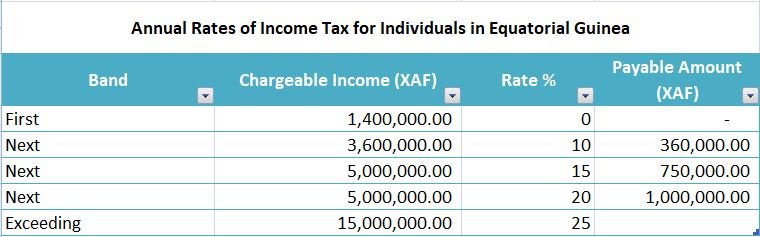
Equatorial Guinea applies five annual income tax brackets, ranging from 0% to 25%. The applicable rates are outlined below.
| Annual Taxable Income (XAF) | Tax Rate |
|---|---|
| Up to 1,400,000 | 0% |
| Above 1,400,000 to 5,000,000 | 10% |
| Above 5,000,000 to 10,000,000 | 15% |
| Above 10,000,000 to 15,000,000 | 20% |
| Above 15,000,000 | 25% |
Under this progressive framework, the first XAF 1.4 million of annual taxable income is exempt from taxation. Earnings exceeding this threshold are taxed incrementally, with each applicable portion attracting its corresponding rate.
For example, someone earning XAF 8 million annually does not pay 15% on their entire income. Instead, the different portions are assessed using their respective tax brackets.
Practical Example of Personal Income Tax Calculation in Equatorial Guinea
Consider an employee in Equatorial Guinea earning an annual taxable income of XAF 12,000,000. Under the country’s progressive personal income tax system, the income is divided into different tax brackets, with each portion taxed at its applicable rate.
The calculation is illustrated below:
| Annual Income Bracket (XAF) | Tax Rate | Tax Payable (XAF) |
|---|---|---|
| First 1,400,000 | 0% | 0 |
| Next 3,600,000 | 10% | 360,000 |
| Next 5,000,000 | 15% | 750,000 |
| Remaining 2,000,000 | 20% | 400,000 |
| Total | 1,510,000 |
Total annual personal income tax
XAF 1,510,000
Annual income after tax
XAF 10,490,000
Effective tax rate
12.58%
Although the employee’s highest applicable tax bracket is 20%, the entire annual income is not taxed at that rate. Instead, each portion is taxed separately, resulting in an effective personal income tax rate of approximately 12.58%.
This example assumes that XAF 12 million is the employee’s annual taxable income before applying the progressive rates, without additional deductions, credits, or other adjustments.
Tax Planning and Compliance Considerations
Employees, entrepreneurs, and foreign nationals should understand how residency classification and taxable earnings influence their liabilities.
Maintaining accurate financial records, identifying applicable income sources, and reviewing payroll deductions can support effective compliance.
Businesses employing local and international personnel should also ensure that payroll calculations reflect the appropriate tax treatment.
Understanding these requirements helps taxpayers anticipate liabilities, manage financial commitments, and reduce the risk of reporting errors.
Frequently Asked Questions
Who Is Required to Pay Personal Income Tax in Equatorial Guinea?
Individuals earning taxable income in Equatorial Guinea are generally subject to personal income tax. Their obligations depend on their residency status, income sources, and applicable tax rates.
What Is the Highest Personal Income Tax Rate in Equatorial Guinea?
The highest personal income tax rate is 25%, applicable to annual taxable income exceeding XAF 15 million. However, this rate applies only to the portion of income above that threshold.
Are Foreign Workers Required to Pay Income Tax in Equatorial Guinea?
Yes. Foreign employees earning income in Equatorial Guinea may be liable for personal income tax. The extent of their obligations depends on whether they qualify as tax residents or non-residents.
Is There a Tax-Free Income Threshold in Equatorial Guinea?
Yes. The first XAF 1.4 million of annual taxable income is exempt from personal income tax under the progressive tax structure.
How Is Personal Income Tax Calculated in Equatorial Guinea?
Income is divided into different tax brackets, with rates ranging from 0% to 25%. Each portion is taxed separately, meaning higher rates do not apply to an individual’s entire earnings.
Do Equatorial Guinea Residents Pay Tax on Foreign Income?
Yes. Tax residents are generally subject to taxation on their worldwide income, including qualifying earnings from overseas. Non-residents are taxed only on income sourced within Equatorial Guinea.