
Withholding tax is a central feature of Rwanda’s corporate tax framework and an important compliance consideration for businesses making payments to suppliers, investors, consultants, lenders, and other counterparties.
For companies operating in Kigali, Huye, Musanze, Rubavu, or across Rwanda’s growing commercial corridors, withholding tax should not be treated simply as an accounting deduction made at the end of a transaction. It should be considered when contracts are negotiated, suppliers are onboarded, financing arrangements are structured, and cross-border payments are approved.
The standard withholding tax rate applicable to many qualifying transactions is 15% of the payment amount, generally excluding VAT. Particular attention is required where payments are made to persons who are not registered with the tax administration or to registered taxpayers whose required income tax declarations are not current.
For businesses, the practical risk is straightforward: paying a supplier in full without first determining the correct tax treatment can leave the payer responsible for an amount that should have been withheld.
Payments That Can Attract the 15% Withholding Tax
Rwanda’s withholding tax regime covers several forms of corporate and investment income.
Dividends are generally subject to withholding tax, although exceptions can apply to certain distributions between resident companies and income distributed to qualifying investors through collective investment structures.
Interest also falls within the withholding tax framework. However, not every interest payment receives identical treatment. Certain longer-term deposits with financial institutions, qualifying development finance arrangements, and specified transactions involving banks and deposit-taking microfinance institutions may benefit from exemptions.
These distinctions matter for businesses raising capital. Consider an agribusiness processor in Nyagatare financing a new grain storage facility through a combination of local borrowing and development finance. The tax consequences of interest payments may differ considerably depending on the lender, financing structure, and applicable exemption.
Royalties are another major category. A Rwandan company licensing software, technology, trademarks, production systems, or intellectual property from another business may need to account for withholding tax when royalty payments are made.
Management and technical service fees can also attract the standard rate, while transport services are generally treated separately under the relevant rules.
An East African manufacturing group with operations in Rwanda, for instance, may receive engineering, quality-control, or strategic management support from a regional headquarters. The fact that the service is provided within the same corporate group does not automatically eliminate the need for withholding tax analysis.
Artists, Athletes and Commercial Performance Income
Rwanda’s withholding tax provisions also extend beyond conventional business-to-business services.
Payments made to craftspeople, musicians, artists, athletes, and individuals participating in sporting, cultural, entertainment, or leisure activities can fall within the regime. This can apply whether the payment reaches the individual directly or through an intermediary.
The rule is relevant to businesses sponsoring concerts, sporting competitions, tourism festivals, promotional campaigns, and corporate events.
For example, a telecommunications company sponsoring a major sporting event in Kigali may engage performers and professional athletes from Rwanda and other African markets. Each payment should be reviewed according to the nature of the income and the recipient’s tax position rather than being processed as a standard event expense.
Qualifying sales of goods within Rwanda may also give rise to withholding obligations, particularly where supplier compliance requirements have not been satisfied.
Cross-Border and Less Obvious Transactions
One of the most common withholding tax risks for expanding African businesses is assuming that the rules apply only when an ordinary supplier invoice is paid.
Rwanda’s framework reaches considerably further.
Profits repatriated from Rwanda can attract withholding tax. Certain payments made by a resident business on behalf of a non-resident contracted party may also fall within the regime where those payments are provided for under the contract in addition to the principal remuneration.
The conversion of retained earnings or after-tax profits into shares can also have withholding implications, although specific exceptions may apply to financial institutions that have not reached prescribed regulatory capital requirements.
Reinsurance premiums paid to non-resident insurers require similar scrutiny. Exemptions may be available where the foreign insurer benefits from an agreement recognised by the Government of Rwanda.
These rules are particularly relevant for multinational groups operating through African regional structures. Internal settlements, cost allocations, reimbursements, and group payments should never be assumed to fall outside withholding tax simply because money is moving between related businesses.
When an Unpaid Liability May Still Trigger Tax
Cash does not always have to move before a withholding tax obligation can arise.
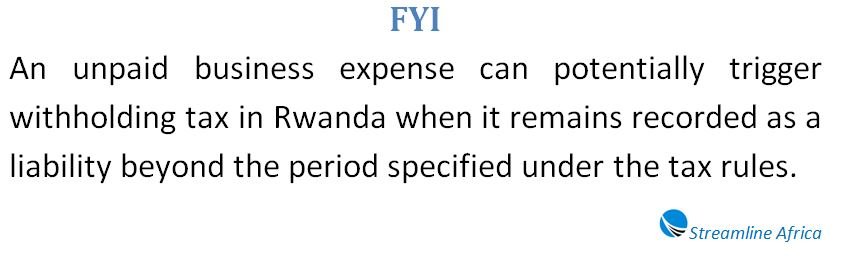
An expense recorded in a company’s accounts as an amount payable to a creditor may eventually be regarded as a payment where it has reduced taxable income and remains outstanding beyond the period prescribed under Rwanda’s tax legislation.
This can create unexpected exposure.
Suppose a construction business operating between Kigali and Muhanga receives technical consulting services from a foreign engineering firm. The expense is recognised in the accounts, but payment is delayed because of project financing constraints. Leaving the invoice unpaid does not necessarily allow the business to postpone withholding tax indefinitely.
Companies should therefore incorporate aged creditor reviews into their tax compliance process. Finance teams need to identify liabilities that could become deemed payments before they create unplanned tax costs, interest, or penalties.
Permanent Establishments and Head Office Payments
Permanent establishments require particularly disciplined controls because payments can be made outside Rwanda even though the underlying expense belongs to the Rwandan operation.
Where a foreign parent or head office pays a third-party supplier on behalf of a Rwandan permanent establishment, withholding tax may become due when the foreign payment is made. The local operation should not automatically wait until the head office subsequently recharges the expense.
Consider a regional logistics company headquartered in Nairobi with a permanent establishment in Rwanda. If headquarters pays a European software provider for a fleet-management system used by the Rwanda operation, the local tax position may need to be considered at the time the software supplier receives payment.
This makes communication between local finance teams and regional headquarters essential. Rwanda operations should have visibility over expenses settled internationally on their behalf.

Reduced Rates and Important Exceptions
While 15% is the standard rate associated with many withholding transactions, reduced rates apply in specified circumstances.
A 5% rate can apply to qualifying dividends and interest from securities listed on a capital market where the beneficiary satisfies applicable residency requirements within Rwanda or the East African Community.
Qualifying interest from Treasury bonds with the required maturity period may also attract a 5% rate.
Commercial imports can similarly be subject to withholding tax at 5%. Importers should therefore factor the tax into working-capital planning, especially where large quantities of agricultural inputs, machinery, consumer products, or industrial materials are brought into Rwanda.
Public institutions generally withhold 3% from payments made to successful public tender contractors. The rate can increase to 15% where the contractor is not properly registered with the tax administration or has failed to meet relevant income tax declaration requirements.
For contractors working on public infrastructure, healthcare, education, technology, or agricultural programmes, maintaining good tax standing can therefore have a direct impact on cash flow.
Businesses holding a valid tax clearance certificate may qualify for exemption from certain withholding deductions. Tax compliance is consequently more than an administrative issue; it can influence liquidity and commercial competitiveness.
Gaming Activities and Player Winnings
Gaming operators also have specific withholding responsibilities.
A 15% tax applies to the difference between a player’s winnings and the stake invested in the gaming activity. The operator is responsible for withholding the tax.
For example, if a participant places a qualifying stake and subsequently receives a higher payout, the relevant tax calculation focuses on the resulting gain rather than simply treating the entire amount received as taxable winnings.
Gaming businesses should maintain reliable systems for tracking stakes, payouts, taxable gains, deductions, and remittances. In a sector characterised by high transaction volumes, weaknesses in these systems can quickly translate into significant compliance exposure.
Remitting Withholding Tax to the RRA
Withholding tax compliance does not end when the tax is deducted from a payment.
Amounts withheld must be declared and remitted to the Rwanda Revenue Authority within the applicable statutory timeframe. Businesses should therefore establish payment controls that identify the withholding tax position before invoices are released for settlement.
A robust process should connect supplier tax information with contracts, invoices, purchase orders, tax clearance certificates, treaty documentation, exemptions, and withholding calculations.
This is particularly important for businesses working with large supplier networks. Agricultural aggregators, construction contractors, mining service providers, telecom operators, retailers, NGOs, and development projects can process hundreds of supplier payments each month. Even small classification errors can accumulate into material tax exposure.
Double Tax Treaties and Cross-Border Payments
Rwanda maintains double taxation agreements with a number of international partners, creating opportunities for qualifying businesses to access lower withholding tax rates on certain cross-border payments.
Treaties can influence the taxation of dividends, interest, royalties, and management or professional fees. Depending on the applicable agreement and underlying conditions, treaty rates may be lower than Rwanda’s standard domestic withholding tax rate.
This can be commercially significant.
Consider a Kigali-based renewable energy company receiving financing from an overseas investor or licensing specialist technology from a foreign provider. Applying the domestic rate automatically could result in more tax being withheld than necessary. Conversely, applying a treaty rate without confirming eligibility could create an underpayment.
Treaty analysis should therefore form part of the payment approval process for material international transactions.
Treaty Relief Is Not Automatic
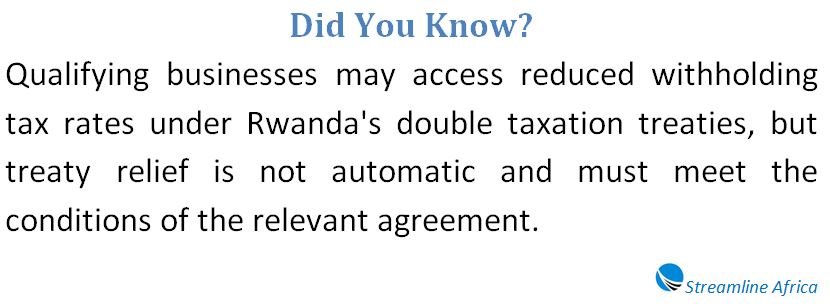
The existence of a double tax treaty does not by itself justify applying a reduced withholding rate.
Businesses must establish whether the recipient satisfies the treaty requirements. Relevant considerations may include tax residence, beneficial ownership, the classification of the income, permanent establishment provisions, supporting certificates, and other conditions contained in the specific agreement.
A Rwandan fintech company paying software royalties to an overseas technology supplier, for example, should determine whether the recipient is genuinely entitled to the treaty benefit rather than relying solely on the supplier’s country of incorporation.
The same principle applies to financing arrangements, professional services, dividend distributions, and intellectual property payments.
Building a Strong Withholding Tax Compliance Process
Effective withholding tax management requires more than knowing the headline rates. Businesses need controls that identify the tax consequences of a transaction before money is transferred.
Supplier onboarding should capture tax registration information and supporting documentation. Contracts should clearly distinguish service fees, royalties, reimbursements, financing charges, and other payment components. Finance teams should monitor aged liabilities, while multinational companies should establish processes for identifying payments made overseas on behalf of Rwanda operations.
Treaty benefits and exemptions should also be supported by appropriate evidence before reduced rates are used.
For companies expanding into Rwanda or managing regional African operations, withholding tax deserves attention at the transaction-planning stage. The cost of resolving an incorrect payment after it has been processed is often greater than the effort required to establish the correct position beforehand.
Because tax legislation, administrative guidance, treaty networks, and compliance procedures can evolve, businesses should confirm the applicable Rwanda Revenue Authority requirements before implementing material transactions or relying on a specific exemption or preferential treaty rate.
FAQs about Withholding Tax in Rwanda
What is the standard withholding tax rate in Rwanda?
The standard rate for many qualifying payments is 15%, generally calculated on the amount excluding VAT. However, reduced rates and exemptions may apply depending on the transaction and taxpayer’s status.
Which payments can attract withholding tax?
Common examples include dividends, interest, royalties, management and technical service fees, certain goods transactions, performance payments, profit repatriations, and some payments involving non-residents.
Are lower withholding tax rates available?
Yes. Certain transactions can qualify for reduced rates. For example, qualifying dividends and interest from listed securities and certain Treasury bond interest may attract a 5% rate, subject to applicable conditions.
How does withholding tax affect public contracts?
Public institutions generally withhold tax from payments to successful tender contractors. The applicable rate can depend on whether the contractor is properly registered and compliant with relevant tax filing requirements.
Can an unpaid invoice create a withholding tax obligation?
Potentially, yes. A liability recorded in the accounts that reduces taxable income may eventually be treated as a payment if it remains outstanding beyond the period prescribed by Rwanda’s tax rules.
Do cross-border payments automatically attract the standard rate?
Not necessarily. Rwanda’s double taxation treaties can provide reduced rates for qualifying dividends, interest, royalties, and certain professional or management fees. The relevant treaty conditions must first be satisfied.
Why is a tax clearance certificate important?
A valid tax clearance certificate can help qualifying businesses benefit from exemptions from certain withholding tax deductions. Maintaining good tax standing can therefore support both compliance and cash-flow management.
How can businesses reduce withholding tax compliance risks?
Businesses should verify supplier tax status before payment, correctly classify transactions, review contracts, monitor outstanding liabilities, retain supporting documentation, and confirm treaty eligibility before applying preferential rates.