

For businesses operating in South Africa, tax exposure depends on residence. Resident companies generally account for income earned locally and abroad, while foreign companies face tax on income sourced within South Africa. The standard corporate income tax rate is 27%, applying to assessment years ending from 31 March 2023 onward. Previously, the rate was 28%.
Smaller Companies Have Different Options
Qualifying small business corporations receive graduated rates rather than an immediate flat charge. Eligibility includes having individual shareholders and gross income not exceeding ZAR 20 million, alongside other statutory conditions.
For assessment years ending between 1 April 2025 and 31 March 2026, taxable income up to ZAR 95,750 attracts no tax. The next band, ending at ZAR 365,000, attracts 7%. Above that threshold, the charge becomes ZAR 18,848 plus 21% of income exceeding ZAR 365,000, until ZAR 550,000. Higher profits attract ZAR 57,698 plus 27% of the excess. These figures relate specifically to that assessment period; subsequent bands differ.
Separately, eligible microbusinesses with annual turnover no greater than ZAR 2.3 million can choose turnover tax. This simplified arrangement calculates liability from taxable turnover rather than profits, using progressive rates ranging from zero to 3%.
Distributing Profits to Shareholders
Dividends generally carry a 20% tax when paid by resident companies, or foreign companies whose relevant shares trade on a South African exchange. Certain recipients, including resident companies and qualifying retirement funds, receive exemptions.
Usually, the paying company or regulated intermediary withholds the amount. However, when distributions comprise assets instead of cash, the declaring company bears the liability. Beneficiaries must provide the required declaration and undertaking before exemptions or treaty reductions can apply.
Industry Rules Change the Calculation
Gold producers calculate normal tax through a specialised formula. Businesses extracting other minerals generally follow the ordinary corporate rate.
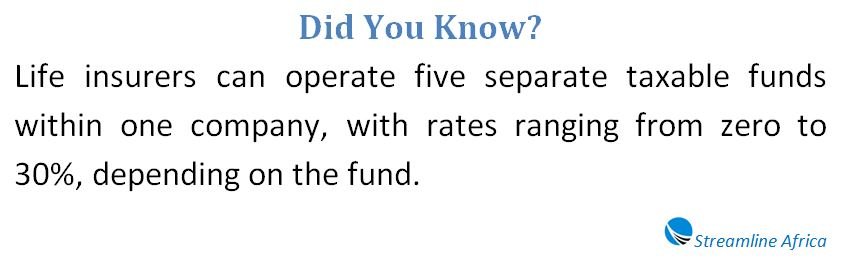
Life insurers allocate activities and assets across five separate taxable funds. Individual policyholder funds attract 30%, while untaxed policyholder funds attract zero. Company policyholder, risk policy and corporate funds generally face the standard corporate rate.
Large Groups Face Minimum Tax Requirements
South Africa’s Pillar Two legislation applies from fiscal years beginning on 1 January 2024. It targets multinational groups meeting the EUR 750 million consolidated revenue threshold under the applicable rules.
An income inclusion rule addresses low taxed overseas operations, while a domestic top up tax addresses qualifying South African earnings below a 15% effective rate. Transitional safe harbours may reduce compliance burdens. The legislation excludes the undertaxed profits rule.
Information returns generally fall due within 15 months after year end, extended to 18 months for the first reporting year. Separate notification requirements also apply. Businesses must meet payment deadlines, retain records for seven years and avoid penalties for noncompliance.
FAQs
Do South African companies pay tax on overseas earnings?
Yes. Resident companies generally pay tax on worldwide income, while non-resident companies are taxed on South African sourced income.
Which businesses qualify for small business corporation tax rates?
Qualifying companies must have individual shareholders and gross income of no more than ZAR 20 million, among other requirements.
Read Also: Starting a Business in South Africa as a Foreigner: A Strategic Market Entry Guide
How much income could qualifying small businesses earn tax-free?
For assessment years ending between 1 April 2025 and 31 March 2026, the first ZAR 95,750 of taxable income was tax-free. Thresholds depend on the assessment year.
How does turnover tax help microbusinesses?
It simplifies tax calculations by applying rates of zero to 3% to taxable turnover. Eligible businesses with annual turnover up to ZAR 2.3 million may qualify.
What tax applies when companies distribute dividends?
Dividends generally attract 20% tax, although qualifying exemptions or treaty benefits can reduce the amount payable.
Who pays the tax on dividends distributed as assets?
For dividends paid in assets rather than cash, the declaring company bears the dividends tax liability.
Do mining companies and life insurers follow special rules?
Yes. Gold producers use a special tax formula, while life insurers divide their business into five funds with different tax treatments.
Which multinational groups fall under South Africa’s minimum tax rules?
The rules cover multinational groups meeting the EUR 750 million consolidated revenue threshold, subject to the applicable conditions, and target a minimum effective tax rate of 15%.