

Building an effective compensation structure in Rwanda requires more than identifying an average salary or referring to the country’s statutory minimum wage. Employers need to understand how pay differs across industries, occupations and skill levels, while ensuring that remuneration remains commercially sustainable and competitive enough to attract and retain capable employees.
Rwanda’s labour market includes a significant agricultural workforce alongside expanding services, manufacturing and professional sectors. These segments do not operate at the same compensation levels. Employers should therefore develop salary structures around the realities of their particular workforce rather than relying on a single national benchmark.
A sound remuneration strategy should balance external market conditions with internal equity, job responsibilities, employee capability and organisational affordability.
Read Also: Why Invest in Rwanda? Complete Guide to the Economy, Business Environment & Growth Opportunities
Use Salary Averages with Caution
National salary averages can provide useful economic context, but they should not become the primary basis for setting employee salaries.
Available labour-market information places average gross monthly earnings at approximately FRw73,948. However, around 40.5% of paid employees reportedly earn below FRw30,000 per month. This difference demonstrates how easily averages can be influenced by higher-paid employees and variations between industries.
Sector differences are equally important. Reported hourly earnings are considerably higher in services than in agriculture, with industrial employment positioned between the two.
Employers conducting salary reviews should consequently benchmark comparable positions. An operations assistant should be assessed against similar operational roles, while accountants, engineers, technology professionals and managers should be compared with employees performing work of similar complexity and responsibility.
Look Beyond Rwanda’s Historical Minimum Wage
Rwanda presents an unusual situation regarding minimum wages. The statutory rate dates back to 1974, when the minimum was established at FRw100 per day. The rate has remained unchanged and is widely regarded as having little practical relevance to present-day employment conditions.
Employers should therefore avoid treating this historical figure as a meaningful benchmark for determining appropriate employee compensation.
Actual salaries are shaped more strongly by labour availability, sector practices, employee experience, qualifications and employer-specific remuneration policies. Some sectors have also developed separate wage arrangements that better reflect contemporary conditions.
For responsible employers, the key question should not simply be the lowest amount that can legally be paid. The more useful question is what level of compensation appropriately reflects the position while enabling the organisation to recruit, motivate and retain the people it needs.
Structure Working Hours and Overtime Properly
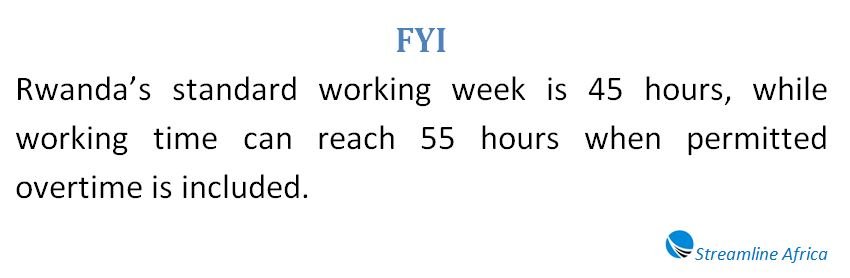
Salary management should be supported by clear working-time controls. Rwanda’s standard working week is 45 hours, while applicable rules allow working time to extend to a maximum of 55 hours under specified overtime arrangements. Overtime is generally limited to two additional hours per day and ten hours per week.
Employers should maintain reliable attendance and timekeeping records, define overtime approval procedures and ensure employees understand how additional working hours are treated.
Regular dependence on overtime should also trigger an operational review. Persistent overtime may indicate inadequate staffing, inefficient scheduling, seasonal workforce pressures or unrealistic workload allocation.
Consider the Real Value of Employee Compensation
For international businesses, converting salaries into US dollars or another international currency may be helpful for budgeting and consolidated reporting. It is less useful when determining whether employees consider their compensation competitive.
Employees experience salaries through local living costs. Transport, accommodation, food, healthcare and household expenses all influence the actual value of earnings.
Compensation reviews should therefore consider local purchasing conditions alongside international comparisons. This is particularly important for multinational organisations seeking consistency across countries without ignoring substantial differences between local labour markets.

Build Benefits Around Workforce Needs
Salary is only one component of a competitive employee proposition. Where financially sustainable, employers can strengthen compensation packages through carefully selected benefits.
Healthcare support, transport arrangements, professional development opportunities, performance incentives and other practical benefits may provide meaningful additional value. The appropriate package will depend on workforce demographics, operational locations and the organisation’s ability to fund benefits sustainably.
Employers should periodically assess whether employees actually value the benefits being provided rather than maintaining programmes simply because they have historically formed part of the package.
Establish a Sustainable Compensation Framework
An effective remuneration framework for Rwanda should ultimately connect business affordability with employee expectations and labour-market realities.
Employers should establish clear salary bands, define the factors that influence movement within those bands and periodically review positions against relevant market benchmarks. Decisions on salary increases, promotions and benefits should also follow consistent principles to reduce unexplained pay differences and strengthen employee confidence in the compensation process.
Rwanda’s outdated statutory minimum wage makes disciplined compensation management particularly important. Rather than allowing a historical legal threshold or broad national average to determine pay, employers should build remuneration structures around job value, market competitiveness, internal fairness and organisational sustainability.
When these principles are applied consistently, compensation becomes more than an administrative payroll decision. It becomes an important tool for attracting talent, retaining critical capabilities and supporting long-term organisational performance.
Frequently Asked Questions
What should employers consider when setting salaries in Rwanda?
Employers should consider the value of the role, required skills, industry benchmarks, internal pay fairness and what the business can sustainably afford.
Is Rwanda’s statutory minimum wage a reliable salary benchmark?
Not really. The statutory rate dates back to 1974 and has not been comprehensively updated, making it largely disconnected from current labour-market conditions.
Why shouldn’t businesses rely solely on average salary figures?
Averages can be pushed upward by higher earners and may not represent what most employees receive. Salary decisions are better based on comparable roles and sectors.
How much do employees typically earn in Rwanda?
Earnings vary considerably. Available data places average gross monthly earnings at about FRw73,948, while approximately 40.5% of paid employees earn below FRw30,000 monthly.
Do salaries differ significantly between industries?
Yes. Agriculture, industry and services have noticeably different earning levels, which makes sector-specific benchmarking important when determining competitive pay.
What is Rwanda’s standard working week?
The standard working week is 45 hours. Employers should have clear systems for recording attendance, approving additional hours and managing overtime appropriately.
Why should employers monitor regular overtime?
Consistently high overtime can indicate understaffing, poor scheduling, seasonal pressure or excessive workloads. It may be a workforce-planning issue rather than simply a payroll matter.
Should international employers convert Rwandan salaries into dollars for comparison?
They can, but currency conversion alone gives an incomplete picture. Local living costs and purchasing power should also be considered when assessing whether compensation is competitive.
Can employee benefits compensate for salary differences?
Benefits can strengthen the overall employment package, particularly when they address genuine employee needs. Healthcare, transport support, training and performance incentives are possible examples.
How can employers maintain internal pay fairness?
Clear salary bands, consistent job grading and defined criteria for salary increases and promotions can help reduce unexplained differences between employees performing comparable work.
How often should businesses review compensation?
There is no single review frequency specified in the article, but employers should periodically reassess salaries against market conditions, employee responsibilities and organisational affordability.
Why should businesses treat compensation as a strategic issue?
Well-designed compensation can support recruitment, retention, motivation and workforce stability. Pay therefore affects business performance beyond the monthly payroll process.