
Latest posts
-
Botswana Personal Income Tax Guide: Rates, Tax Bands, Withholding Tax and Calculations
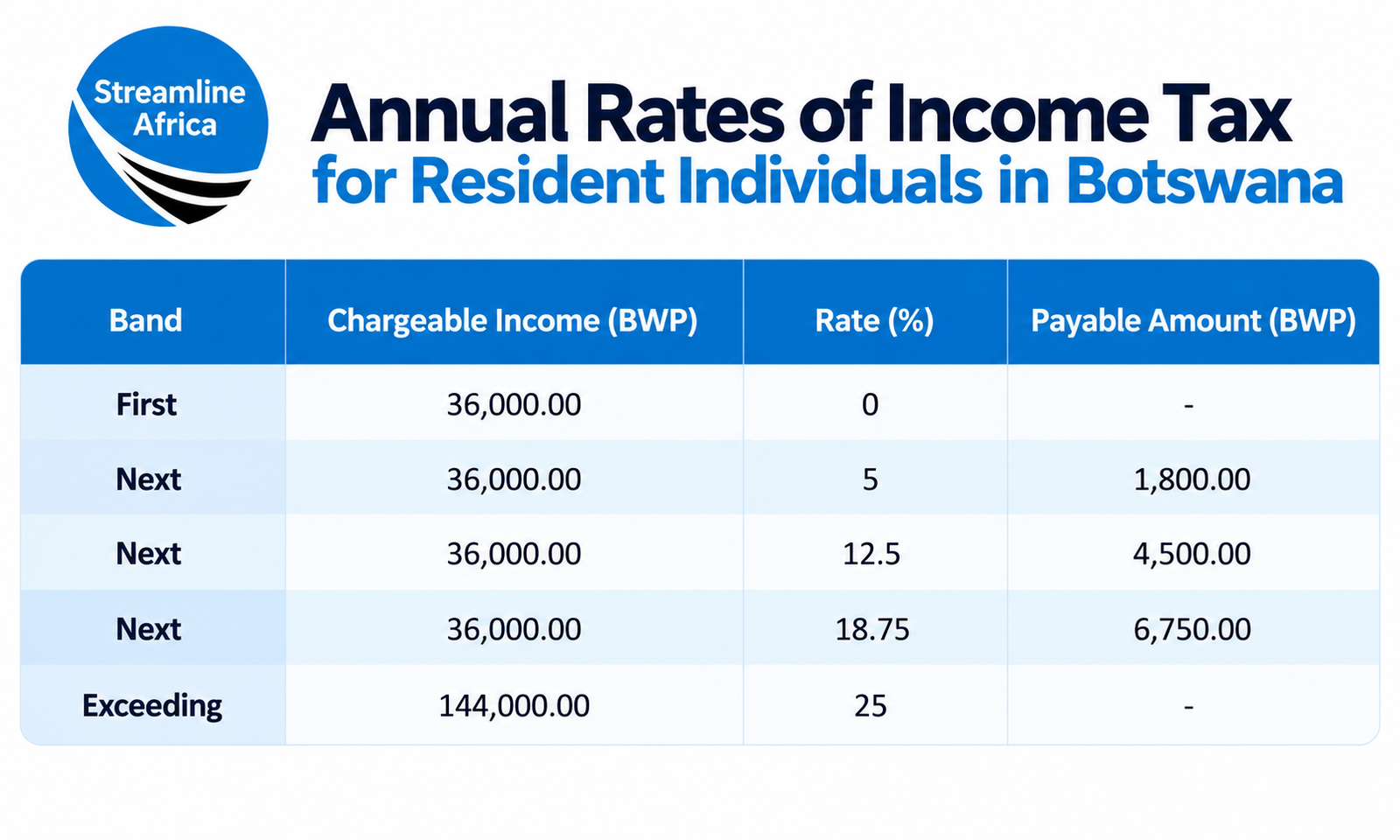
Did you know that Botswana follows a territorial approach to personal income tax? In practical terms, tax is generally determined by the source of income rather than simply an individual’s nationality. Income arising from employment, business activities or other taxable sources within Botswana may therefore be subject to tax in the country. Work performed outside…
-
Angola Individual Income Tax Guide

Angola’s personal income tax system is structured around the type of income an individual earns. Employees, independent professionals and people operating commercial activities may therefore face different methods of calculating and paying tax. The Personal Income Tax framework, commonly referred to as PIT, divides income into three principal groups. Understanding these classifications is particularly important…
-
Corporate Group Tax Treatment in Botswana

Botswana generally treats each company within a corporate group as a separate taxpayer. This means businesses under common private ownership cannot normally combine profits and losses when determining corporate income tax. A notable exception applies to wholly owned subsidiaries of the Botswana Development Corporation Limited (BDC). Established in 1970 and wholly owned by the Botswana…
-
Botswana’s Corporate Tax Incentives: SPEDU Tax Rates, Foreign Tax Credits and Eligibility Guide

Botswana provides targeted tax incentives to encourage investments that contribute to economic development, employment, productive capacity and regional growth. Qualifying business development projects may receive additional relief relating to revenue or capital expenditure where the government considers the investment beneficial to the country. For example, a company establishing a food-processing facility that purchases agricultural produce…
-
How Personal Income Is Taxed in Botswana

Botswana generally taxes individuals according to where their income comes from. In practical terms, income connected to employment, business activities, professional services, investments, or other taxable sources within Botswana may fall within the country’s tax system. This source-based approach can also extend to some work performed outside Botswana. For example, where an employee normally works…
-
Botswana Corporate Tax Guide: VAT, Customs, Payroll and Business Taxes Explained

Did you know that running a business in Botswana involves more than paying corporate income tax? Depending on the nature of a company’s activities, additional obligations may arise from sales, imports, property ownership, asset transfers and employee remuneration. Value-added tax (VAT) is one of the most common considerations for businesses, while customs duties, vocational training…
-
Withholding Tax in Botswana

Withholding tax is an important consideration for businesses making certain types of payments in Botswana. Instead of leaving the recipient to account for all the tax later, the system generally requires the person making a qualifying payment to deduct a portion at source and remit it to the tax authorities. For a business, this means…
-
Angola Tax Guide: VAT, Customs Duties, Property Tax, Payroll and Business Compliance Explained
Operating a business in Angola involves more than corporate income tax. Companies may encounter value-added tax, customs duties, excise duties, stamp tax, property tax, payroll obligations and special levies depending on their activities. Consider a Luanda-based company called Kwanza Industrial Solutions, which imports equipment, employs local workers and leases commercial premises. Its tax responsibilities would…
-
Zambia Withholding Tax Guide: Rates, Exemptions, DTT Relief and Compliance Rules

Withholding tax is an important part of Zambia’s corporate tax system. It requires the person making certain payments to deduct tax before transferring the remaining amount to the recipient. For businesses, this means that tax compliance does not begin only when an annual return is prepared. It can arise whenever qualifying income is paid, accrued…
-
Long-Term Debt-to-Total-Assets Ratio: Formula, Calculation, Examples and Financial Analysis Guide

A company can own factories, vehicles, software, warehouses, and equipment while depending heavily on borrowed money. That is why the size of an asset base alone does not reveal financial strength. Analysts want to know how those assets were financed. The long-term debt-to-total-assets ratio provides a practical way to examine that relationship. This ratio measures…